Why Merger Documents Require Notarization: 2026 Guide
Why Merger Documents Require Notarization: 2026 Guide
Notarization is the process of an impartial notary public verifying the identity of signers and witnessing their signatures on merger documents to prevent fraud and confirm authenticity. Understanding why merger documents require notarization is not a formality question. It is a legal and operational necessity. Merger certificates, certificates of authority, and powers of attorney all require notarization to be legally effective and accepted by government agencies. Without it, the entire transaction is vulnerable to rejection, dispute, and delay.
Why merger documents require notarization: the legal foundation
Notarization creates a strong legal presumption that the signatures on a document are authentic and were given voluntarily. That presumption carries real weight in court and in regulatory filings.
When a merger document is notarized, anyone who later claims the signature was forged or coerced must provide clear and convincing evidence of invalidity. That is a higher legal standard than the typical “preponderance of evidence” bar. This shift in the burden of proof is one of the most underappreciated benefits of notarization in mergers.

One critical distinction: notarization certifies signer identity and voluntariness. It does not confirm the truth or legality of the document’s contents. Courts treat notarized merger documents as highly credible, which eases regulatory and third-party acceptance, but the substance of the document still must be legally sound.
Notaries are impartial officers. They must refuse notarization if a signer appears coerced or mentally incapacitated. This requirement directly protects all parties in a merger from unauthorized or involuntary execution of binding agreements.
Key documents that typically require notarization in a corporate merger include:
- Certificates of merger filed with the state
- Certificates of authority granting corporate powers
- Powers of attorney authorizing representatives to act
- Affidavits supporting regulatory submissions
- Consent agreements from shareholders or boards
Pro Tip: Always verify with your state’s Secretary of State office which specific merger documents require notarization before scheduling your appointment. Requirements vary by state and document type.
What are the mandatory steps for notarizing merger documents?
Effective notarization follows five state-mandated steps. Skipping or mishandling any one of them can result in document rejection by banks or government agencies during merger filings.
- Personal appearance. The signer must appear in person before the notary at the time of notarization. Remote online notarization follows the same rule virtually, with live video interaction required.
- Identity verification. The notary checks government-issued photo ID. The name on the ID must match the name on the signature line. Mismatches are the most frequent cause of delays.
- Document inspection. The notary reviews the document for blank spaces. Blank fields are a fraud risk and a common rejection trigger. Every field must be completed before the notary proceeds.
- Journal recording. The notary logs the transaction in an official journal. This record creates an audit trail that protects all parties if the document is ever challenged.
- Notarial certificate and seal. The notary completes the certificate, applies their official seal, and signs. The venue on the certificate must reflect the actual location where notarization took place.
Most notarization sessions last less than 15 minutes when signers arrive with proper ID and fully completed documents. Standard identification issues are the most frequent cause of delays.
Remote online notarization is now permanently authorized in many U.S. states. It allows virtual identity verification under strict protocols, which increases convenience for business mergers. A live, commissioned notary must still be present on screen throughout the session.
Pro Tip: Bring two forms of ID to your notarization appointment. If your primary ID has a name variation, a secondary document like a Social Security card or passport can resolve the mismatch on the spot.
How does notarization impact the merger process and risk management?
Notarization does more than satisfy a procedural checkbox. It actively protects the merger from fraud, delays, and costly legal disputes.
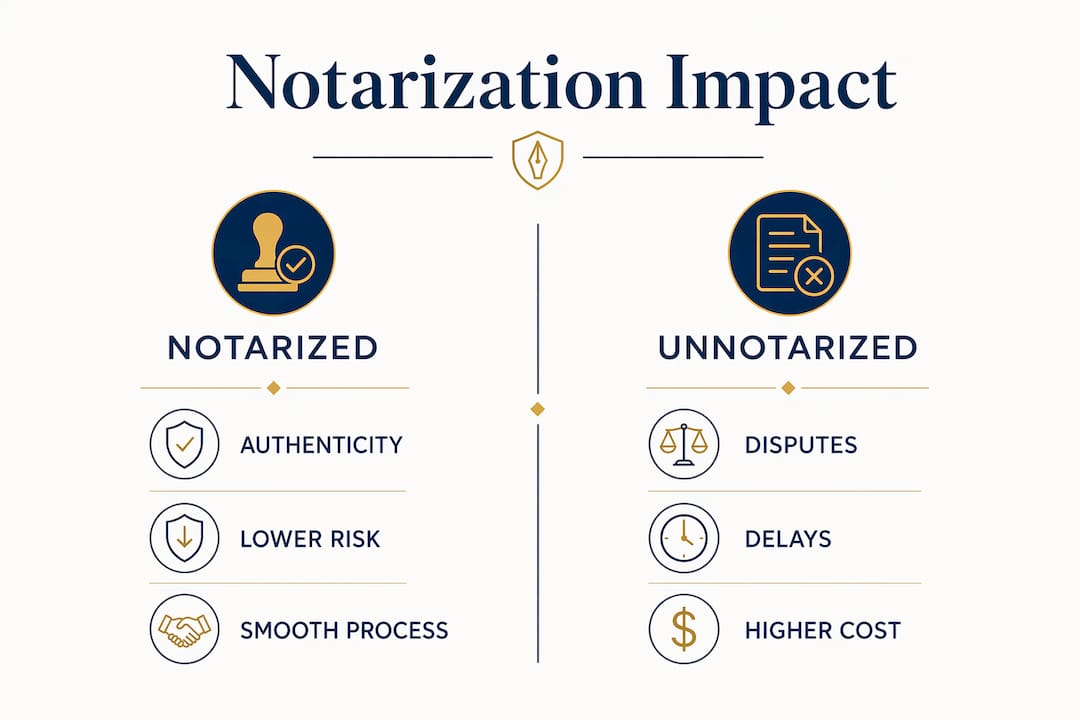
Defective or absent notarization can increase merger timelines and costs significantly. Disputes triggered by missing or flawed notarization force parties into corrective filings, legal reviews, and sometimes litigation. Institutions such as banks and lenders require notarized documents for acceptance because notarization confirms signed authority. Without it, documents face rejection or extra scrutiny that compounds delays and raises costs.
The table below compares outcomes for notarized versus unnotarized merger documents across key risk categories.
| Risk category | Notarized documents | Unnotarized documents |
|---|---|---|
| Legal presumption of authenticity | Strong presumption; challenger bears burden of proof | No presumption; authenticity must be independently proven |
| Regulatory acceptance | Accepted by state agencies and courts | Often rejected or flagged for additional review |
| Institutional acceptance | Banks and lenders accept without extra scrutiny | Frequently rejected or delayed pending verification |
| Fraud deterrence | High; notary verifies identity and voluntariness | Low; no independent witness or identity check |
| Dispute resolution | Faster; notarized record reduces litigation risk | Slower; disputes require more evidence and legal cost |
Notarization also plays a direct role in due diligence. Acquiring companies and their legal teams review notarized documents as part of confirming the target company’s authority to execute the merger. A missing notarial seal on a certificate of authority can stall the entire due diligence process.
How do notarization requirements vary by jurisdiction and international context?
Notarization rules are not uniform across states or countries. Business professionals handling cross-border mergers face a more complex set of requirements than those completing domestic transactions.
Within the United States, each state sets its own notarization procedures, acceptable ID types, and journal requirements. Some states require notarization for documents that other states treat as self-authenticating. Checking the specific rules of the state where the document will be filed is a non-negotiable step before any merger closing.
International mergers add another layer of complexity. Germany, for example, requires notarial certification that includes a legal validity review by the notary. This differs significantly from U.S. practice, where notaries authenticate signatures but do not review legal content. That distinction affects merger closing timelines and due diligence requirements in cross-border deals.
When a U.S. notarized document must be used in a foreign country, an apostille or additional authentication may be required. An apostille is a standardized certification under the Hague Convention that validates the notary’s authority for international use. For countries outside the Hague Convention, a chain of authentication through the U.S. Department of State may be necessary.
For companies registering or merging across borders, understanding document certification requirements in each jurisdiction prevents costly compliance gaps.
| Context | Notarization standard | Additional requirements |
|---|---|---|
| U.S. domestic merger | Signature authentication by commissioned notary | State-specific journal and ID rules |
| U.S. to Hague Convention country | U.S. notarization plus apostille | Apostille from Secretary of State |
| U.S. to non-Hague country | U.S. notarization plus full authentication chain | U.S. Department of State certification |
| Germany (domestic) | Notarial certification with legal validity review | Notary reviews legal content, not just signatures |
Pro Tip: If your merger involves foreign entities, confirm apostille requirements before the closing date. Last-minute apostille processing can delay wire transfers and regulatory filings by days or weeks.
Key Takeaways
Merger documents require notarization because it creates a legal presumption of authenticity, shifts the burden of proof in disputes, and satisfies mandatory requirements from courts, regulators, and financial institutions.
| Point | Details |
|---|---|
| Notarization shifts legal burden | Challengers must prove invalidity with clear and convincing evidence, a high legal standard. |
| Five steps are mandatory | Personal appearance, ID check, document inspection, journal entry, and certificate completion are all required. |
| Content is not validated | Notarization certifies signer identity and voluntariness, not the truth of the document’s contents. |
| Defective notarization costs time and money | Missing or flawed notarization triggers regulatory rejection, delays, and increased legal costs. |
| Jurisdiction rules differ | State and international notarization standards vary; apostilles may be required for cross-border mergers. |
What I’ve learned from handling merger notarizations
Most of the problems I see with merger notarizations come from one source: people treating notarization as a rubber stamp rather than a legal procedure with real consequences.
The most common mistake is submitting documents with blank fields. Signers assume the notary will catch it and fix it later. The notary cannot complete a document on the signer’s behalf. Blank spaces get flagged, the session ends, and the closing gets pushed. That is an avoidable delay that costs real money in a merger context.
The second issue I see regularly is ID mismatches. A signer whose license reads “Robert J. Smith” but whose signature line says “Bob Smith” will not get notarized without additional documentation. Bring your passport as a backup. It resolves most name variation issues immediately.
The third thing business professionals consistently underestimate is jurisdictional variation. A document notarized correctly in Missouri may not meet the filing requirements in Delaware or New York. If your merger involves multiple states, verify each state’s requirements independently. Do not assume one standard applies everywhere.
Notarization done right takes less than 15 minutes and protects a transaction worth millions. Notarization done wrong can unwind months of work. Use a notary who is familiar with commercial and merger documents, not just the notary closest to your office.
— Premier
Notarization for your merger documents, handled right
Merger closings move fast. The last thing you need is a rejected document slowing down your filing or your funding.

Premier Notary & Apostille Services specializes in commercial document notarization for business transactions, including mergers, acquisitions, and corporate filings. With over 1,900 documents processed and a 5-star rating on Google, the team understands what banks, courts, and state agencies require. Same-day processing is available, and the guided intake process means you arrive prepared. For merger-related real estate transfers, real estate document notarization is also available. Get your documents right the first time.
FAQ
What does notarization actually certify in a merger document?
Notarization certifies that the signer appeared in person, their identity was verified, and they signed voluntarily. It does not confirm the legal accuracy or truth of the document’s contents.
Can a merger document be rejected if it is not notarized?
Yes. State agencies, courts, and financial institutions routinely reject merger documents that lack required notarization. Missing notarization can delay filings and trigger additional legal review.
How long does notarizing a merger document take?
Most notarization sessions take less than 15 minutes when the signer brings proper ID and a fully completed document. ID mismatches and blank fields are the most common causes of delays.
Is remote online notarization valid for merger documents?
Remote online notarization is permanently authorized in many U.S. states and is valid for most merger documents. A live, commissioned notary must be present via video throughout the session.
Do international mergers require anything beyond standard notarization?
Yes. Documents used in foreign countries often require an apostille or a full authentication chain, depending on whether the destination country is a member of the Hague Convention.