Why Mortgage Documents Need Notarization: A Clear Guide

Why Mortgage Documents Need Notarization: A Clear Guide

Notarization is the legal process by which a commissioned notary public verifies a signer’s identity and confirms that signing is voluntary, making mortgage documents enforceable and eligible for recording. Understanding why mortgage documents need notarization is not optional knowledge for homebuyers. Without a valid notarial certificate, a mortgage cannot be recorded in county land records, and an unrecorded mortgage lien has no legal standing against third parties. That means your lender’s security interest in your property is unprotected, and your ownership rights could be challenged. Notarization is the legal foundation that makes the entire transaction real.
Why mortgage documents need notarization
Mortgage notarization is mandatory because state laws and county recorder offices require it before any lien can be officially recorded. The deed of trust or mortgage document creates the lender’s legal claim against your property. Without notarization, that claim does not exist in the public record.
The core function of notarization is identity verification and confirmation of voluntary signing. Notarization does not validate the truth of what the document says. It confirms that the person who signed is who they claim to be, and that they signed willingly. This distinction matters because it prevents fraud claims and forgery challenges from arising years later in court.

Recording a mortgage in the county land records creates what lawyers call “constructive notice.” This means the entire world is legally assumed to know your lender holds a lien on the property. Without that recorded notice, a second lender or buyer could claim they had no knowledge of the first lien. Notarization is the gateway requirement that makes recording possible.
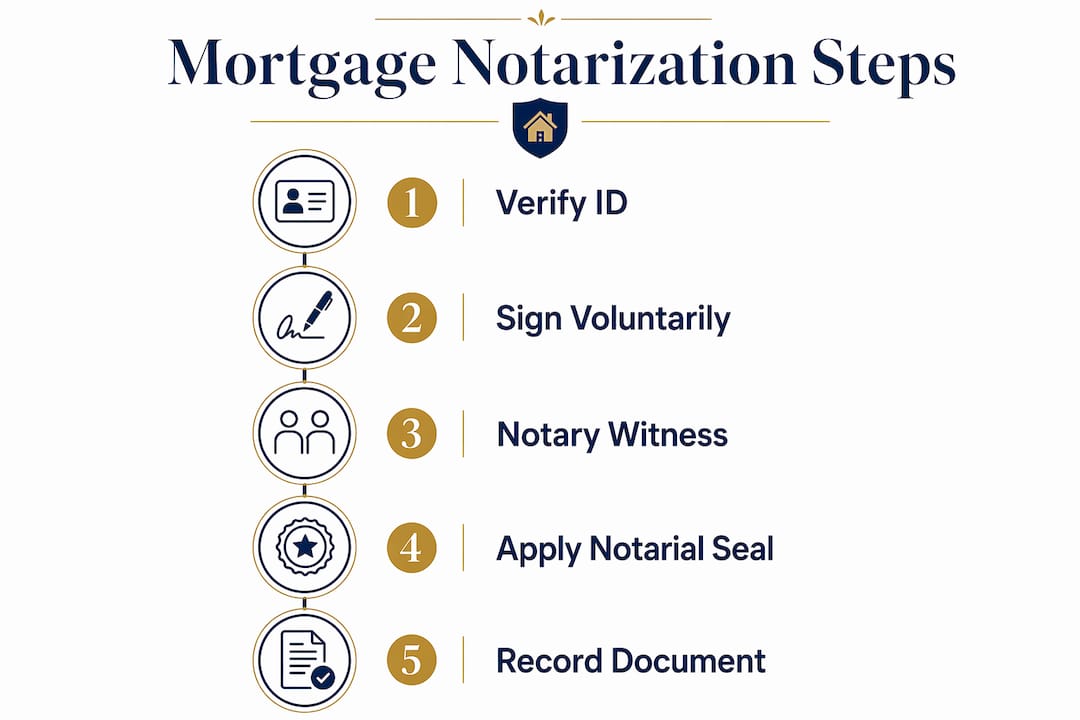
State laws governing notarization requirements for loans vary, but the core standard is consistent across the United States. The notary must personally witness the signing, verify government-issued identification, and complete a notarial certificate. Learn more about which real estate documents require notarization and the legal reasons behind each requirement.
What mortgage documents require notarization?
Not every piece of paper in your mortgage package requires notarization. The documents that create or transfer legal interests in real property always do.
DocumentNotarization Required?Deed of trustYesMortgage documentYesAffidavit of titleYesPromissory noteVaries by stateLoan estimateNoClosing disclosureNoHomeowner’s insuranceNo
The deed of trust and the mortgage document are the two most critical. Both create the lender’s lien against your property. County recorder offices will not accept them without a completed notarial certificate. Affidavits related to title, ownership status, or property condition also require notarization because they are sworn statements with legal consequences.
Promissory notes are a common point of confusion. Some states require notarization on the note itself; others do not. Your title company or closing attorney will confirm the specific notarization requirements for loans in your state. The safest approach is to ask before closing day, not during it.
Deed of trust or mortgage: Creates the lender’s lien; notarization is mandatory for recording.
Affidavit of title: Sworn statement about ownership; requires notarization as a legal declaration.
Promissory note: Confirms the debt obligation; notarization varies by state law.
Closing disclosure and loan estimate: Informational documents; no notarization required.
How notarization protects all parties in a mortgage transaction
Notarization protects lenders, borrowers, and the public record simultaneously. Each group benefits in a specific and concrete way.
For lenders, the protection is financial. An improperly notarized mortgage lien risks being treated as never recorded. A later lien could take legal priority, potentially costing the lender hundreds of thousands of dollars. Proper notarization is the lender’s first line of defense against that outcome.
For homebuyers, notarization confirms that no one forged your signature on a document transferring your property rights. Courts invalidate mortgage transactions where the notary failed to ensure the signer’s personal appearance. That rule exists precisely to protect you. If someone tried to take out a mortgage against your home without your knowledge, a properly administered notarization requirement would stop it.
For the public record, notarization creates a reliable chain of verified transactions. Every recorded mortgage carries a notarial certificate that documents when, where, and before whom the signing occurred. That paper trail supports title searches, protects future buyers, and keeps the property ownership system trustworthy.
The notary acts as an impartial witness with no financial stake in the transaction. That independence is what gives the notarial certificate its legal weight. A notary who has a personal interest in the deal cannot legally perform the notarization.
Pro Tip: Ask your notary to confirm their commission is active and covers your state before the signing appointment. An expired commission invalidates the notarial act, which can delay your closing.
Common mistakes in mortgage document notarization
Name mismatches are the single most common reason county recorders reject mortgage documents. A name discrepancy as small as “Jim” versus “James” between the mortgage document and the notarial certificate leads to immediate rejection. The fix requires a corrective affidavit, which adds time and cost to your closing.
County recorders enforce strict document formatting standards, including black ink on white paper, correct margins, and consistent names across all pages. These rules are not suggestions. A document that fails formatting requirements is returned unfiled, and your closing timeline shifts accordingly.
The five most common notarization errors in mortgage closings are:
Name mismatch between the signer’s ID, the document, and the notarial certificate.
Incomplete notarial certificate with missing dates, signatures, or notary seal.
Signer not physically present before the notary at the time of signing.
Expired notary commission that invalidates the entire notarial act.
Wrong notarization type used, such as an acknowledgment when a jurat was required.
When a minor clerical error does slip through, a corrective affidavit is the standard remedy. This is a notarized statement that identifies and corrects the error. It relates back to the original filing date, so your lien priority is preserved. The process is straightforward, but it still adds days to your timeline.
Pro Tip: Before your closing appointment, verify that your full legal name appears identically on your government-issued ID, every mortgage document, and the notarial certificate. Bring this checklist to the signing table and review it before you sign anything.
Review the common notarization mistakes that cause the most delays, so you can avoid them before closing day.
What does a Notary Signing Agent do at mortgage closings?
A Notary Signing Agent (NSA) is a notary public with specialized training in mortgage and loan documents. Standard notaries verify identity and witness signatures. NSAs go further. They understand the full mortgage document package, know which documents require notarization, and manage the entire signing appointment from start to finish.
NSAs verify identities, manage signing procedures, and handle documents securely during mortgage closings. Their training reduces the risk of signing errors that cause funding delays. A missed signature line or an unsigned initial block can send the entire package back to the lender, delaying your closing by days.
The cost for an NSA appointment is typically $75–$200 for a full mortgage closing. Evening and weekend appointments may cost more. These fees are usually paid by the borrower or rolled into closing costs. For a transaction involving hundreds of thousands of dollars, that fee is a practical safeguard.
The benefits of working with a trained NSA include:
Document familiarity: NSAs recognize every form in the package and know where notarization is required.
Error prevention: They catch missing signatures and incomplete certificates before the package leaves the table.
Identity verification: NSAs confirm government-issued ID against every document in the package.
Secure handling: Documents are managed and returned according to lender and title company instructions.
Scheduling flexibility: Many NSAs offer evening and weekend appointments to fit your schedule.
The notarization process for a mortgage closing typically takes 60–90 minutes. Having an NSA who knows the package keeps that appointment on track.
Key takeaways
Mortgage notarization is the legal requirement that makes a lien enforceable, protects all parties from fraud, and enables recording in county land records.
PointDetailsNotarization enables recordingWithout a valid notarial certificate, county recorders will not accept mortgage documents.Identity verification prevents fraudNotarization confirms the signer is who they claim to be and signed voluntarily.Name consistency is criticalEven minor name mismatches between documents and certificates cause rejection and delays.NSAs reduce closing errorsSpecialized Notary Signing Agents catch missing signatures and incomplete certificates before submission.Corrective affidavits fix minor errorsA notarized corrective statement can resolve clerical mistakes without restarting the entire filing.
What I’ve learned from watching mortgage closings go wrong
Working with homebuyers through hundreds of document signings, I’ve seen the same pattern repeat. The closing feels routine until a county recorder rejects the package two days later. The cause is almost always something that could have been caught at the table.
The most preventable problem is signer confusion about what notarization actually does. Many homebuyers assume the notary is reviewing the document for accuracy or fairness. The notary is not doing that. The notary is confirming your identity and your willingness to sign. You are responsible for reading and understanding what you sign. That distinction matters, and most people do not know it going in.
My consistent recommendation to homebuyers is to contact your title company at least a week before closing and ask three questions. First, confirm which documents require notarization. Second, ask whether a Notary Signing Agent will be present or whether you need to arrange one. Third, verify that your legal name appears identically on your ID and every document in the package.
Lenders and title companies appreciate buyers who come prepared. A prepared signer reduces the chance of errors, speeds up the appointment, and protects everyone at the table. Notarization is not a formality. It is the legal act that makes your mortgage real.
— Premier
Premier Notary & Apostille Services makes mortgage notarization straightforward
Mortgage closings involve a lot of moving parts. Getting the notarization right the first time protects your timeline and your investment.

Premier Notary & Apostille Services has processed over 1,900 documents with a 5-star rating on Google reviews. The team includes professionals trained in real estate and mortgage document notarization, with same-day processing options available. Transparent pricing and a guided intake process mean you know exactly what to expect before your appointment. Book your real estate notarization and get your mortgage closing handled correctly the first time.
FAQ
Why do mortgage documents need notarization?
Mortgage documents require notarization so they can be recorded in county land records and establish a legally enforceable lien. Without a valid notarial certificate, the mortgage has no standing against third parties.
What happens if a mortgage is not properly notarized?
A missing or defective notarial certificate results in rejection by county land records and leaves the lien unprotected against competing claims. Courts can treat an improperly notarized mortgage as never recorded.
Do all documents at closing require notarization?
No. Only documents that create or transfer legal interests in real property require notarization, such as the deed of trust and affidavits of title. Informational documents like the closing disclosure and loan estimate do not require notarization.
What is a Notary Signing Agent and do I need one?
A Notary Signing Agent is a notary with specialized training in mortgage documents who manages the full signing appointment. Using an NSA reduces the risk of errors that cause funding delays and is standard practice at most mortgage closings.
Can a notarization error be fixed after recording?
Yes. A corrective affidavit is a notarized statement that corrects minor clerical errors in recorded documents and relates back to the original filing date, preserving your lien priority.