Why Deeds Require Notarization: A Clear Legal Guide
Why Deeds Require Notarization: A Clear Legal Guide
Notarization is defined as the official process by which a licensed notary public verifies a signer’s identity and confirms their voluntary execution of a document. For property deeds, this process is not optional. Recording a deed is the only way to officially secure priority over later-filed claims in most U.S. property law systems. Without a valid notarial certificate attached, county recorders will reject the deed outright. Understanding why deeds require notarization protects you from title disputes, recording delays, and fraud. This guide covers the legal requirements, state-specific witness rules, the acknowledgment versus jurat distinction, and how Remote Online Notarization fits into modern real estate practice.
Why deeds require notarization: the legal foundation
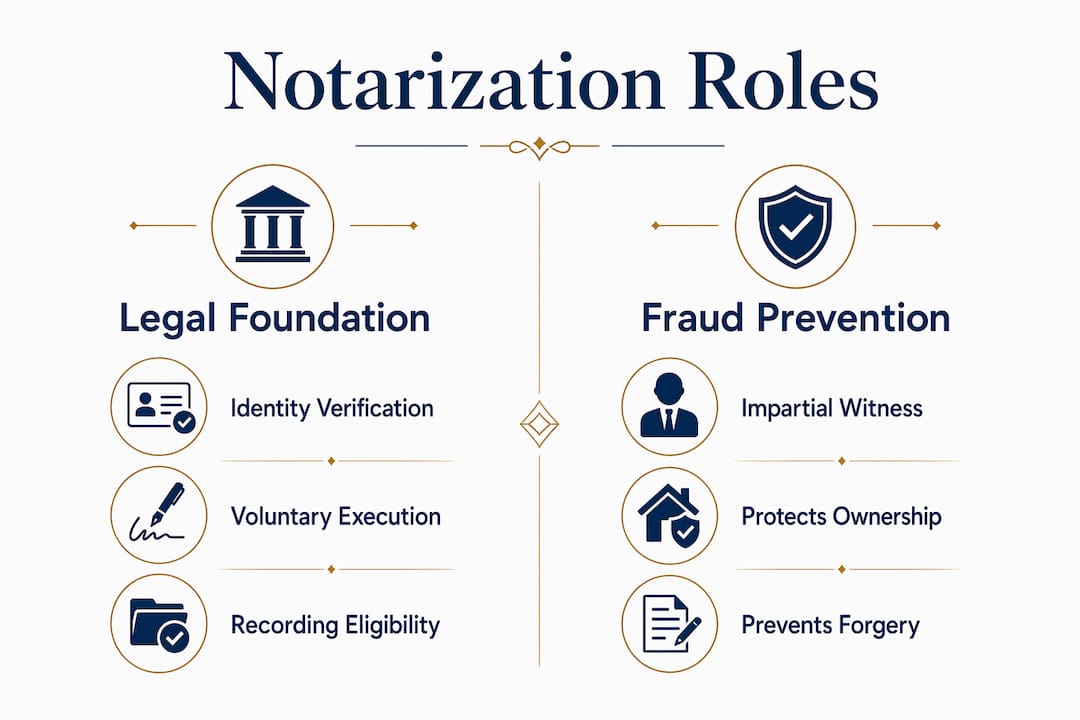
Notarization serves one primary legal function for deeds: it makes the document eligible for recording in public land records. Recording creates what property law calls “constructive notice,” meaning the entire world is legally presumed to know about the transfer once it appears in public records. Without that notice, a later buyer or lender who records first can legally claim superior title, even if your deed was signed earlier.
County recorders enforce notarization as a prerequisite for deed recording but do not verify the truth of the deed’s contents or the legality of the transfer itself. That distinction matters. A notarized deed is “recordable,” but notarization alone does not guarantee the deed is legally correct or that the grantor had the right to transfer the property.

The Revised Uniform Law on Notarial Acts (RULONA), adopted by a growing number of states, standardizes what notaries must do when authenticating a deed. RULONA requires the notary to identify the signer through acceptable credentials, confirm the signer is acting voluntarily, and complete a proper notarial certificate. States that have adopted RULONA align their recording requirements around these steps, which reduces inconsistency across county offices.
How notarization protects property ownership and prevents fraud
Notaries act as impartial gatekeepers to prevent fraud by verifying identity and voluntary consent, giving deeds a presumption of validity relied upon by courts and title companies. This presumption is not trivial. When a title company underwrites a policy, it looks at the notarial certificate as evidence that the grantor was who they claimed to be and signed without coercion. A clean notarization record significantly reduces the risk of a title claim being challenged.
The fraud protection role becomes especially clear in vulnerable situations. Elderly grantors, family disputes over inherited property, and transfers under financial pressure are all scenarios where a bad actor might forge a signature or pressure someone to sign. A notary’s physical presence and identity check create a documented barrier against those tactics.
A deed with a defective acknowledgment may be treated as never recorded, making the grantee vulnerable to competing claims by parties who record later. That outcome can be catastrophic in a real estate transaction. You could pay full price for a property, receive a deed, and still lose title to a lender or buyer who records a competing claim first.
Key protections notarization provides for deeds:
- Identity verification: The notary checks government-issued ID to confirm the signer is who they claim to be.
- Voluntary consent: The notary confirms the signer is acting freely, which protects against coercion claims.
- Presumption of validity: Courts and title companies treat a properly notarized deed as authentic unless proven otherwise.
- Recording eligibility: Without notarization, the county recorder will reject the deed and the transfer has no public record.
- Fraud deterrence: A notary’s seal and signature create a documented chain of accountability that discourages forgery.
Pro Tip: Always verify that your notary’s commission is active and that their seal matches the state where the property is located. An expired commission invalidates the notarization, which can trigger a recording rejection weeks after you think the deal is closed.
What legal requirements must be met for deed notarization and recording?
The type of notarial certificate used on a deed determines whether the document will be accepted or rejected. Confusing acknowledgments with jurats is a common error that leads to deed rejection. Real estate deeds almost always require acknowledgments, not jurats.
The difference is fundamental. An acknowledgment confirms that the signer voluntarily executed the document and that the notary verified their identity. A jurat, by contrast, requires the signer to swear an oath in the notary’s presence that the document’s contents are true. Jurats are used for affidavits and sworn statements, not for property transfers. Using a jurat certificate on a deed signals to the recorder that the wrong procedure was followed, and the deed gets sent back.
| Certificate type | Used for | Requires oath | Confirms identity | Accepted for deeds |
|---|---|---|---|---|
| Acknowledgment | Deeds, mortgages, contracts | No | Yes | Yes |
| Jurat | Affidavits, sworn statements | Yes | Typically no | No |
State and county requirements add another layer. Each state sets its own statutory form for the acknowledgment certificate, and some counties have additional formatting rules. A deed notarized in one state for property located in another must comply with the recording rules of the state where the property sits. That rule catches many people off guard during interstate transfers.
Recording offices focus on notarization as a gatekeeper process rather than content validation. The recorder checks that a valid notarial certificate is present, that the notary’s seal and signature appear, and that the certificate language matches the state’s statutory form. If any of those elements are missing or incorrect, the deed is rejected and must be re-executed.
Pro Tip: Before you sign any deed, download your state’s statutory acknowledgment form from the Secretary of State’s website and confirm your notary is using that exact language. A single missing phrase can void the certificate.
What are the special state-specific notarization and witness rules for deeds?
Five states require two witnesses to observe the signing of a deed in addition to the notary: Connecticut, Florida, Georgia, Louisiana, and South Carolina. Failure to meet these witness requirements is a fatal error resulting in deed rejection by county recorders. The witnesses must be present at the actual signing, not added after the fact.
The rules differ by state in important ways:
- Florida: Two witnesses are required. The notary may serve as one of the two witnesses, which reduces the logistical burden.
- Georgia: Two witnesses are required, and they must be separate from the notary. The notary cannot count as a witness.
- Louisiana: Two witnesses are required and must be separate from the notary, consistent with Louisiana’s civil law tradition.
- South Carolina: Two witnesses are required. State practice generally requires them to be disinterested parties with no stake in the transaction.
- Connecticut: Two witnesses are required. Local recording offices may have additional formatting requirements for the witness attestation block.
In Georgia and Louisiana specifically, two witnesses must be separate from the notary. Relying on the notary to fill a witness slot in those states causes the deed to be rejected and forces a full re-execution. That means gathering all parties again, which creates delays and additional costs.
Witnesses must also be disinterested. A witness who stands to benefit from the property transfer, such as a named beneficiary or a co-grantee, can be challenged as an interested party. Most title companies and recorders expect witnesses to be adults with no financial connection to the transaction.
Pro Tip: If your deed involves property in a witness-requirement state, arrange your two disinterested witnesses before the notary appointment. Scrambling to find witnesses at the last minute is the most common cause of re-execution delays in Florida and Georgia closings.
How has Remote Online Notarization changed deed notarization practices?
Remote Online Notarization (RON) allows a signer and a notary to complete the notarization process over a live video call, using identity verification technology in place of physical ID inspection. As of early 2025, 45 states and D.C. permit RON, applying the same security checks as in-person notarization. That broad adoption has made deed notarization significantly more accessible for people who cannot appear in person.
The RON process for a deed typically follows these steps:
- Identity proofing: The signer completes knowledge-based authentication (KBA), answering questions drawn from credit and public records that only the real person should know.
- Credential analysis: The platform scans a government-issued ID to verify it is genuine and matches the signer’s identity.
- Live video session: The notary and signer connect via live video. The notary observes the signing in real time and completes the acknowledgment certificate electronically.
- Audit trail creation: The platform records the session and stores a tamper-evident log, which serves as the equivalent of a notary journal entry.
- Electronic seal and signature: The notary applies a digital seal and electronic signature to the document, completing the notarization.
The critical limitation is at the recording stage. Not all counties accept electronic filings for real estate records, even when the state permits RON. Confirming local recording office acceptance prevents delays in title transfers. Before using RON for a deed, call the county recorder’s office directly and ask whether they accept electronically notarized documents. Some counties require a paper printout of the electronically notarized deed, which must then be submitted physically.
Remote Online Notarization significantly expands access to deed notarization but requires vigilance about acceptance per local laws and recording office regulations. RON is a valid and legally equivalent option in most states, but local infrastructure gaps can still create problems if you do not verify first.
Key Takeaways
Deeds require notarization because the notarial acknowledgment verifies signer identity, confirms voluntary execution, and makes the deed eligible for recording, which secures legal priority over competing claims.
| Point | Details |
|---|---|
| Notarization enables recording | Without a valid notarial certificate, county recorders reject the deed and no public record exists. |
| Acknowledgment, not jurat | Real estate deeds require an acknowledgment certificate; using a jurat triggers automatic rejection. |
| Five states require two witnesses | Connecticut, Florida, Georgia, Louisiana, and South Carolina mandate two witnesses at signing. |
| RON is widely accepted but verify locally | 45 states and D.C. permit Remote Online Notarization, but not all county recorders accept electronic filings. |
| Defective notarization risks title loss | A deed with a flawed acknowledgment may be treated as unrecorded, exposing the grantee to competing claims. |
What I’ve learned from handling deeds at the notary table
The single most costly mistake I see is the acknowledgment versus jurat confusion, and it almost never comes from the signer. It comes from notaries who are not specialized in real estate documents. A general notary who handles mostly affidavits and loan documents can default to a jurat certificate out of habit. The deed gets signed, the parties leave, and the rejection notice arrives two weeks later. By then, the grantor may be unavailable or the transaction timeline has collapsed.
The second pattern I see constantly is people in witness-requirement states who show up with only one witness, or with a witness who is also a grantee. That is an automatic rejection in Georgia and Louisiana. No amount of explanation to the recorder’s office will fix it. The deed has to be re-executed from scratch.
My practical advice: check your state’s deed notarization requirements before you schedule the appointment, not after. Confirm whether your county accepts RON-notarized documents if you plan to go that route. And remember that a notary’s job is identity verification and acknowledgment. They cannot tell you which deed type to use or whether the transfer is legally sound. That is your attorney’s role. Keeping those boundaries clear prevents the most common errors I encounter.
— Premier
Premier Notary & Apostille Services: real estate deed notarization made straightforward
Deed notarization has real consequences when it goes wrong. A rejected filing or a defective acknowledgment can stall a property transfer for weeks and expose you to title disputes.

Premier Notary & Apostille Services has processed over 1,900 documents with a 5-star Google rating, offering same-day processing and a guided intake process that confirms your document requirements before you sign. For real estate transactions, the team handles the acknowledgment certificate correctly the first time. Book your real estate notarization online and get a confirmed appointment fast. If your transaction also involves commercial documents, commercial notarization services are available with the same turnaround standards.
FAQ
Why do deeds require notarization to be recorded?
County recorders require a valid notarial acknowledgment before accepting a deed for recording. Recording establishes legal priority over later-filed claims and provides constructive notice to third parties.
What is the difference between an acknowledgment and a jurat for a deed?
An acknowledgment confirms the signer’s identity and voluntary execution without an oath. A jurat requires a sworn oath and is used for affidavits, not deeds. Using a jurat on a deed causes rejection.
Which states require witnesses in addition to a notary for deed signing?
Connecticut, Florida, Georgia, Louisiana, and South Carolina all require two witnesses at the deed signing. In Georgia and Louisiana, the notary cannot count as one of the two witnesses.
Can I use Remote Online Notarization for a property deed?
RON is permitted in 45 states and D.C. as of early 2025, but you must confirm that your county recorder accepts electronically notarized documents before proceeding. Some counties still require paper submissions.
What happens if a deed has a defective notarization?
A deed with a defective acknowledgment may be treated as never recorded, leaving the grantee exposed to competing claims from later buyers or lenders who record valid documents first.