What Is a Grade Certification Document? A Student Guide

What Is a Grade Certification Document? A Student Guide

A grade certification document is an official record that verifies stated grades or academic performance. For most students and academic stakeholders, that means an official transcript or institution-certified grade statement issued by a college or university registrar. A second, unrelated meaning exists in commerce: a commodity grading certificate that confirms a product meets exchange or trade standards. These are two very different documents sharing the same phrase.
Here is how to tell which one applies to you:
- Academic grade certificate / official transcript — issued by your school’s registrar, used for admissions, employment, and licensure. The National Student Clearinghouse facilitates secure transcript exchange between institutions.
- Commodity grading certificate — issued by inspectors such as the USDA Agricultural Marketing Service (AMS) or third-party firms, used in trade, futures delivery, and loan collateral.
- Credential evaluation — a third-party review (e.g., World Education Services) that translates foreign academic records into U.S. equivalents.
If you are a student, the academic transcript is almost certainly what you need. The sections below cover both meanings, but the academic path gets the most detail.
Table of Contents
- What does “grade certification document” actually mean?
- What an official academic transcript contains
- How to request an official grade certificate or transcript in the U.S.
- When do you need a grade certification document, and which format?
- How to authenticate academic grade documents for international or official use
- What a commodity grading certificate is and how it differs
- Key Takeaways
- Why getting authentication right matters more than most students realize
- Premier Notary & Apostille Services handles the authentication step for you
- Useful sources
- FAQ
What does “grade certification document” actually mean?
The phrase covers two distinct documents that share almost no overlap in purpose or issuer.
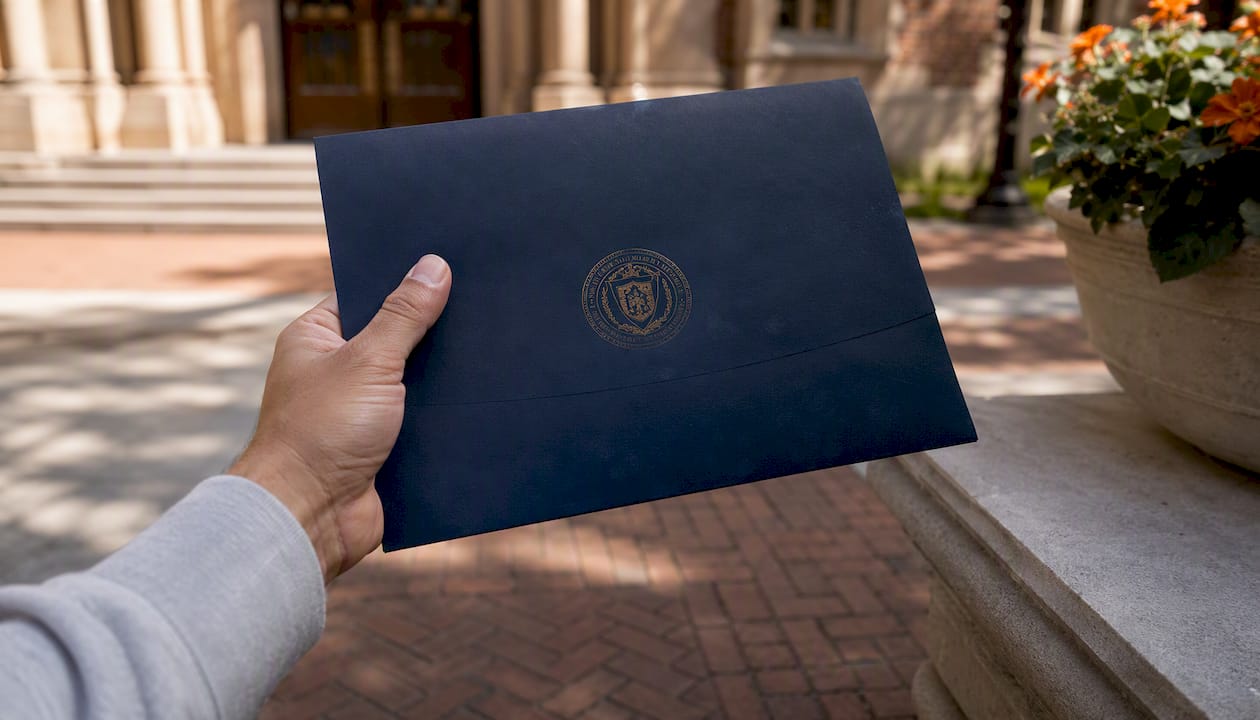
Academic meaning. An academic grade certificate is an official statement from a school confirming a student’s coursework, grades, and academic standing. Most U.S. institutions call this an official transcript. Some use “certificate of grades” or “academic record.” Whatever the label, it is issued by the registrar, carries the institution’s seal and an authorized signature, and is the document colleges, employers, and licensing boards trust.
Commodity meaning. In trade and futures markets, a grading certificate confirms that a physical commodity (grain, cotton, metals) meets a defined quality standard. Buyers, exchanges, and lenders rely on it to confirm deliverability or collateral value. A student applying to graduate school has no use for this version.
| Dimension | Academic transcript | Commodity grading certificate |
|---|---|---|
| Primary audience | Students, applicants, employees | Traders, lenders, commodity buyers |
| Typical issuer | College/university registrar | USDA AMS, SGS, Bureau Veritas |
| Common uses | Admissions, transfer credit, licensure | Futures delivery, loan collateral |
| Governing authority | Accreditation body, state law | USDA, exchange rules, 7 CFR |
What an official academic transcript contains
A legitimate U.S. academic grade certification document includes specific fields that let recipients verify both authenticity and content. Knowing what to look for helps you confirm you have the right version before submitting it anywhere.
Core fields on a standard official transcript:
- Student’s full legal name and student ID
- Institution name, address, and official seal
- Registrar’s signature (wet ink or digital)
- List of courses by term, with credit hours
- Grade earned for each course
- Cumulative GPA and grading scale (e.g., A = 4.0)
- Degree(s) conferred and conferral date
- Date the transcript was issued
- Unique document ID or tracking number (common on electronic transcripts)
U.S. institutions use slightly different terminology. “Official transcript” is the most common label. Others say “grade report,” “academic record,” or “certificate of grades.” The format varies, but the core fields above appear on all of them.
Pro Tip: Always confirm whether the recipient needs a sealed paper copy or accepts a secure electronic transcript (e-transcript). An unofficial PDF printed from a student portal is not the same as an official e-transcript delivered through a verified platform.
How to request an official grade certificate or transcript in the U.S.
The process is straightforward, but small missteps (wrong delivery format, account holds) can add days or weeks.
- Log in to your registrar’s portal. Most U.S. colleges use platforms like the National Student Clearinghouse’s Transcript+ or a school-specific system. Look for “Transcript Request” under student records.
- Choose official vs. unofficial. Official transcripts carry the seal and signature; unofficial copies are for your own reference only. Most recipients require official.
- Select your delivery method. Options are typically: secure e-transcript (PDF delivered directly to the recipient), sealed paper copy mailed by the registrar, or in-person pickup (less common).
- Pay the fee. Fees vary by institution. Many schools charge $5–$15 per copy; some offer free transcripts for current students or financial aid recipients. Fee waivers exist at some institutions for students with demonstrated need.
- Submit the request and confirm. You will usually receive an email confirmation. Check for any holds on your account (unpaid balances, incomplete exit requirements) that could block processing.
- Follow up if needed. Standard processing runs same-day to 3 business days for e-transcripts. Paper copies can take 1–3 weeks, especially during peak periods (May, August, December).
Special cases to know:
- Degree in progress: Request a “transcript with enrollment verification” if your degree is not yet conferred.
- Grade changes: Wait until the grade change is posted before requesting.
- Name changes: Bring legal documentation to the registrar before requesting.
- Deceased student records: Next of kin typically must submit a written request with proof of relationship.
When do you need a grade certification document, and which format?
The right format depends entirely on who is asking and why. Sending the wrong version wastes time.
Common situations that require an official transcript:
- College or graduate school admissions
- Transfer credit evaluation
- Professional licensure (nursing, teaching, engineering boards)
- Employment background screening
- U.S. visa or immigration applications
- Scholarship and fellowship applications
- Study abroad program enrollment
When an unofficial copy is enough:
- Advising appointments with your own institution
- Personal records and planning
- Preliminary review by an employer (before a formal offer)
Decision rule: If a third party is making a formal decision based on your grades, send official. When in doubt, ask the recipient directly. A useful question to copy: “Does your office require an official sealed transcript, an apostille, or a credential evaluation from WES or a similar service?”
Common pitfall. Many students assume a PDF downloaded from their student portal counts as official. It does not. An official e-transcript is delivered directly from the registrar’s system to the recipient’s verified address, not forwarded by the student.
How to authenticate academic grade documents for international or official use
Sending an academic transcript abroad, or using it for immigration, often requires more than just an official copy. The authentication path depends on the destination country and the recipient’s requirements.
| Method | What it proves | When required |
|---|---|---|
| Notarization | A notary confirms the document is genuine and the signature is authentic | Some employers, state agencies, or foreign consulates |
| Apostille | Certifies the notary’s or registrar’s authority for use in Hague Convention countries | Study abroad, immigration, foreign employment internationally |
| Certified copy | A notarized photocopy confirmed to match the original | When the original must stay with you |
| Credential evaluation (WES, ECE) | Translates foreign or U.S. credentials into a recognized equivalency | Graduate admissions, immigration, professional licensing |
Step-by-step for international use:
- Request an official transcript from your registrar.
- Confirm whether the destination country is a Hague Convention member. If yes, an apostille is the standard authentication path. If no, consular legalization applies.
- Have the transcript notarized if the apostille office or recipient requires it. Learn more about what notarization means before you start.
- Submit the notarized document to your state’s Secretary of State office for an apostille. Processing times vary by state, typically 5–15 business days, though same-day options exist through authorized services.
- If the recipient also requests a credential evaluation, submit your authenticated transcript to an evaluation service such as World Education Services.
Timing pitfall. Apostille processing at state offices can add one to three weeks to your timeline. Factor this in before application deadlines. The difference between legalization and apostille matters if your destination country is not a Hague Convention member.
What a commodity grading certificate is and how it differs
If you arrived here looking for the commercial version of a grade certification document, here is the short version.
A commodity grading certificate confirms that a physical good (grain, oilseeds, cotton, metals) meets a defined quality standard. It is used in futures markets, trade finance, and large-scale commerce. According to Investopedia, a grading certificate verifies commodity quality for futures delivery and can determine whether goods are deliverable under contract terms.
Typical fields on a commodity grading certificate:
- Commodity type and lot number
- Inspection date and location
- Factor-by-factor test results (moisture, test weight, defects, foreign material)
- Inspector name and agency
- Serial number and certificate ID
- Grade designation (e.g., U.S. No. 2 Yellow Corn)
The USDA Agricultural Marketing Service sets the grades and standards for agricultural commodities, and official certificates document inspection results factor by factor. 7 CFR § 800.162 specifies the required fields for official grain inspection certificates, including special rules for cargo shipments, canola, soybeans, and aflatoxin testing for corn.
Issuer credibility matters in this context. Certificates from recognized inspection firms such as SGS and Bureau Veritas carry more market weight than generic documents. Different exchanges also use different delivery instruments. Some markets accept a warehouse receipt or warrant rather than a stand-alone grading certificate. CME Group and similar exchanges treat these certificates as time-sensitive legal instruments: an expired certificate can render a commodity non-deliverable and trigger a contract default.
This is a different world from academic transcripts. If you are a student, this section is background context only.
Key Takeaways
A grade certification document is most commonly an official academic transcript issued by a registrar, and authenticating it correctly for international use requires notarization, an apostille, or a credential evaluation depending on the destination.
| Point | Details |
|---|---|
| Two distinct meanings | “Grade certification document” refers to either an academic transcript or a commodity grading certificate — context determines which applies. |
| Official transcript fields | Look for the institution seal, registrar signature, course list, grades, GPA scale, and a unique document ID to confirm authenticity. |
| Request through the registrar | Use your school’s online portal, select official delivery, and check for account holds before submitting. |
| Authenticate for international use | Determine Hague Convention status first, then notarize and obtain an apostille or pursue consular legalization if needed. |
| Premier Notary & Apostille Services | Handles notarization and apostille processing for academic documents, with same-day options and guided intake for students and applicants. |
Why getting authentication right matters more than most students realize
Most students treat document authentication as a formality. It is not. The authentication step is where applications stall, visa approvals get delayed, and job offers get rescinded.
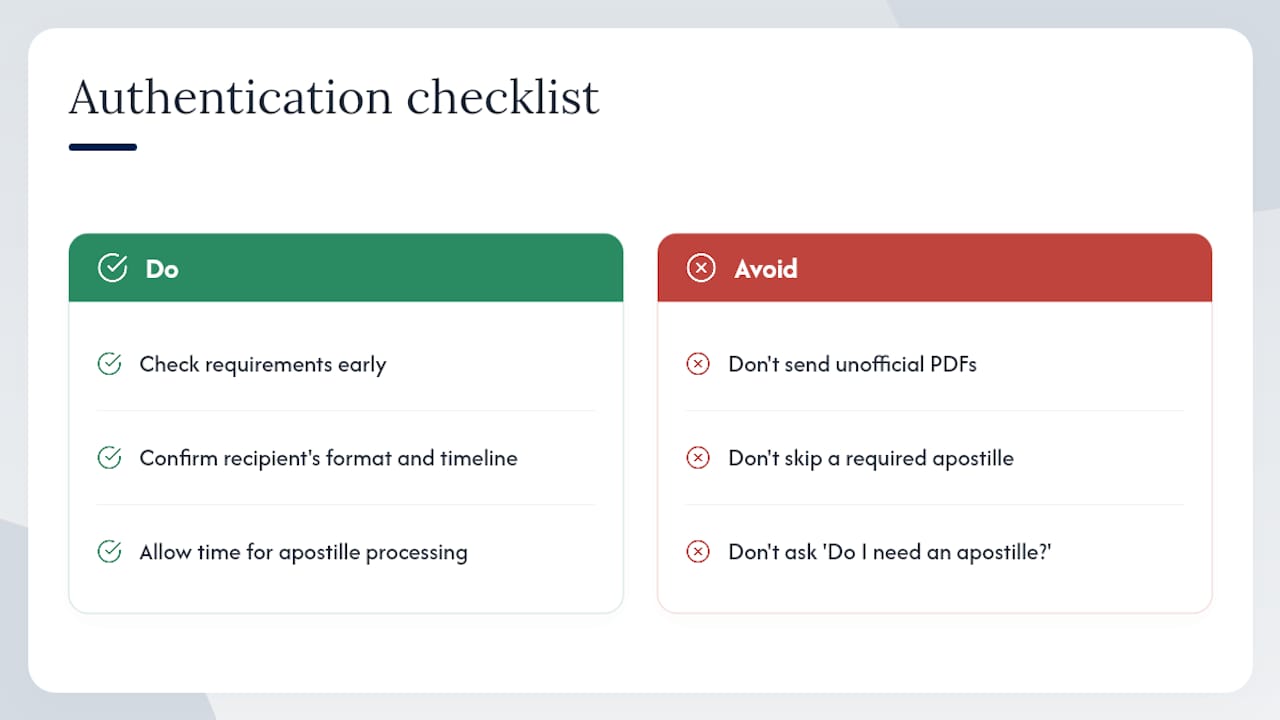
The most common mistake is format confusion. A student sends an unofficial PDF assuming it counts as official. Or they get an official transcript but skip the apostille because they did not know the destination country required one. By the time the error surfaces, a deadline has passed.
There is also a subtler problem: students often ask the wrong question. They ask “do I need an apostille?” when the better question is “what exact format does this specific recipient require, and what is their processing timeline?” Those two questions together prevent most delays.
The commodity grading world has a parallel lesson. Practitioners at exchanges like CME Group treat expired or invalid grading certificates as grounds for default, not just inconvenience. The same logic applies to academic documents: a transcript sent in the wrong format, or without the required authentication, is functionally useless regardless of the grades it shows.
Check requirements early. Confirm the delivery method. Build in time for apostille processing. Those three steps cover the majority of authentication failures.
Premier Notary & Apostille Services handles the authentication step for you
Once you have your official transcript, the next step is often the one that trips people up: notarization, apostille processing, or both. Premier Notary & Apostille Services processes academic and legal documents with same-day options, a guided intake process, and over 1,900 documents completed with a 5-star Google rating.

You do not need to navigate state apostille offices or figure out Hague Convention requirements on your own. Premier Notary & Apostille Services handles notarization and apostille certification for U.S. documents, with mobile and mail-in options for students who cannot come in person. Transparent pricing, no hidden fees, and a process built to move fast when deadlines are close.
Ready to get your document authenticated? Book your notarization appointment and get started today.
This article provides general information about document types and authentication procedures. It is not legal advice. Confirm current requirements with your institution, the relevant state office, or a qualified professional before submitting documents for official use.
Useful sources
- Official Certificates | Agricultural Marketing Service
- Grades & Standards | Agricultural Marketing Service
- 7 CFR § 800.162 — Certification of grade; special requirements. | Electronic Code of Federal Regulations (e-CFR) | US Law | LII / Legal Information Institute
- Grading certificate: What It is, How it Works, Example — Investopedia
- Grading Certificates: What They Are, Types, and Why They Matter for Product Value
- Grading Certificate in Commodity Futures: Definition, How It Works & Examples — quantopia.net
- Becoming certified — PCI
- CME Group
FAQ
What is a document that shows your grades and GPA?
An official transcript is the standard document that shows your courses, grades, credit hours, and cumulative GPA. It is issued by your school’s registrar and carries the institution’s seal and an authorized signature.
What does “certifying a document” mean?
Certifying a document means having an authorized party confirm that a copy is a true and accurate reproduction of the original. For academic records, this is typically done by a notary public or the issuing institution’s registrar.
What are the three common types of grade certification?
Definitions vary, but the three most common forms are: an official transcript (issued by the registrar), a certified copy (a notarized photocopy of the original), and a credential evaluation (a third-party equivalency assessment from a service like World Education Services).
What is the meaning of a grading certificate in commerce?
In commodity markets, a grading certificate is an official document confirming that a product meets a defined quality standard for trade or futures delivery. It is issued by accredited inspectors such as USDA AMS, SGS, or Bureau Veritas, and is distinct from any academic document.
Do I need an apostille on my academic transcript?
You need an apostille if the receiving country is a member of the Hague Convention and requires it for official document acceptance. Check the destination country’s requirements first, then contact your state’s Secretary of State office or a service like Premier Notary & Apostille Services to process it.