Corporate Seal Notarization: What It Means for Your Business

Corporate Seal Notarization: What It Means for Your Business

Corporate seal notarization is the process where an authorized corporate officer signs a document, the company’s official seal is applied, and a notary public independently verifies the officer’s identity and witnesses the signature. The corporate seal signals that the company itself approves the document. The notary confirms who signed it and that they did so willingly. These are two separate functions, and confusing them is one of the most common mistakes business owners make.
Documents that commonly go through this process include:
- Corporate resolutions
- Real estate transfer agreements
- Banking authorization letters
- Loan documents and promissory notes
- International business contracts
Table of Contents
- What is a corporate seal and why do companies use it?
- How state law shapes corporate seal requirements
- The role of a corporate seal in the notarization process
- How to obtain and properly use a corporate seal
- Key benefits of using a corporate seal on notarized documents
- Expert insights on corporate seal notarization
- Premier Notary & Apostille Services handles corporate document notarization for you
- FAQ
- Key takeaways
What is a corporate seal and why do companies use it?
A corporate seal is a formal stamp or embossed emblem that represents a company’s official approval on a document. Think of it as the business equivalent of a personal signature, except it speaks for the entire organization rather than one individual.
Historically, corporate seals authenticated documents at a time when literacy rates were low and a physical mark carried more legal weight than a written name. Today, the practical necessity has faded in most U.S. states, but the seal persists for good reasons.
Modern corporate seals typically include:
- The company’s legal name
- The state of incorporation
- The year of formation or incorporation
Companies continue using seals to reinforce professional credibility, meet expectations in formal or international transactions, and add a visible layer of authenticity to high-value documents. Corporate secretaries or designated officers usually hold custody of the seal and apply it on the company’s behalf.
How state law shapes corporate seal requirements
Most U.S. states no longer legally require companies to use corporate seals on their documents. The shift away from mandatory seals happened gradually as state corporate statutes modernized throughout the late 20th century. That said, “not required” does not mean “irrelevant.”
State law considerations worth knowing:
- No universal mandate. The majority of states treat corporate seals as optional for domestic transactions.
- Contractual expectations. Some agreements, particularly in real estate or banking, may specify that a corporate seal is required by the other party.
- International transactions. Many foreign jurisdictions still expect corporate seals on business documents, making the seal practically necessary for cross-border deals.
- Dispute prevention. Affixing a seal reinforces corporate formality and can reduce challenges to whether a document was officially authorized.
- Sealed vs. unsealed contracts. A handful of states still recognize a legal distinction between sealed and unsealed contracts, which can affect statutes of limitations or enforceability.
The seal does not replace proper notarization, and notarization does not replace the seal. Each addresses a different question: the seal asks “did the company approve this?” while notarization asks “did the right person sign this, and did they do it freely?”
The role of a corporate seal in the notarization process
Notarization is an identity-based verification performed by a government-authorized notary public who confirms the signer’s identity, witnesses the signature, and applies an official notary seal to the document. The notary’s seal contains the notary’s name, commission state, and expiration date. It is a public record of that verification.

A corporate seal does something entirely different. It indicates that the company, as an entity, has authorized the document. The two seals serve distinct legal purposes and are not interchangeable.
Common points of confusion:
- The notary does not validate the corporate seal. A notary verifies the person signing, not the seal they are applying.
- The corporate seal is not notarization. Stamping a document with a company seal does not make it notarized.
- Both can appear on the same document. For legally sensitive corporate documents, using both the corporate seal and notarization together provides the strongest authentication.
- Notary seals must meet state requirements. Per the National Notary Association, notary seals must contain the notary’s name, commission state, and expiration date, and must be capable of being reproduced in copies.
Pro Tip: When preparing a corporate document for notarization, have the corporate seal applied before the notary appointment. The notary witnesses the officer’s signature, not the seal placement, so the order matters for workflow efficiency.
How to obtain and properly use a corporate seal
Getting a corporate seal is straightforward. Most businesses order one through a legal supply company or a registered agent service when they incorporate. The process typically takes a few days and costs a modest amount.
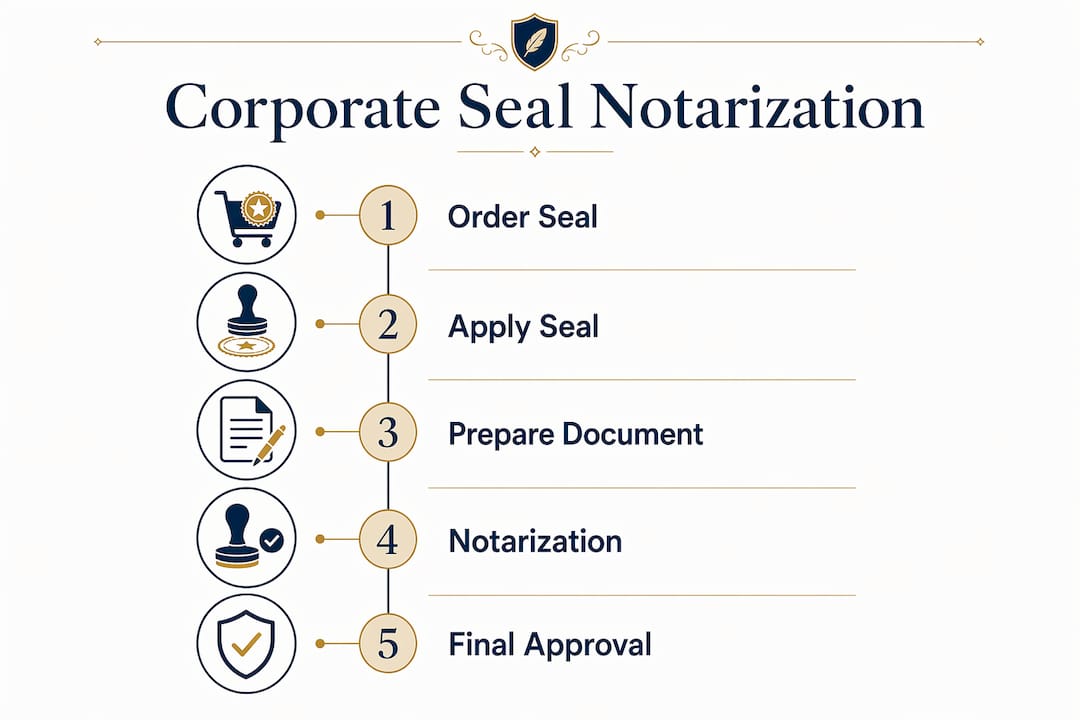
Steps to create and use a corporate seal correctly:
- Choose a format. Seals come as embossers (raised impression devices) or rubber ink stamps. Embossers are traditional; ink stamps are more practical for photocopying and scanning.
- Include required information. The seal should display the company’s legal name, state of incorporation, and year of formation.
- Assign custody. Corporate seals are kept by company secretaries or officers who apply them on behalf of the corporation. Limit access to authorized personnel only.
- Affix correctly. Place the seal near the authorized officer’s signature on the document. Do not cover signatures or printed text with the impression.
- Store securely. Keep the seal in a locked location when not in use. An unsecured seal creates a fraud risk.
For smaller businesses or sole proprietors, a corporate seal may not be worth the investment if the company rarely handles formal corporate documents. The decision depends on the volume and type of transactions the business conducts. Reviewing a legal document signing workflow can help you determine where a seal fits into your process.
Key benefits of using a corporate seal on notarized documents
Using a corporate seal alongside notarization adds a layer of protection and professionalism that a signature alone cannot provide. The combination signals both company-level authorization and independent identity verification.
Practical benefits include:
- Fraud deterrence. A seal helps prevent fraud by visibly indicating official company endorsement, making unauthorized alterations easier to detect.
- Dispute reduction. When a document carries both a corporate seal and notarization, it is harder for any party to later claim the signing was unauthorized.
- International acceptance. Cross-border transactions often require seals because many foreign jurisdictions expect them as proof of corporate authority.
- Professional credibility. Seals reinforce the perception of an established, formal organization, which matters in high-value negotiations.
- Simplified signature verification. In disputes over whether a signature was authorized, a corporate seal provides supporting evidence of official approval.
For real estate transactions in particular, combining a corporate seal with notarization is standard practice. You can book real estate document notarization directly if you need that combination handled correctly.
Expert insights on corporate seal notarization

Legal professionals consistently point to one core misunderstanding: business owners treat the corporate seal as a substitute for notarization, or assume notarization validates the seal. Neither is true.
A corporate seal primarily communicates company endorsement and upholds professional tradition rather than fulfilling a strict legal requirement in most U.S. states. Notarization, by contrast, is a formal public act. A notary public verifies identity, witnesses the signature, and creates a public record of that act. The notary’s role is entirely independent of what the corporate seal represents.
Key distinction: A corporate seal does not perform notarization functions. Its presence indicates internal company authorization, while notarization establishes signer identity and voluntary agreement as a public record.
Business owners need to clearly separate these two purposes. Assuming a notarized document automatically carries corporate authority, or that a sealed document is automatically notarized, can create real legal exposure. For corporate documents like affidavits or commercial agreements, both steps are often necessary and neither replaces the other.
When corporate seals are most useful:
- High-value contracts where company authorization must be clear
- Documents submitted to foreign governments or international partners
- Real estate transfers involving corporate entities
- Banking documents requiring proof of corporate approval
- Commemorative or formal corporate certificates
For documents where the stakes are lower and the transaction is purely domestic, a corporate seal may add formality without adding legal necessity. The right call depends on the document type, the other party’s expectations, and any applicable state or contractual requirements. Checking a remote notarization guide can also clarify how seal requirements apply in digital or remote notarization contexts.
Premier Notary & Apostille Services handles corporate document notarization for you
Corporate documents carry real stakes. Getting the notarization right, with the correct certificate, proper identity verification, and accurate seal placement, protects both the company and the individuals signing.
Premier Notary & Apostille Services has processed a large number of documents with a 5-star rating on Google reviews. The team offers same-day processing options and a guided intake process so you know exactly what to prepare before your appointment. Whether you need commercial notarization for a business agreement or affidavit notarization for a corporate attestation, the process is clear, fast, and handled by experienced professionals. Book your appointment directly to get started.
FAQ
Is a corporate seal the same as a notary seal?
No. A corporate seal represents the company’s official endorsement of a document, while a notary seal confirms the signer’s identity and makes the notarial act official. They serve distinct legal purposes and neither substitutes for the other.
Why would a business need a corporate seal?
A corporate seal signals that a document carries official company authorization, which is particularly useful for high-value contracts, real estate transfers, banking documents, and international business transactions where counterparties expect formal corporate approval.
How do I get a corporate seal for my company?
Order one through a legal supply company or registered agent service after incorporation. The seal should include your company’s legal name, state of incorporation, and year of formation, and custody typically rests with the corporate secretary or a designated officer.
Is a corporate seal required in Florida?
Florida does not legally require corporations to use a corporate seal on most documents. However, specific contracts, lenders, or foreign jurisdictions may still request one, so having a seal available is advisable for businesses that handle formal or international agreements.
Key takeaways
Corporate seal notarization combines a company’s internal authorization mark with independent identity verification by a notary public, and the two functions are legally distinct and not interchangeable.
| Point | Details |
|---|---|
| Two separate functions | The corporate seal shows company approval; notarization verifies the signer’s identity and creates a public record. |
| Not legally required in most states | Most U.S. states do not mandate corporate seals, but international transactions and some contracts still expect them. |
| Notary does not validate the seal | A notary witnesses the officer’s signature, not the corporate seal itself. |
| Fraud prevention benefit | Using both a corporate seal and notarization together makes unauthorized alterations easier to detect and dispute. |
| Premier Notary & Apostille Services | Offers same-day corporate document notarization with a guided intake process and over 1,900 documents processed. |