Commercial Invoice Notarization: What U.S. Exporters Need to Know

Commercial Invoice Notarization: What U.S. Exporters Need to Know

Commercial invoice notarization is the process of having a commissioned U.S. notary verify the identity of the person signing your commercial invoice, creating the official link between that private business document and a recognized government authority. That link is what makes the invoice eligible for the next step: either a state-level Apostille for Hague Convention countries or full consular legalization for non-member nations.
- Customs acceptance: Many foreign customs offices require a notarized invoice before releasing your goods.
- Tender and bid submissions: Government and institutional tenders abroad often mandate notarized supporting documents.
- Letters of credit and trade finance: Banks issuing or confirming letters of credit may require notarized invoices as part of the document package.
- Importer or buyer requests: Some buyers contractually require notarized invoices as proof of authenticity.
Notarization alone does not make your invoice internationally valid. It creates the verifiable signature link that government authentication authorities require before they will act on the document.
Table of Contents
- When do you actually need to notarize a commercial invoice?
- What must a commercial invoice include before notarization?
- Who should sign the invoice, and how do notaries verify authority?
- How does the authentication chain work after notarization?
- How do you get a commercial invoice notarized in the U.S.?
- What does the full process cost, and how long does it take?
- Why are notarized commercial invoices rejected, and how do you avoid it?
- Pre-submission checklist and sample notarization wording
- Key Takeaways
- A practical perspective on commercial invoice authentication
- How Premier Notary & Apostille Services handles commercial invoice notarization
- Useful sources and where to check current rules
- FAQ
When do you actually need to notarize a commercial invoice?
Not every international shipment requires notarization. The trigger is almost always the destination country’s rules or the specific transaction type.
- Destination country requirement: Countries that are members of the 1961 Hague Apostille Convention typically require notarization followed by a state Apostille. Non-member countries require notarization plus a longer chain ending at the destination embassy.
- Customs clearance: Some foreign customs authorities will not release goods without a notarized invoice, particularly for high-value or regulated shipments.
- International tenders and bids: Government procurement processes in many countries require fully authenticated supporting documents, including the commercial invoice.
- Letters of credit: Banks processing documentary letters of credit frequently specify notarized invoices in the credit terms.
- Importer or buyer request: A foreign buyer may require notarization as a contractual condition, independent of any government rule.
- Certificate of origin bundles: When a certificate of origin accompanies the invoice, both documents are often notarized and apostilled together as a single package.
The practical rule: confirm with your importer and the destination country’s consulate or customs authority before shipping. Requirements vary significantly, and assuming a plain invoice will suffice can delay clearance by days or weeks.
What must a commercial invoice include before notarization?
A notary can only certify what is already on the document. If the invoice is incomplete or improperly formatted, it will be rejected at the notary’s desk or, worse, at the foreign customs office after you have already shipped.
Required fields:
- Company letterhead with full legal name and address
- Full buyer and seller names, addresses, and contact details
- Invoice number and date
- Detailed product descriptions, including HS (Harmonized System) codes where the destination requires them
- Quantities and units of measure
- Unit prices and total invoice value, with currency clearly stated
- Incoterms and shipping terms (e.g., FOB, CIF)
- Payment terms
- Authorized signer’s wet signature, printed name, title, and company seal if applicable
The authorized signer’s signature is the element the notary is actually verifying. Everything else on the invoice must be accurate and complete before that signature goes on the page, because alterations after notarization void the notarization.
Most apostille service providers recommend printing e-invoices and obtaining a wet signature because most states and the U.S. Department of State require a physical, verifiable signature for apostille processing.

Pro Tip: Prepare the invoice on official company letterhead and attach any supporting documents the destination authority expects, such as a packing list or certificate of origin, before you visit the notary. Bringing a complete package in one trip avoids multiple notarization appointments.
Who should sign the invoice, and how do notaries verify authority?
The person who signs the commercial invoice must have legal authority to bind the company. That typically means a corporate officer, director, or an agent holding a valid power of attorney or board resolution.
Authorized signers:
- Corporate officers (CEO, CFO, VP of Operations)
- Directors with signing authority
- Delegated agents with a written corporate resolution or power of attorney
When an agent signs rather than a named officer, the notary will ask for documentation proving that delegation. A board resolution or letter of authorization on company letterhead usually satisfies this requirement.
What the notary checks:
- Government-issued photo ID matching the signer’s name
- Physical presence of the signer at the time of notarization
- Corporate authorization documents when an agent is signing
The notary will perform either an acknowledgment (the signer confirms they signed voluntarily) or a jurat (the signer swears the contents are true). For commercial invoices, an acknowledgment is the more common form, but confirm with the Secretary of State’s office or your service provider which wording the destination authority expects.
Pro Tip: Carry a certified copy of the corporate resolution or board authorization whenever an agent, not a named officer, will sign. A notary who cannot verify signing authority must refuse the notarization, and that costs you time.
How does the authentication chain work after notarization?
Notarization is step one. What happens next depends entirely on whether the destination country is a member of the Hague Apostille Convention.
Check membership first. The U.S. Department of State maintains a current list of Hague Convention member countries. Confirm your destination’s status before starting the process.
Path A: Hague Convention member countries
- Notarization by a commissioned U.S. notary
- State Apostille issued by the Secretary of State in the same state where the notary is commissioned
- Document accepted by the destination country’s authorities
Path B: Non-Hague Convention countries
- Notarization by a commissioned U.S. notary
- State-level certification by the Secretary of State
- U.S. Department of State authentication
- Legalization by the destination country’s embassy or consulate in the U.S.
- Possible additional embassy-specific steps (translations, cover letters, application forms)
Certificates of origin are often stamped by a local Chamber of Commerce before notarization, and combined export packages (invoice, certificate of origin, packing list) are commonly apostilled together. In some workflows, the Chamber stamp precedes notarization, so confirm the sequence with your importer or consulate.
| Destination Type | Step 1 | Step 2 | Step 3 | Step 4 |
|---|---|---|---|---|
| Hague member | Notarization | State Apostille | Accepted abroad | — |
| Non-Hague member | Notarization | State certification | U.S. Dept. of State auth. | Embassy legalization |
For a deeper look at how these two paths differ, see Premier Notary's guide on apostille vs. legalization.
How do you get a commercial invoice notarized in the U.S.?
The process is straightforward, but the details matter. A mismatch between the notary’s commission state and the state issuing the Apostille is one of the most common causes of rejection.
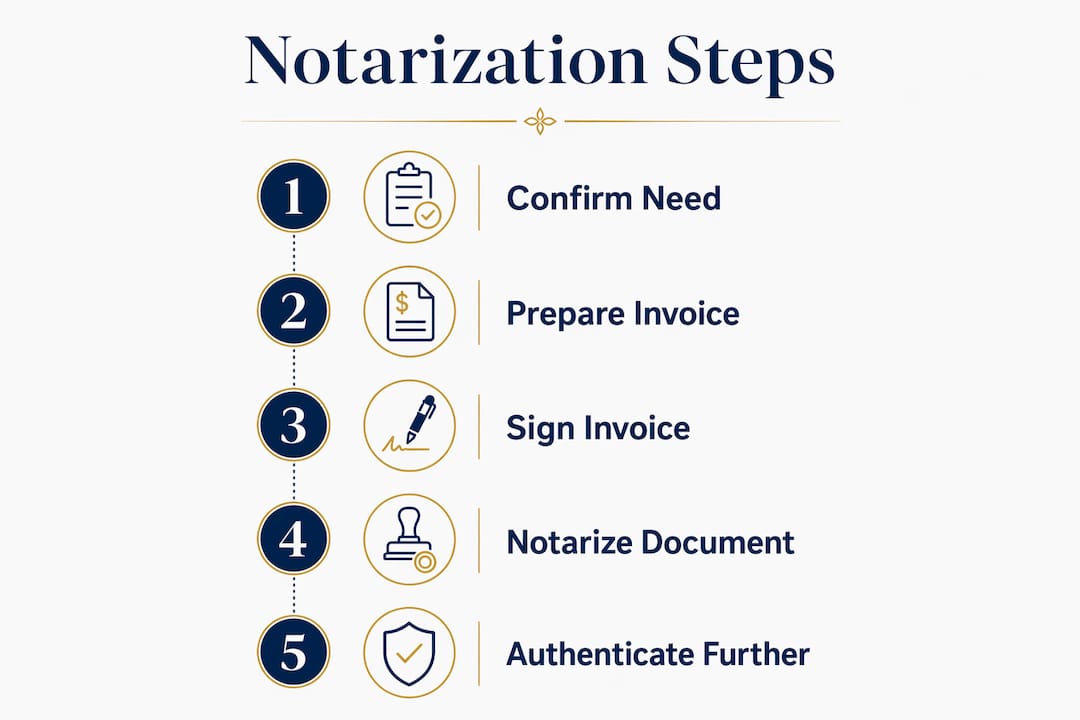
Step-by-step:
- Prepare the invoice on company letterhead with all required fields complete.
- Print the invoice. Do not sign it yet.
- Locate a notary commissioned in the state whose Secretary of State will issue your Apostille.
- Bring government-issued photo ID and any corporate authorization documents.
- Sign the invoice in the notary’s physical presence.
- Receive the notary’s acknowledgment or jurat, seal, and signature.
- Submit the notarized invoice to the Secretary of State for Apostille (Hague) or begin the longer chain (non-Hague).
Notarization options:
- Local walk-in notary: Banks, UPS stores, and law offices often have commissioned notaries available without an appointment.
- Mobile notary: Comes to your office or warehouse, useful for high-volume shipments or when multiple signers are present.
- In-house corporate notary: Some larger exporters commission an employee as a notary for routine document needs.
- Remote online notarization (RON): State-dependent and often not accepted for apostille or consular legalization. Confirm acceptance with the Secretary of State before relying on RON.
For an overview of how RON limitations apply to business documents, Premier Notary's remote online notarization guide covers the state-by-state picture.
Pro Tip: Ask the notary or service provider upfront whether their acknowledgment wording is accepted by your state’s Secretary of State. Nonstandard wording is a frequent rejection trigger that is easy to prevent with one question.
What does the full process cost, and how long does it take?
Costs and timelines vary by state, destination, and whether you use rush services. The table below shows typical ranges; always verify current fees with the issuing state’s Secretary of State and the destination consulate.
| Step | Typical Timeframe | Notes |
|---|---|---|
| Notarization | Same day | Walk-in or mobile notary; schedule in advance for mobile |
| State Apostille | 1–7 business days | Varies by state; same-day available in some states in person |
| U.S. Dept. of State auth. | 5–10 business days | Non-Hague only; rush options may be available |
| Embassy/consulate legalization | 3–10 business days | Varies widely by country and embassy workload |
| Translation (if required) | 1–5 business days | Depends on language pair and document length |
Fee components to budget for:
- Notary fee (set by state law or market rate)
- Secretary of State Apostille fee (state-set; confirm with your state)
- U.S. Department of State authentication fee (non-Hague only)
- Embassy or consulate legalization fee (varies by country)
- Courier and return shipping costs
- Translation costs if the destination requires a translated invoice
Planning tip: For non-Hague destinations, the multi-step authentication chain can add several business days. Build buffer time into your shipping or tender schedule, and consider using a single service provider to coordinate the full chain. Same-day notarization and rush apostille submissions are available in some states with in-person processing, which is critical when deadlines are tight.
Why are notarized commercial invoices rejected, and how do you avoid it?
Most rejections trace back to a small set of preventable errors. Catching them before submission saves days of rework and potential shipment delays.
Common rejection causes:
- Wrong signer: The person who signed is not an authorized officer or agent, and no delegation documentation was provided.
- Missing or illegible signature: The wet signature is absent, smudged, or does not match the printed name.
- Altered invoice: Any change to the document after notarization voids the notarization.
- Incorrect notary wording: The acknowledgment or jurat language does not match the Secretary of State’s requirements.
- Missing attachments: The destination requires a packing list, certificate of origin, or translation that was not included.
- Commission state mismatch: The notary is commissioned in State A, but the Apostille is requested from State B’s Secretary of State. This is a direct cause of rejection.
- Digital-only signature: The invoice was signed electronically without printing, and the Secretary of State requires a wet signature.
How to validate before submitting:
- Confirm the notary’s commission state matches the state issuing your Apostille.
- Verify destination requirements directly with the importer or consulate.
- Use a pre-submission checklist (see the next section).
- Ask the notary to confirm their wording matches the Secretary of State’s current standard.
Pro Tip: If you are bundling multiple documents (invoice, certificate of origin, packing list), confirm with the consulate whether all documents must be notarized individually or whether a single notarization covering the package is accepted.
Pre-submission checklist and sample notarization wording
Use this checklist before visiting the notary or sending documents for Apostille.
Pre-submission checklist:
- [ ] Invoice printed on official company letterhead
- [ ] All required fields complete: buyer/seller details, HS codes, quantities, values, currency, Incoterms, payment terms
- [ ] No alterations or corrections on the printed document
- [ ] Authorized signer identified and corporate authorization documents ready (if agent)
- [ ] Government-issued photo ID available for the signer
- [ ] Notary commissioned in the correct state (matches Apostille state)
- [ ] Attachments assembled: packing list, certificate of origin, translations if required
- [ ] Destination Hague membership confirmed (Apostille vs. consular legalization path)
- [ ] Secretary of State and consulate fees and processing times checked
Sample acknowledgment wording (adapt to your state’s requirements; confirm with your Secretary of State or service provider before use):
Note on digital invoices: Print and sign. Most state apostille offices and the U.S. Department of State require a physical, wet signature on a printed invoice. A purely electronic signature is rejected in most apostille workflows.
For rush shipments:
- Use a mobile notary who can come to your location same day.
- Request in-person Apostille submission at the Secretary of State’s office where same-day processing is available.
- Use a full-service provider to coordinate notarization, Apostille, and courier in one step.
Pro Tip: For apostille certification details and how authentication works internationally, the guide on apostille certification is a useful third-party reference to read before you start.
Key Takeaways
Commercial invoice notarization is the required first step in a two-path authentication chain: Apostille for Hague Convention countries, or state certification plus U.S. Department of State authentication plus embassy legalization for non-member countries.
| Point | Details |
|---|---|
| Notarization is step one | It verifies the signer’s identity and links the invoice to a U.S. authority for further authentication. |
| Two authentication chains exist | Hague member countries need a state Apostille; non-members require state certification, U.S. Dept. of State auth., and embassy legalization. |
| Signer authority matters | Only a corporate officer or properly delegated agent may sign; bring authorization documents when an agent signs. |
| Commission state must match | The notary’s commission state must match the state issuing the Apostille, or the document will be rejected. |
| Premier Notary & Apostille Services handles the full chain | Same-day notarization, Apostille filing, and consular legalization coordination are available through Premier Notary & Apostille Services. |
A practical perspective on commercial invoice authentication
The part most exporters underestimate is not the notarization itself. It is the gap between notarization and what comes after. Many businesses treat notarization as the finish line when it is actually the starting gate. The Apostille or consular legalization step is where delays accumulate, especially for non-Hague destinations where the U.S. Department of State and the destination embassy each add their own processing window.
The other overlooked issue is signer authority. Confirming that the right person signs, with the right documentation in hand, prevents the single most common rejection. A corporate officer who forgot their ID, or an agent without a board resolution, turns a same-day notarization into a multi-day delay. Prepare that paperwork before the appointment, not during it.
For businesses with recurring export shipments, building a standard invoice template that already meets notarization requirements, and keeping corporate authorization documents current, removes most of the friction from the process entirely.
How Premier Notary & Apostille Services handles commercial invoice notarization
Getting a commercial invoice notarized, apostilled, and legalized involves multiple agencies, tight deadlines, and state-specific rules that change without much notice. Premier Notary & Apostille Services handles the full chain: on-site and mobile notarization, Apostille filing with the Secretary of State, U.S. Department of State authentication coordination, consular legalization handling, and courier return options.
With many documents processed and positive ratings from Google reviews, Premier Notary & Apostille Services brings the experience to catch errors before they reach a government desk. Same-day processing options are available for urgent shipments and tender deadlines. The guided intake process means you know exactly what to bring and what to expect at each step, with a single point of contact managing the paperwork from notarization through final legalization.
Ready to get your commercial invoice notarized and authenticated? Book commercial notarization directly through Premier Notary & Apostille Services and get a clear timeline for your specific destination.
Useful sources and where to check current rules
Before starting the authentication process, verify current fees and requirements at these official sources.
| Resource | What it covers |
|---|---|
| U.S. Department of State — Authentications and Apostilles | Official Apostille and authentication procedures, fees, and Hague Convention membership list |
| Your state’s Secretary of State website | State-specific Apostille fees, processing times, and submission instructions |
| Destination country’s embassy or consulate in the U.S. | Legalization requirements, fees, required attachments, and processing times for non-Hague countries |
| National Association of Secretaries of State (NASS) | Directory of state Secretary of State offices and notary commission information |
| Premier Notary & Apostille Services — Apostille vs. legalization | Plain-language explanation of when an Apostille suffices vs. when consular legalization is required |
| Travel document authentication guide | Third-party overview of authentication mechanics and timelines |
Always check the issuing state’s Secretary of State website and the destination consulate for current fees and processing times before submitting documents.
FAQ
What qualifies as a commercial invoice for notarization?
A commercial invoice is a formal billing document issued by the seller to the buyer that describes the goods, quantities, prices, and terms of a transaction. For notarization, it must be printed on company letterhead, fully completed, and signed by an authorized company officer or agent before the notary appointment.
Who fills out and signs a commercial invoice?
The exporting company (seller) prepares the commercial invoice. An authorized corporate officer, director, or delegated agent with a valid board resolution or power of attorney signs it. The notary verifies that signer’s identity and authority.
What is the difference between a commercial invoice and a regular invoice?
A commercial invoice is specifically designed for international trade and includes fields required by customs authorities, such as HS codes, Incoterms, country of origin, and detailed product descriptions. A standard domestic invoice typically omits those fields and is not structured for customs or authentication purposes.
Does notarization make a commercial invoice legally valid abroad?
Notarization alone does not make the invoice internationally valid. It creates the verified signature link that government authentication offices require before issuing an Apostille (for Hague Convention member countries) or completing consular legalization (for non-member countries).
Can Premier Notary & Apostille Services handle both notarization and the Apostille filing?
Yes. Premier Notary & Apostille Services manages the full chain, from on-site or mobile notarization through Apostille filing with the Secretary of State and consular legalization coordination, with same-day options available for urgent deadlines. Book through the commercial notarization page to get started.
This article is general information, not legal advice. Requirements vary by state and destination country. Confirm current rules with your state’s Secretary of State, the U.S. Department of State, and the destination country’s consulate or a qualified professional before submitting documents.