What Is an Acknowledgment Notarization? Full Guide

What Is an Acknowledgment Notarization? Full Guide

An acknowledgment notarization is the official act in which a notary public verifies a signer’s identity and confirms their voluntary signature on a document. This process, formally called a “notarial acknowledgment,” is one of the most common types of notarization in the United States and applies to real estate deeds, powers of attorney, and commercial contracts. The notary does not validate the document’s content. The notary only confirms who signed it and that the signing was willing. Understanding what is an acknowledgment notarization protects you from costly legal errors before you ever walk into a notary’s office.
What is an acknowledgment notarization and how does it work?
An acknowledgment notarization follows five defined steps, each required to produce a legally valid notarial certificate. The National Notary Association identifies these as: personal appearance, document review, identity verification, verbal declaration, and completion of the notarial certificate with seal. Skipping any step can invalidate the entire notarization.
Here is how the process works from start to finish:
- Personal appearance. You must appear in person before the notary. Remote online notarization follows a similar standard through audio-video technology, but the appearance requirement remains.
- Document review. The notary reviews the document to confirm it is complete and not missing pages or signatures where required.
- Identity verification. You present a current, government-issued photo ID such as a driver’s license or passport. Most states require this form of identification without exception.
- Verbal acknowledgment. You verbally declare to the notary that you signed the document willingly and that the signature is yours. You do not need to sign the document in front of the notary. The signature can be completed before the appointment, which is a key flexibility acknowledgments offer.
- Notarial certificate and seal. The notary completes the certificate, records the act in a journal if required by state law, and applies an official seal or stamp.
Fees vary by state, and many states cap the cost for basic notarial acts. The entire appointment typically takes 10–20 minutes when documents are prepared in advance.
Pro Tip: Bring your signed document and a valid photo ID to your appointment. Arriving with an unsigned document is fine too, since you can sign before or during the visit. What you cannot do is skip the in-person appearance entirely.

Why is acknowledgment notarization important for legal protection?
A properly executed acknowledgment gives a document self-authenticating status in court. That means the document is presumed authentic without requiring expert handwriting analysis or additional witness testimony. Without notarization, proving a signature’s authenticity requires costly forensic verification.
The legal protections acknowledgment notarization provides include:
- Presumption of authenticity. Courts treat a notarized document as genuine unless a challenger produces clear and convincing evidence of forgery.
- Shifted burden of proof. Any party claiming the signature is invalid must prove it. The signer does not need to defend the document’s authenticity.
- Reduced litigation costs. A notarized acknowledgment removes the need for expert signature verification in disputes, cutting legal costs significantly.
- Acceptance by recording offices. Real estate deeds and liens require notarized acknowledgments to be recorded by county offices. An unnotarized deed cannot be filed.
- Support for powers of attorney. Financial institutions and healthcare providers routinely require notarized powers of attorney before honoring them.
One critical limitation applies to every acknowledgment notarization:
A notary public verifies who signed a document and that the signing was voluntary. The notary does not verify whether the document’s contents are truthful, legal, or accurate. Signing a fraudulent contract before a notary does not make the contract enforceable.
This distinction matters. Many people assume a notarized document is legally bulletproof. The notarization only authenticates the signer’s identity and intent, not the document’s substance. An attorney reviews content. A notary verifies identity.
Common pitfalls that can invalidate an acknowledgment include using an expired ID, having the notary complete the certificate with missing information, or selecting a notary with a financial interest in the transaction. The notary’s impartiality is the legal foundation of the entire process.
How does acknowledgment notarization differ from a jurat?
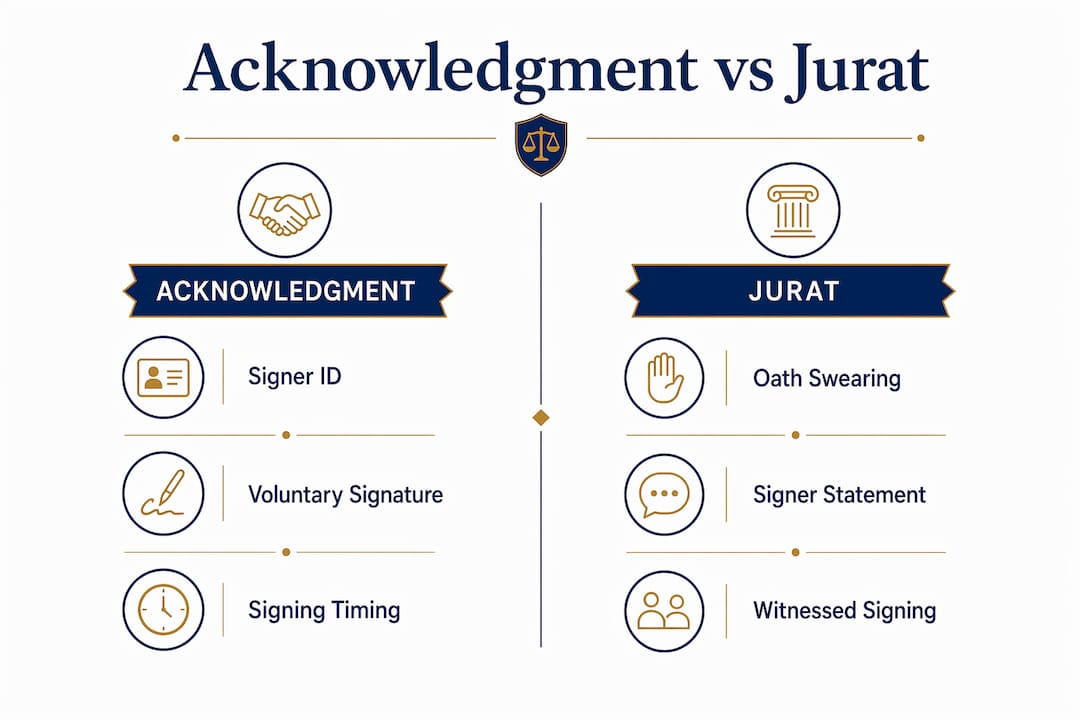
An acknowledgment and a jurat are the two most common notarization types, and using the wrong one can cause document rejection. Courts and recording offices require the specific notarization type the document calls for. Substituting one for the other is not a minor clerical error.
| Feature | Acknowledgment | Jurat |
|---|---|---|
| Signing requirement | Can sign before the notary appointment | Must sign in the notary’s presence |
| Oath or affirmation | Not required | Required by law |
| Signer’s declaration | “I signed this willingly” | “I swear this content is true” |
| Typical documents | Deeds, powers of attorney, contracts | Affidavits, sworn statements, court filings |
| Certificate wording | “Acknowledged before me…” | “Subscribed and sworn before me…” |
The core difference is purpose. An acknowledgment confirms identity and voluntary signing. A jurat confirms the signer swears the document’s contents are true under oath. Affidavits, for example, require jurats because the signer is making a sworn statement of fact. A real estate deed requires an acknowledgment because the goal is to confirm the owner willingly transferred the property.
Certificate wording matters as much as the procedure. Each notarization type uses specific statutory language set by state law. Using acknowledgment certificate wording on a document that requires a jurat, or vice versa, produces an invalid notarization. Many states publish approved certificate forms, and Premier Notary & Apostille Services uses the correct state-specific wording for every document type.
Pro Tip: Check the document itself before your appointment. Most legal documents specify which notarization type is required, either in the signature block or in accompanying instructions. If you are unsure, ask the notary before signing anything.
When documents cross international borders, the notarization requirements can expand further. Certified translations paired with notarized documents often require specific authentication steps, and understanding document certification standards helps you prepare the full package correctly.
What practical tips help you avoid common notarization mistakes?
Most notarization problems are preventable. The errors that cause document rejection are almost always procedural, not substantive.
- Choose a disinterested notary. A notary public must be a state-commissioned impartial official with no financial or personal stake in the transaction. A notary who benefits from the document’s outcome cannot legally notarize it.
- Verify the venue on the certificate. The venue on the notarial certificate must reflect where the notarization physically occurred, not where the document will be filed or where it originated. An incorrect venue is a common reason recording offices reject documents.
- Confirm the certificate is complete. Missing signer names, dates, venue details, or incomplete certificate wording can cause document rejection by recording offices and government agencies.
- Do not alter a signed document after notarization. Any change to the document after the notarial seal is applied voids the notarization. If corrections are needed, the process starts over.
- Know when prior signing is allowed. For acknowledgments, you may sign the document before appearing before the notary. You must still appear in person and verbally confirm the signature is yours.
Pro Tip: Review the notarial certificate before leaving the notary’s office. Confirm your name is spelled correctly, the date is accurate, and the seal is clear and complete. Catching errors on the spot is far easier than returning for a corrected notarization.
For a broader look at errors that derail notarizations, the common notarization mistakes guide from Premier Notary & Apostille Services covers the full list of procedural traps to avoid.
Key Takeaways
An acknowledgment notarization confirms a signer’s identity and voluntary intent, giving the document legal presumption of authenticity in court without validating its content.
| Point | Details |
|---|---|
| Core definition | A notary verifies identity and voluntary signing, not document truth or legality. |
| Five required steps | Appearance, document review, ID check, verbal declaration, and completed certificate with seal. |
| Legal protection | Notarized documents carry a presumption of authenticity, shifting the burden of proof to challengers. |
| Acknowledgment vs. jurat | Acknowledgments allow prior signing; jurats require signing under oath before the notary. |
| Common rejection causes | Incorrect venue, missing certificate details, or wrong notarization type invalidate documents. |
What working with acknowledgment notarizations has taught me
Most people arrive at a notarization appointment thinking the notary’s job is to approve their document. That is not what happens. The notary’s job is to verify you are who you say you are and that you signed willingly. Nothing more.
The most frequent misconception I see is the belief that a notarized document cannot be challenged in court. A notarization raises the bar for challengers significantly, but it does not make a document immune. If the underlying contract is fraudulent, illegal, or signed under duress, a court can still void it. The notarization protects the signature, not the substance.
The second thing I have learned is that state-specific requirements matter more than most people realize. Certificate wording, ID requirements, journal obligations, and fee caps all vary by state. A notarization that is valid in Missouri may not satisfy requirements in California or New York. Working with a notary who knows your state’s rules is not optional. It is the difference between a document that holds up and one that gets rejected.
— Premier
Acknowledgment notarizations made simple with Premier Notary & Apostille Services
Premier Notary & Apostille Services has processed over 1,900 documents with a 5-star rating on Google reviews. Whether you need a notarized affidavit, a real estate deed, or a commercial contract, the process is straightforward and supported at every step.

Book your affidavit notarization or real estate document notarization online in minutes. Same-day processing options are available, and transparent pricing means no surprises at the appointment. Premier Notary & Apostille Services handles the correct certificate wording, venue details, and state-specific requirements so your document is accepted the first time.
FAQ
What is the difference between an acknowledgment and a jurat?
An acknowledgment confirms the signer’s identity and voluntary signature; a jurat requires the signer to swear under oath that the document’s contents are true. The signer must sign in the notary’s presence for a jurat but may sign beforehand for an acknowledgment.
Can I sign a document before my notary appointment?
Yes, for an acknowledgment notarization you may sign the document before appearing before the notary. You must still appear in person and verbally confirm the signature is yours.
Does a notarized document prove the content is true?
No. Notarization only authenticates the signer’s identity and confirms the signing was voluntary. The notary does not verify whether the document’s contents are accurate or legally valid.
What ID do I need for acknowledgment notarization?
Most states require a current, government-issued photo ID such as a driver’s license or passport. Expired IDs are not accepted.
What happens if the wrong notarization type is used?
Using an acknowledgment certificate when a jurat is required, or vice versa, can cause the document to be rejected by courts or recording offices. The notarization must match the type specified by the document or governing law.