What Is an Affidavit of Title Document? Buyer & Seller Guide

What Is an Affidavit of Title Document? Buyer & Seller Guide

An affidavit of title is a notarized sworn statement the seller signs at closing that certifies ownership and discloses known title issues. It is a required document in most U.S. real estate transactions.
- Who signs it: The property seller (sometimes called the affiant), in the presence of a notary public.
- When it’s used: At or just before closing, alongside the deed and title commitment.
- Legal effect: Once notarized, it becomes a sworn legal declaration. False statements can trigger perjury liability and indemnity claims.
Title insurance underwriters and lenders rely on this document to confirm what the public record may not show. County recording offices may also require it to be filed after notarization.
Table of Contents
- What a typical affidavit of title contains
- Why the affidavit of title matters at closing
- Notarization requirements and when an apostille is needed
- How to prepare and notarize your affidavit of title
- Sample clause language and drafting cautions
- Common red flags to watch before signing
- Typical costs and timing for notarization and recording
- Premier Notary & Apostille Services handles your affidavit notarization
- Key Takeaways
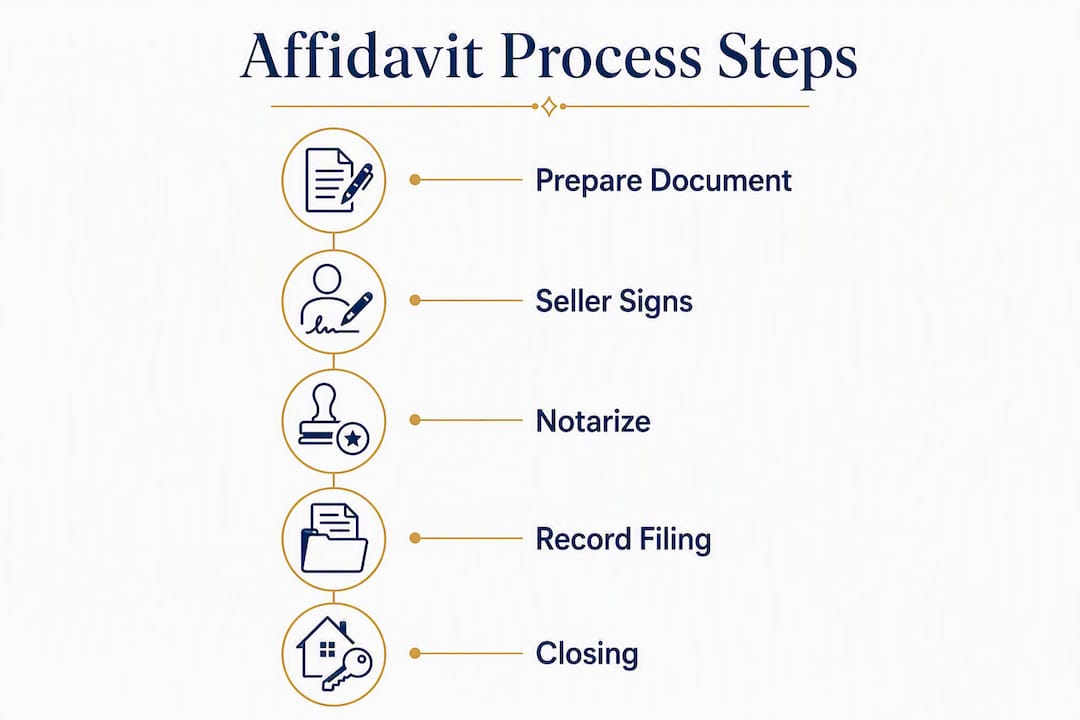
- What the affidavit of title process actually looks like
- Useful sources
- FAQ
What a typical affidavit of title contains
Standard affidavit contents cover the seller’s identity, the property description, and a series of sworn disclosures. The table below shows the most common clause categories.

| Clause Category | What It Covers |
|---|---|
| Seller identity | Full legal name, address, and capacity to convey |
| Property description | Legal description and common address |
| Ownership statement | Seller is the true and exclusive owner of record |
| Liens and encumbrances | No outstanding mortgages, judgments, or tax liens |
| Bankruptcy status | No pending or prior bankruptcy proceedings |
| Pending lawsuits/judgments | No active legal actions affecting the property |
| Existing leases/tenancies | No undisclosed tenants or lease agreements |
| Undisclosed contracts/options | No side agreements to sell to another party |
| Easements | Known access rights or utility easements disclosed |
| Marital status | Spouse’s interest or waiver, where applicable |
Sellers must disclose under oath the status of liens, bankruptcy proceedings, pending lawsuits, judgments, existing leases, and undisclosed contracts. Some states add homestead declarations or mechanics’ lien statements. New Jersey, for example, requires precise marital-status language because a spouse may hold an automatic legal claim to property even when only one name appears on the deed.
Why the affidavit of title matters at closing
The affidavit fills gaps that a public-record title search can miss. It creates personal accountability for the seller and gives buyers a sworn document they can use in court if a hidden claim surfaces later.
Key functions:
- Supplements the title search with the seller’s personal knowledge of issues not yet recorded
- Supports title insurance underwriting by confirming no undisclosed encumbrances exist
- Creates a contractual representation the insurer can rely on for indemnity or subrogation
- Informs buyer decision-making before funds are transferred
Many states require an affidavit of title as part of transfer paperwork, and title companies and lenders typically require one to complete the closing. It is not a substitute for a title search or title insurance policy. If a seller provides false information, the title insurer may deny coverage and pursue subrogation against the seller directly.
Pro Tip: Before signing as a buyer, read every exception the seller has written into the affidavit. Vague language like “subject to any recorded matters” can limit your recourse. Ask for specifics or request a cure before closing.
Notarization requirements and when an apostille is needed
Notarization is mandatory to make the affidavit a legally effective sworn declaration. The notary checks the signer’s government-issued ID, confirms the signer is present and willing, administers an oath or affirmation, and applies a stamp and jurat. Without that seal, the document is just an unsigned statement with no legal weight.
An affidavit of title without a notary’s jurat is not a sworn statement. It cannot be used as legal evidence of the seller’s representations, and most title companies will reject it outright at closing.
An apostille is only needed if the affidavit will be used in a country that is a member of the Hague Apostille Convention. For a standard U.S. domestic closing, no apostille is required. If a foreign buyer or lender needs the document authenticated for use abroad, the notarized affidavit must first go through the appropriate state authority for apostille certification.
Note: Notarization does not equal recording. Some counties require the affidavit to be filed in the land records after notarization. Check with your county recorder’s office before closing day.
How to prepare and notarize your affidavit of title
- Confirm who prepares the document. The seller’s attorney, the title company, or a real estate attorney typically drafts the affidavit. Do not rely on a generic online template without legal review.
- Gather your documents. Bring a government-issued photo ID, a copy of the current deed, and the title commitment. If there are known liens, bring payoff statements.
- Review every clause before signing. Read each disclosure carefully. If something is inaccurate, correct it before the notary appointment, not after.
- Appear in person before the notary. The signer must be physically present. Remote online notarization (RON) is permitted in many states but confirm availability in your jurisdiction.
- Complete the jurat. The notary administers the oath, witnesses the signature, and applies the seal. The document is now a sworn legal declaration.
- Record if required. Check whether your county requires the affidavit to be recorded in the land records after notarization. Recording fees typically apply.
For notarization, you have several options. In-office appointments work well for scheduled closings. A mobile notary comes to your location, which is useful for sellers who cannot travel. Same-day service handles last-minute closing needs. Mail-in or courier options work for out-of-state sellers with straightforward documents.
Pro Tip: Coordinate with your title company and lender at least 48 hours before closing. Confirm that payoff statements and lien releases are in hand before the notary appointment. Last-minute surprises on lien balances are the most common cause of same-day closing delays.
Sample clause language and drafting cautions
Clear, specific language protects everyone. Vague absolutes create disputes.
Ownership statement example:
Lien disclosure example:
Marital status example:
Drafting cautions: avoid blanket “no issues” language when you know of minor encumbrances. Disclose them explicitly with dates and amounts. False statements in an affidavit can lead to perjury liability and indemnity claims against the seller. Use precise property descriptions and confirm all dates are accurate.
Pro Tip: If the affidavit includes any unusual exceptions or carve-outs, have your attorney or the title company review the language before you sign. One ambiguous phrase can delay recording or trigger a coverage dispute.
Common red flags to watch before signing
Watch for these issues before the affidavit is signed or accepted:
- Ambiguous exceptions: Phrases like “subject to all matters of record” without specifics give buyers no real protection.
- Undisclosed mechanics’ liens: Recent construction or renovation without lien waivers from contractors is a serious risk. Buyers should request lien releases or a title hold-back.
- Irregular marital-status statements: A missing spousal consent in a community-property or dower-rights state can cloud title after closing. Ask for documentation.
- Unpaid property taxes: Any outstanding tax balance should appear in the affidavit and be resolved at closing via escrow.
- Pending lawsuits or judgments: An active lawsuit against the seller can attach to the property. Demand written confirmation of dismissal or resolution.
- Contradictory recorded instruments: If the deed on record conflicts with the affidavit’s ownership statement, stop and consult counsel before proceeding.
Each flag has a clear next step: request documentation, demand a cure before closing, or consult a real estate attorney. A home inspection also catches physical defects the affidavit won’t address. Buyers who skip home inspection risk missing structural or mechanical issues that no title document covers.
Typical costs and timing for notarization and recording
| Line Item | Typical Range |
|---|---|
| Notary fee (per signature) | $10–$25 |
| County recording fee | $10–$65 |
| Mobile notary surcharge | Varies by provider |
| Same-day / expedited service | Varies by provider |
| Apostille (if required) | State-set fee, varies |
Notary fees commonly range from a few dollars up to around $25, and county recording fees for a short document typically range from about $10 to $65 depending on jurisdiction. Same-day notarization is available through mobile and in-office providers. Recording turnaround varies by county, from same-day electronic filing to several weeks for paper submissions. For closing-day timing, plan to have the affidavit notarized before or at the same time as the deed signing.
Premier Notary & Apostille Services handles your affidavit notarization
Affidavit of title notarization is one of the most time-sensitive steps in any real estate closing. Premier Notary & Apostille Services offers in-office, mobile, same-day, and mail-in notarization for affidavit of title documents, real estate closing packages, and apostille coordination when foreign use is required.
With over 1,900 documents processed and a 5-star rating on Google reviews, Premier Notary & Apostille Services provides transparent pricing and guided intake so you know exactly what to bring and what to expect. Same-day processing is available for closing-day needs. For business clients, commercial notarization covers property-related contracts and entity documents.
Book your affidavit notarization now. Select your appointment type, confirm your documents, and a notary will be ready when you are.
Key Takeaways
An affidavit of title is a notarized sworn statement the seller signs at closing that certifies ownership and discloses known liens, lawsuits, and encumbrances affecting the property.
| Point | Details |
|---|---|
| Core definition | A seller-signed, notarized sworn statement confirming ownership and disclosing known title issues. |
| Notarization is required | The signer must appear before a notary; without a jurat and seal, the document has no legal effect. |
| Supplement, not substitute | The affidavit adds to a title search and title insurance; it does not replace either one. |
| Watch for red flags | Ambiguous exceptions, undisclosed liens, and missing spousal consents can delay or derail closing. |
| Premier Notary & Apostille Services | Offers same-day, mobile, and in-office affidavit notarization with over 1,900 documents processed. |
This article is general information, not legal advice. Consult a qualified real estate attorney for guidance specific to your transaction and jurisdiction.
What the affidavit of title process actually looks like
Most articles treat the affidavit of title as a formality. It is not. It is the seller’s sworn personal guarantee that fills the gap between what the county recorder shows and what is actually true on the ground. A title search tells you what is on record. The affidavit tells you what the seller knows that may not be on record yet.
The practical implication is that buyers should read the affidavit as carefully as the deed. Sellers should treat it as a legal commitment, not a checkbox. The most common closing-day problems come from sellers who sign a blanket “no issues” affidavit without disclosing a minor lien or an informal lease, assuming it won’t matter. It does matter, and the title insurer will find it.
Same-day and mobile notarization services reduce one real source of closing risk: the last-minute scramble to get a document signed and sealed. Having a reliable notary available on closing day, whether in-office or at the table, keeps the process moving without unnecessary delays.
Useful sources
- Affidavit of Title Explained: Definition, Purpose, and Key Elements — Investopedia; good starting point for definition and standard contents.
- Affidavit of Title Law and Legal Definition — USLegal; authoritative legal definition and clause list.
- Affidavit of Title | Legal Glossary — Barnes Walker; covers insurer reliance and subrogation consequences.
- What Is a Title Affidavit in Real Estate? — LegalClarity; notarization requirements and fee ranges.
- Affidavit of Title: What You Need to Know — ContractsCounsel; drafting cautions and consequences of false statements.
- Affidavit of Title: Explanation and Significance — HAR; standard contents and title company requirements.
- What Is an Affidavit of Title? — Kansas City Real Estate Lawyer; supplement vs. substitute framing.
- New Jersey Property and Marital Law Reference — State of New Jersey; marital status and spousal interest rules.
- Book Affidavit Notarization — Premier Notary & Apostille Services; same-day and mobile notarization booking.
- Real Estate Notarization: Essential Documents — Premier Notary & Apostille Services; practical guidance on closing documents.
FAQ
What is an affidavit of title document?
An affidavit of title is a notarized sworn statement signed by the property seller at closing that certifies ownership and discloses known liens, lawsuits, leases, and other title issues.
Who prepares and signs the affidavit of title?
The seller signs it. A real estate attorney, title company, or closing agent typically prepares the document, though the seller is responsible for the accuracy of every sworn statement.
Is notarization required for an affidavit of title?
Yes. The signer must appear before a notary public who verifies identity, administers an oath, and applies a seal. Without notarization, the document is not a legally effective sworn declaration.
Does an affidavit of title replace title insurance?
No. The affidavit supplements a title search and supports title insurance underwriting, but it does not replace either. Buyers should still obtain a title search and a title insurance policy.
Can Premier Notary & Apostille Services notarize an affidavit of title same day?
Yes. Premier Notary & Apostille Services offers same-day, mobile, and in-office notarization for affidavit of title documents. Book your appointment to confirm availability and next steps.