How to Get a U.S. Department of State Apostille

How to Get a U.S. Department of State Apostille
The U.S. Department of State issues apostilles only for documents issued by U.S. federal agencies. If your document was issued by a state, the District of Columbia, or a U.S. territory, you go to that jurisdiction’s competent authority, which is usually the Secretary of State, not the federal State Department.
Before you do anything else, run through these three steps:
- Federal or state? Confirm whether your document was issued by a federal agency (go to the State Department’s Office of Authentications) or a state agency (go to that state’s Secretary of State).
- Check the destination country. Apostilles apply only to Hague Convention member countries. Non-member countries require an authentication certificate instead.
- Gather your materials. You need the original document (or a certified copy with original seals), a completed Form DS-4194, and the correct payment.
For in-person appointments, email CA-PPT-TO-AUT@state.gov. For mail submissions, send to: 44132 Mercure Circle, Sterling, VA 20166-1206.
Key Takeaways
The U.S. Department of State apostilles only federal documents; state-issued documents go to the issuing state’s Secretary of State, and the fee is a standard amount per document, with same-day processing available by appointment.
| Point | Details |
|---|---|
| Federal vs. state split | Federal documents go to the State Department’s Office of Authentications; state documents go to the issuing state’s Secretary of State. |
| Confirm destination country | Apostilles apply only to Hague Convention member countries; non-members require an authentication certificate instead. |
| Fee and form | The fee is $20 per document; include a completed Form DS-4194 with every submission. |
| Processing timeline | Mail submissions need at least five weeks of lead time; in-person appointments offer same-day processing for eligible documents. |
| Premier Notary & Apostille Services | Offers guided DS-4194 intake, same-day handling, and secure tracked returns for apostille and notarization needs. |
Table of Contents
- What does the U.S. Department of State Office of Authentications do?
- Apostille vs. authentication certificate: which one do you need?
- Which federal documents does the State Department apostille?
- How to prepare a federal document for apostille submission
- How to request apostille services: mail vs. in-person
- If your document was issued by a state: where to go
- Common mistakes and how to avoid them
- Why preparation accuracy matters more than speed
- Premier Notary & Apostille Services handles the details for you
- Sources
- FAQ
What does the U.S. Department of State Office of Authentications do?
The Office of Authentications is the federal office that issues both apostille certificates and authentication certificates for federal documents. It operates two locations.
Mailing address (all mail submissions): Office of Authentications 44132 Mercure Circle Sterling, VA 20166-1206
In-person / walk-in address (Washington, DC): 600 19th Street NW Washington, DC 20006
Appointments are required for in-person service. Email CA-PPT-TO-AUT@state.gov to schedule. Appointments offer same-day processing when you are eligible, which makes them the right choice if your travel date is less than five weeks out. For current hours and any updates to office schedules, check the official Office of Authentications page directly, since hours can change without notice.
Apostille vs. authentication certificate: which one do you need?
The type of certificate you need depends entirely on where the document is going.
- Apostille certificate: Used when the destination country is a member of the Hague Convention of 1961. An apostille is a standardized certificate that confirms the authenticity of a public document’s signature, seal, or stamp. It is recognized automatically by all other Hague member countries.
- Authentication certificate: Used when the destination country is NOT a Hague member. This is a separate chain-of-certification process and is not interchangeable with an apostille.
To confirm whether your destination country is a Hague member, check the HCCH (Hague Conference on Private International Law) official country list. The USA.gov authentication guide also links to this resource and explains the difference clearly.
The most common rejection reason is sending an apostille to a non-Hague country or sending an authentication to a Hague member country. Confirm the destination before you prepare anything. For a deeper look at how these two processes differ, see this guide on the difference between legalization and apostille.
Which federal documents does the State Department apostille?
The Office of Authentications accepts federal documents bearing the signature of a qualifying federal official. Per the State Department’s apostille requirements, the following signatures qualify:
- A federal government official acting in their official capacity
- A U.S. consular officer
- A foreign consul registered with the U.S. Office of Protocol
- A military notary or judge advocate
Common federal documents submitted for apostille include FBI background checks (when issued directly by the FBI with an original signature), federal court documents, documents signed by federal agency officials, and consular reports of birth abroad.
Eligibility checklist before you submit:
- The document bears an original signature from a qualifying official (not a facsimile).
- The document has an original seal or stamp where required.
- The official’s printed name and title appear on the document.
- You have the original or a certified copy with original seals (photocopies are not accepted).
- The document is in its final form and has not been altered.
A note on U.S. territories: Documents from Puerto Rico, Guam, the U.S. Virgin Islands, and other territories may follow different processes depending on the issuing agency. If your document originates from a territorial agency rather than a federal one, contact the Office of Authentications directly before submitting to confirm the correct procedure.
How to prepare a federal document for apostille submission
Follow these steps in order. Skipping any one of them is the most common reason submissions get returned.
- Confirm your document type. Verify it was issued by a federal agency and that the signing official’s signature qualifies (see the list above).
- Do not notarize the federal original. The State Department explicitly warns that notarizing a federal original can invalidate it for apostille purposes. Submit it as-is.
- Obtain a certified copy if needed. If the issuing agency provides certified copies with original seals, those are acceptable. Plain photocopies are not.
- Arrange certified translations if required. If the destination country requires the document in another language, have a professional translator complete a certified translation. Notarize the translation if the destination country or the receiving institution requires it. Complete translations before submitting for apostille.
- Complete Form DS-4194. Download the current PDF from eforms.state.gov. Fill in the document type, number of documents, destination country, and your contact information. Do not leave fields blank.
- Prepare your payment. The fee is $20 per document. Payment must be a check or money order made payable to the U.S. Department of State. Do not send cash.
- Prepare a return envelope. Include a prepaid return envelope with tracking (USPS Priority Mail, FedEx, or UPS). Label it clearly with your name and return address.
- Assemble the package. Place the document(s), completed DS-4194, payment, and return envelope together. Include a printed checklist inside the package so the reviewer can confirm everything is present.
How to request apostille services: mail vs. in-person
Mail submission
Mail is the right choice when your travel or use date is at least five weeks away. Per State Department guidance, include the following in your package:
- Original document(s) or certified copies with original seals
- Completed Form DS-4194
- Check or money order for $20 per document, payable to the U.S. Department of State
- Prepaid return envelope with tracking
Send to: 44132 Mercure Circle, Sterling, VA 20166-1206
Use a trackable shipping method for your outbound package as well. Keep your tracking number. If processing exceeds your expected timeline, use that number to confirm delivery before contacting the office.
In-person appointment
Email CA-PPT-TO-AUT@state.gov to schedule an appointment at 600 19th Street NW, Washington, DC 20006. Appointments offer same-day processing for eligible documents, which makes this the right path when your timeline is tight.
Fees and processing times
| Service type | Fee per document | Typical processing |
|---|---|---|
| Mail submission | $20 | 5+ weeks recommended lead time |
| In-person appointment | $20 | Same-day (when eligible) |
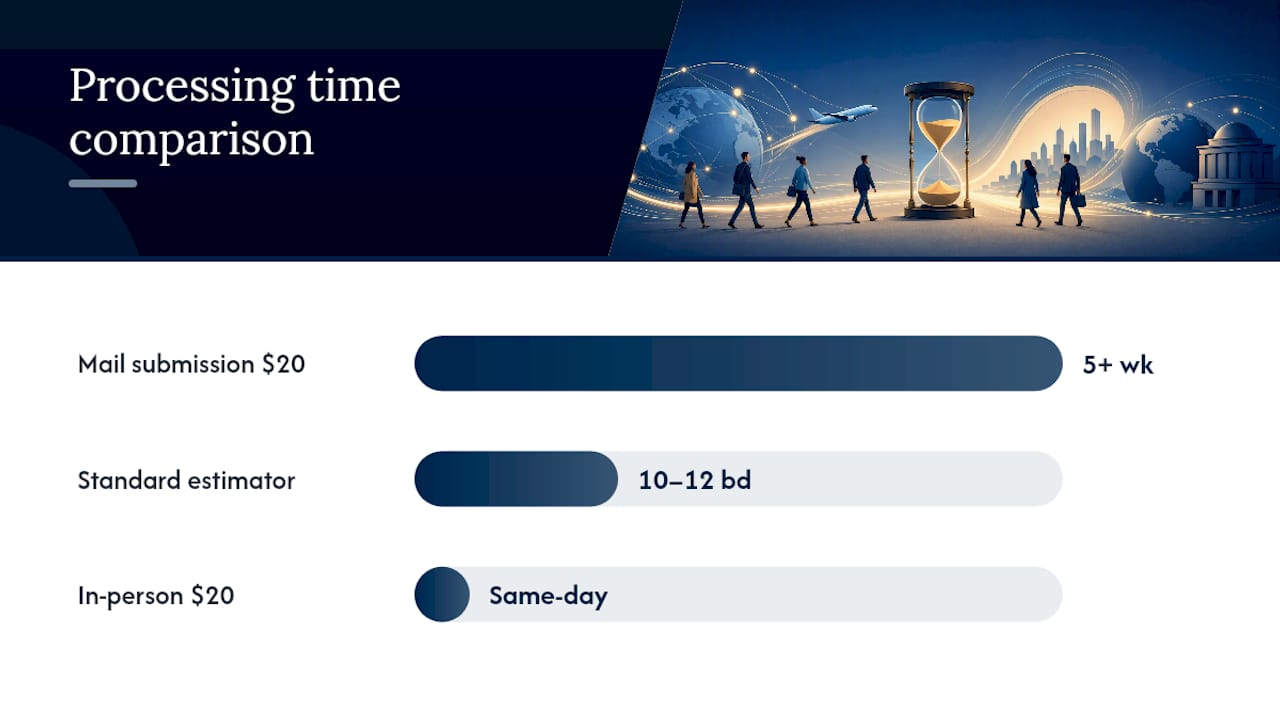
An independent processing time estimator commonly shows standard federal apostille processing at approximately 10–12 business days. That figure is an estimate. The State Department recommends mailing at least five weeks before your planned travel date to account for transit time in both directions.
Payment methods accepted: Check or money order only. No cash, no credit cards for mail submissions.
If your document was issued by a state: where to go
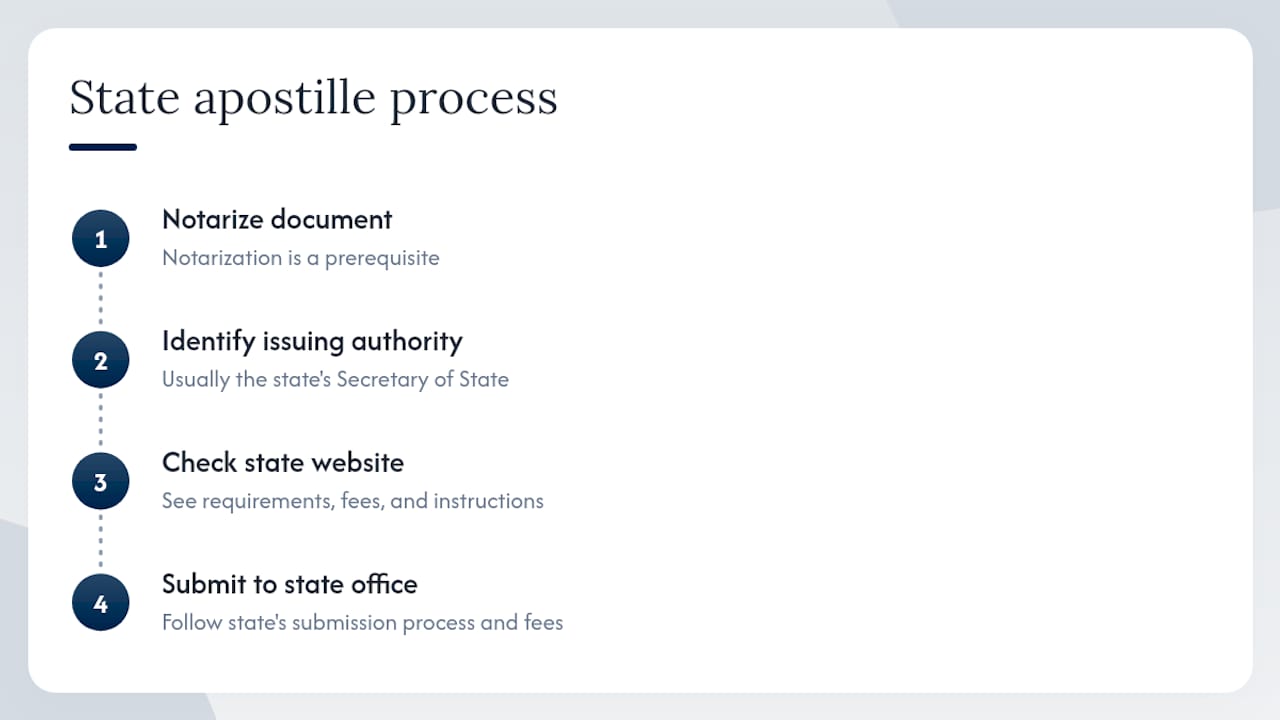
State-issued public documents, such as birth certificates, marriage licenses, and notarized documents, are not handled by the U.S. Department of State. Each state designates its own competent authority, and in most states that is the Secretary of State’s office.
Notaries do not issue apostilles. Their role in the state-level process is to notarize a document (or a translation) so it can then be submitted to the Secretary of State for apostille. The notarization is a prerequisite step, not the apostille itself. This jurisdictional confusion, federal vs. state, is the most frequent source of delays.
For state-specific requirements, fees, and submission instructions, go directly to the issuing state’s Secretary of State website. Requirements vary by state. For a state-by-state breakdown, the apostille by state guide covers the major differences. If you are in Texas, for example, the Secretary of State of Texas handles apostilles for all state-issued documents through its own submission process and fee schedule.
Common mistakes and how to avoid them
These are the errors that cause the most rejections and delays.
- Wrong destination type. Sending an apostille request for a non-Hague country, or an authentication request for a Hague member. Always confirm first.
- Missing seals or printed name/title. The document must show the official’s printed name, title, and agency. A signature alone is not enough.
- Notarizing a federal original. This can invalidate the document. Do not do it.
- Sending cash. Only checks or money orders are accepted for mail submissions.
- Poor packaging. Documents that arrive loose, folded incorrectly, or without a return envelope cause delays.
- No tracking on the return envelope. If the office cannot return your document securely, processing stalls.
Pro Tip: Include a printed checklist inside your envelope that lists every item you included: document name, DS-4194, payment amount, and return envelope carrier. This gives the reviewer an instant reference and reduces back-and-forth.
Pro Tip: If your document is unusual (a federal agency document with a non-standard format, or a document from a U.S. territory), email CA-PPT-TO-AUT@state.gov before mailing. A quick confirmation saves weeks.
If your submission exceeds the expected processing window, check your outbound tracking number first to confirm delivery. Then contact the Office of Authentications directly with your tracking number and submission date. For passport-related document preparation that may require apostille, a passport document checklist can help you confirm supporting materials are in order before you submit.
Why preparation accuracy matters more than speed
The federal apostille process has no shortcut for mail submissions. The Office of Authentications processes what it receives. A package missing a seal, an incorrect payment, or a notarized federal original does not get a quick fix, it gets returned. That return trip costs you two to three weeks minimum.
The cases where people consistently run into trouble are not complex ones. They are straightforward submissions where someone assumed a photocopy was acceptable, or notarized a document out of habit, or sent the wrong form version. The State Department’s preparation page is specific about what qualifies. Reading it before you prepare anything is the single most useful step you can take.
When a same-day turnaround is genuinely necessary, or when the document involves a federal agency with a non-standard format, or when secure courier handling is required, working with a professional apostille service is the practical choice. The time saved on a single rejected submission more than covers the cost.
Premier Notary & Apostille Services handles the details for you
Preparing a federal apostille submission correctly the first time takes attention to detail most people only develop after a rejection. Premier Notary & Apostille Services has processed over 1,900 documents and offers same-day handling, a guided DS-4194 intake process, and secure tracked return shipping so nothing gets lost.
For urgent travel deadlines, same-day mobile notarization and apostille services in St. Louis are available. The intake process walks you through every requirement, from confirming your document type to selecting the right payment method, before anything goes in the mail. If you need a notarization as part of a state-level workflow, you can book an affidavit notarization directly online. Transparent pricing, experienced staff, and no guesswork on packaging or form completion.
Sources
These are the official pages you need to verify current fees, download forms, and confirm appointment availability.
- Authenticate an official document for use outside the U.S.
- Office of Authentications
- United States of America - Competent Authority
- Eforms
Official pages are the source of truth for current fees and processing times. Check them before submitting, since figures can be updated.
FAQ
How long does a U.S. Department of State apostille take?
Mail submissions should be sent at least five weeks before your planned travel date. An independent processing time estimator puts standard federal apostille processing at approximately 10–12 business days, not counting transit time. In-person appointments offer same-day processing for eligible documents.
Where do I get an apostille for a state-issued document?
State-issued documents, such as birth certificates or marriage licenses, are apostilled by the issuing state’s competent authority, which is usually the Secretary of State’s office. The U.S. Department of State handles federal documents only.
Can a notary issue an apostille?
No. Notaries perform notarizations; they do not issue apostilles. In a state-level workflow, a notarization is often a required step before the document goes to the Secretary of State for apostille, but the notary and the apostille authority are separate.
Can I walk in for an apostille at the State Department?
Walk-in service requires an appointment. Email CA-PPT-TO-AUT@state.gov to schedule. Eligible documents can receive same-day processing at the Washington, DC office at 600 19th Street NW.