The Role of Notary in Diploma Verification: 2026 Guide
The Role of Notary in Diploma Verification: 2026 Guide
A notary public’s role in diploma verification is to confirm the identity of the document presenter and certify that copies are true reproductions of the original. Notarization does not validate academic content, degree authenticity, or institutional records. This distinction matters because notaries confirm identity and certify copies but do not verify whether a degree was legitimately earned. Individuals applying for jobs abroad, students seeking graduate admissions, and educational institutions processing foreign credentials all depend on this process. Understanding exactly what notarization does and does not cover prevents costly errors in legal and academic contexts.
What is the role of notary in diploma verification?
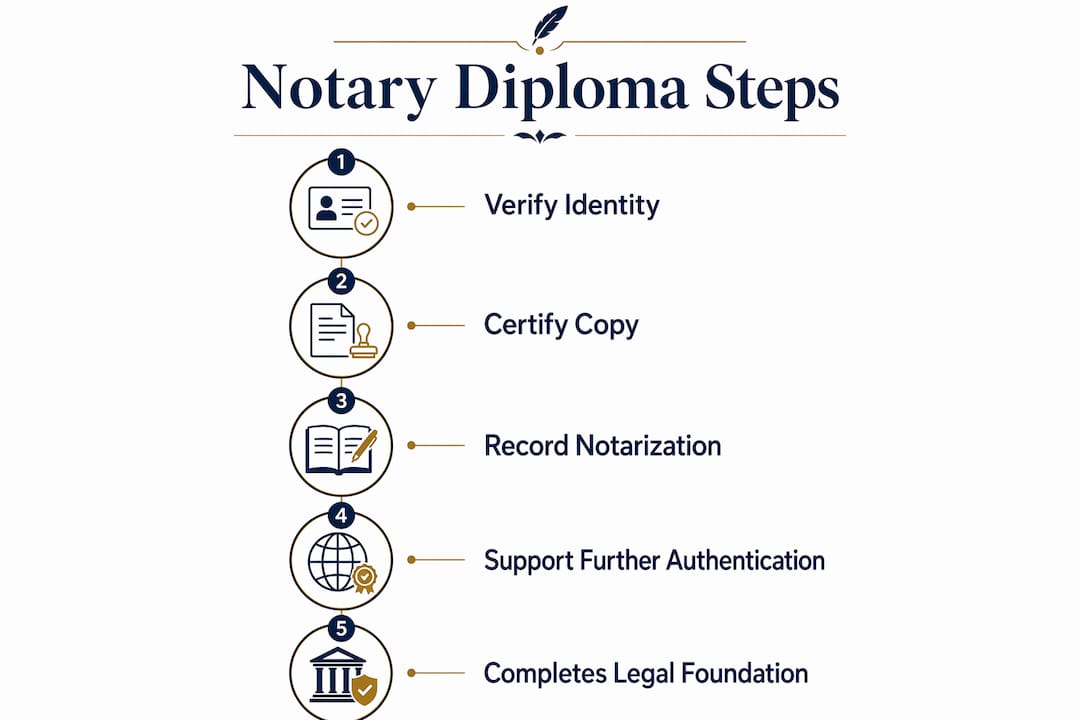
Notarization in the context of educational credentials is formally called notarial certification of document copies. The notary public, a state-commissioned official, performs two core functions: verifying the identity of the person presenting the diploma and certifying that a photocopy is a true and accurate reproduction of the original document.
The notary does not contact the issuing institution. The notary does not confirm that the degree program existed, that the student graduated, or that the grades are accurate. Notarization alone cannot detect diploma fraud; that requires direct contact with the issuing institution. This is the foundational limitation every individual and institution must understand before relying on notarized diplomas.
Regulatory authority for notaries comes from state law. Each state issues its own notarial commission, and the scope of permitted notarial acts varies by jurisdiction. The National Notary Association and individual state statutes define what a notary may certify. This legal framework is what gives notarized documents their standing in courts, government agencies, and foreign institutions.
How does notarization work in the diploma verification process?
The diploma verification process through notarization follows a defined sequence. Getting it right the first time saves time and avoids rejected documents.
- Gather the original diploma. The notary must physically compare the original to the photocopy. No original means no certified copy.
- Choose the correct notarial method. Two common notarization methods exist for diplomas: the Certified Copy Method and the Custodian Method. In the Certified Copy Method, the notary physically compares the original diploma to a photocopy and certifies the copy as accurate. In the Custodian Method, the notary notarizes a signed statement from the document holder asserting that the copy is accurate.
- Present valid government-issued ID. The notary verifies the signer’s identity using a passport, driver’s license, or other accepted identification.
- Select the right notarial act. For diplomas, an acknowledgment or a jurat may apply depending on the document’s purpose. An acknowledgment confirms the signer voluntarily signed; a jurat requires the signer to swear the contents are true.
- Receive the notarial certificate. The notary attaches a certificate, stamps the document with an official seal, and signs. This certificate is what downstream authorities, such as the Secretary of State, rely on.
- Confirm jurisdiction alignment. If the document will be used internationally, the notary’s commission must match the state where the apostille will be requested. Out-of-state notarizations are frequently rejected.
Pro Tip: Always request multiple certified copies in one sitting. Returning for additional copies later means repeating the full process and paying again.
Notarization creates a legal record of identity verification and copy accuracy. It does not create a record of academic achievement.
What are the common misconceptions about notaries and diploma verification?
The most damaging misconception is that a notarized diploma is a verified diploma. It is not. Notarization confirms the copy matches the original and that the presenter is who they claim to be. It says nothing about whether the original diploma is genuine.
Consider this scenario: a person presents a fraudulent diploma to a notary. The notary certifies the copy as a true reproduction of the document in hand. The notarized copy is now legally certified as an accurate copy of a fake. The notarization process does not flag the fraud.
Common false beliefs that create real risk include:
- Notarization equals degree verification. False. Notarization is identity and copy certification only.
- A notarized diploma satisfies primary source verification. False. Primary source verification requires direct contact with the registrar or a third-party verification service.
- Any notary can notarize a diploma for international use. False. Jurisdiction matters. A notary commissioned in Missouri cannot support an apostille request filed in Texas.
- Notarized documents are accepted everywhere without additional steps. False. Many countries and institutions require apostilles, credential evaluations, or direct institutional confirmation.
“Employers should distinguish between a diploma check and primary source verification to avoid false security risks. Treating a notarized copy as proof of academic achievement creates a compliance gap that exposes organizations to negligent hiring liability.”
Notarization is distinct from academic verification and should never be treated as a substitute for it. Institutions that conflate the two expose themselves to fraud risk and potential legal liability.
How do notary services fit into the broader diploma authentication ecosystem?
Notarization is the first link in a chain of trust, not the final one. Understanding where it sits relative to other verification methods prevents gaps in compliance.
Notarization vs. apostille
Notarization is the first step; apostille authentication by the Secretary of State follows to certify the notary’s legitimacy for international use. An apostille is a government-issued certificate that validates the notary’s commission for use in countries that are members of the Hague Convention. Without a properly notarized document, the Secretary of State will not issue an apostille. The two steps are sequential, not interchangeable.
Credential evaluation and primary source verification
Credential evaluation services, such as those used by universities and licensing boards, assess whether a foreign degree is equivalent to a U.S. degree. These services require certified copies, often notarized, as part of their intake process. Primary source verification goes further: it contacts the issuing institution directly to confirm enrollment, graduation date, and degree awarded. Most reliable international diploma verification involves certified copies obtained directly from school registrars, often with in-house notary services.
International complexity
International diploma verification can require multi-tiered authentication beyond notarization, including federal-level certifications, especially for countries outside the Hague Convention. In those cases, the chain runs from notarization to state authentication to federal authentication to foreign embassy legalization. Skipping any step results in rejection.
Pro Tip: Before notarizing a diploma for international use, confirm the destination country’s membership in the Hague Convention. Non-member countries require a longer legalization chain. Resources like Fast Passport Center explain document authentication workflows that parallel diploma legalization steps.
For individuals, notarization typically supports job applications, graduate school admissions, and visa processes. For educational institutions, notarized copies support record-keeping, transcript requests, and compliance with accreditation bodies.
What practical steps should you follow when using notary services for diploma verification?
Preparation determines whether the process goes smoothly or requires multiple attempts.
- Start with the original diploma. Bring the physical diploma, not a previously made copy. The notary must compare the original to the photocopy being certified.
- Make clean, high-quality photocopies. Blurry or cropped copies will be rejected. Every detail on the original must be visible on the copy.
- Identify the correct notarial act. For a certified copy, the notary uses a copy certification certificate. For a sworn statement about the document, a jurat applies. Confirm the requirement with the receiving institution before your appointment.
- Verify state jurisdiction. If the document will be used for an apostille, the notary must be commissioned in the same state where you will file the apostille request. School apostille and transcript notarization requirements vary by destination country and intended use.
- Coordinate with the registrar’s office. Many universities provide notarized transcripts and diploma copies directly through their registrar. This is often the most accepted format for credential evaluators and foreign institutions.
- Review the notarial certificate before leaving. Check that the notary’s name, commission expiration date, seal, and signature are all present and legible. Errors on the certificate cause rejections downstream.
Pro Tip: Ask the receiving institution for its exact notarization requirements in writing before you book an appointment. Requirements differ between graduate schools, foreign embassies, and professional licensing boards.
Coordinating notarization with registrar offices and authentication agencies reduces the chance of rejection. A notarized diploma that does not meet the recipient’s specific requirements is a wasted step.
What are the benefits and limitations of notarization in hiring and academic admissions?
Notarization delivers measurable value in hiring and admissions, but only when paired with additional verification steps.
Benefits of involving a notary:
- Identity verification reduces fraud risk. The notary confirms the presenter is the named degree holder, creating a legal record of that confirmation.
- Certified copies support faster processing. Institutions and employers receive documents they can rely on without waiting for original documents to be mailed and returned.
- Legal standing. Notarized documents carry legal weight in courts and government agencies, which matters for professional licensing and immigration.
- Foundation for apostille. Without notarization, international document legalization cannot proceed.
Limitations to recognize:
- Notarization does not detect fake diplomas. A notarized copy of a fraudulent diploma is still fraudulent.
- No academic content validation. The notary does not confirm grades, majors, graduation dates, or institutional accreditation.
- Jurisdiction errors invalidate documents. A notarization performed in the wrong state for an apostille request wastes time and money.
Organizations that implement systematic degree and diploma verification reduce hiring risk by 73% and improve time-to-hire by 40%. That improvement comes from combining notarization with primary source verification, not from notarization alone. 78% of job postings require bachelor’s degrees, making rigorous verification a compliance necessity, not a formality. Negligent hiring costs average $1.2 million per incident, which makes the cost of proper verification trivial by comparison.
Notarization is a cost-effective first step. It becomes a liability only when treated as the final step.
Key Takeaways
The role of a notary in diploma verification is to certify identity and document copies, providing a legal foundation that enables, but does not replace, primary source verification and apostille authentication.
| Point | Details |
|---|---|
| Notarization certifies copies, not content | A notary confirms a copy matches the original but does not validate academic records or degree authenticity. |
| Two methods apply to diplomas | The Certified Copy Method and the Custodian Method are the standard approaches for notarizing diploma documents. |
| Jurisdiction determines apostille eligibility | The notary’s state commission must match the state where the apostille is filed, or the document will be rejected. |
| Notarization is the first step, not the last | Apostilles, credential evaluations, and primary source verification must follow notarization for full authentication. |
| Systematic verification reduces hiring risk | Organizations using structured verification reduce hiring risk by 73% and improve time-to-hire by 40%. |
What I’ve learned working with diploma notarization every day
The most common error I see is individuals arriving with a photocopy of a photocopy and no original diploma. The notary cannot certify a copy of a copy. That single mistake delays the entire process by days or weeks.
The second most common problem is jurisdiction mismatch. Someone gets a diploma notarized in Illinois, then files an apostille request in California. The Secretary of State rejects it. The fix requires starting over with a notary commissioned in California.
What I have observed consistently is that the best outcomes happen when notaries and credential evaluators communicate early. When an institution specifies its exact requirements upfront, and the notary understands the downstream use of the document, errors drop significantly. The notary’s job is precise and limited. Respecting that scope, rather than expecting it to cover everything, is what makes the process work.
Digital notarization is changing how diploma verification works. Remote online notarization platforms now allow signers to appear before a notary via video, with electronic seals and audit trails. This does not change what a notary certifies. It changes how the certification is delivered. The legal scope remains the same.
— Premier
How Premier Notary & Apostille Services supports your diploma verification needs
Diploma notarization requires accuracy at every step. One missed detail on a notarial certificate can delay a job offer, a visa application, or a graduate school admission.

Premier Notary & Apostille Services has processed over 1,900 documents with a 5-star rating from Google reviews. State-commissioned notaries handle diploma and educational credential notarizations with same-day processing options available. Whether you need a certified copy notarized for domestic use or a document prepared for apostille filing, the guided intake process confirms your requirements before the appointment. Transparent pricing and expert support mean you arrive prepared and leave with documents that meet the standards of the receiving institution. Book directly at Premier Notary & Apostille Services to get started.
FAQ
What does a notary actually verify on a diploma?
A notary verifies the identity of the person presenting the diploma and certifies that a photocopy is an accurate reproduction of the original. The notary does not confirm that the degree was legitimately earned or that the academic records are accurate.
Can a notarized diploma replace primary source verification?
No. Notarization is distinct from primary source verification, which requires direct contact with the issuing institution. A notarized diploma is a certified copy, not a confirmed academic record.
What is the difference between notarization and an apostille for a diploma?
Notarization certifies the document copy and the signer’s identity. An apostille, issued by the Secretary of State, then certifies the notary’s commission for international use. Notarization must come first; the apostille follows.
Does the notary’s state matter for diploma verification?
Yes. The notary’s commission must be in the same state where the apostille is requested. A notarization performed in a different state will be rejected by the Secretary of State.
How do educational institutions use notarized diplomas?
Universities and licensing boards use notarized diploma copies as part of credential evaluation intake. Many registrar offices provide notarized copies directly, which are the most widely accepted format for foreign institutions and credential evaluators.