Settlement Statement Notarization: A 2026 Real Estate Guide

Settlement Statement Notarization: A 2026 Real Estate Guide

Settlement statement notarization is the formal process where a notary public verifies signer identity, witnesses signatures, and applies an official seal to authenticate the financial closing document in a real estate transaction. If you are buying or selling a home in 2026, understanding what is a settlement statement notarization means knowing exactly what stands between you and a legally binding, fraud-proof closing. The key documents involved include the Closing Disclosure and the older HUD-1 Settlement Statement. Both require careful review and, in most closings, notarized signatures to protect buyers, sellers, and lenders alike.
What is a settlement statement notarization and why does it matter?
A settlement statement is a mandatory, itemized accounting document that discloses every financial debit and credit in a real estate transaction. Think of it as the final scoreboard for your closing: every fee, credit, prorated tax, and commission appears in one place. Under federal standards, this document must be issued at least three business days before closing for most residential mortgage transactions. That window exists so buyers and sellers can review the numbers before signing anything.

Two versions of this document are in common use today. The HUD-1 Settlement Statement was the standard form for decades and is still used in reverse mortgage and some cash transactions. The Closing Disclosure replaced the HUD-1 for most federally regulated mortgage loans after 2015. Both documents serve the same core purpose: reconciling all money moving between parties, including prorated property taxes, lender fees, title insurance, and agent commissions.
Notarization enters the picture because a signature alone does not prove identity or consent. A notarized settlement statement carries legal weight that an unwitnessed signature does not. Specifically, notarization confirms three things:
- The signer appeared in person before a commissioned notary
- The notary verified the signer’s identity using a valid, government-issued photo ID
- The signer executed the document willingly and without coercion
That third point matters more than most buyers realize. Notarization must not proceed if the signer appears unwilling or coerced. The notary’s impartial role protects every party by guaranteeing genuine consent at the moment of signing.
How is the notarization process performed for a settlement statement?
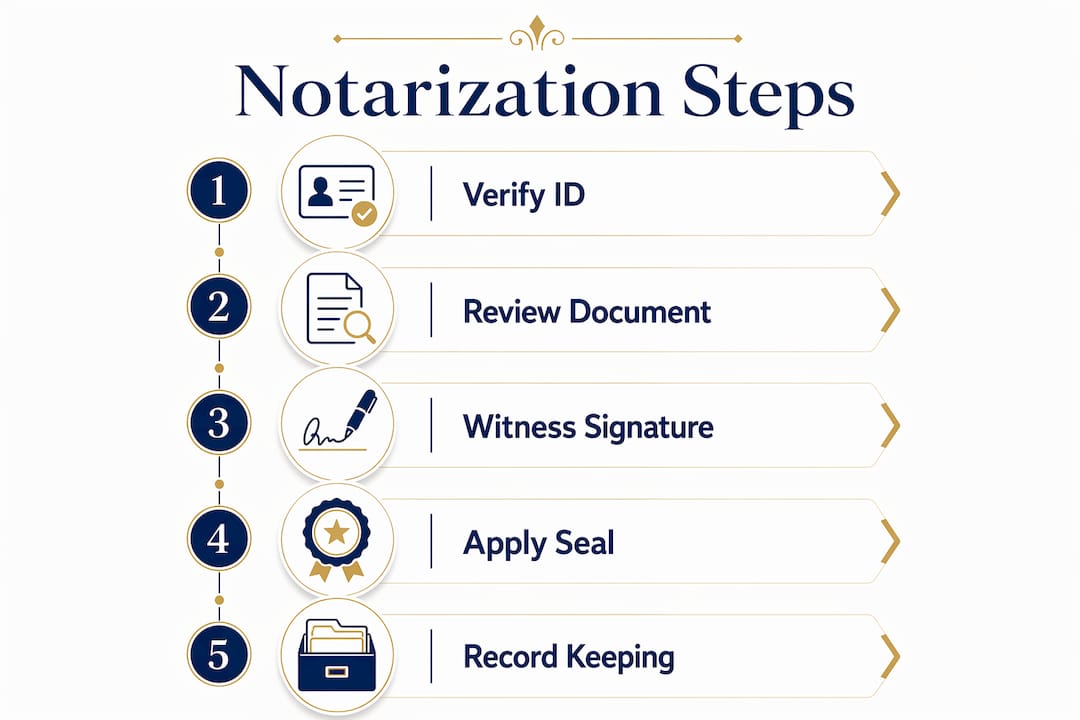
The notarization process for a settlement statement follows a clear sequence. Knowing each step prevents surprises at the closing table.
- Gather your documents and ID. Bring the complete settlement statement and a valid, unexpired government-issued photo ID such as a driver’s license or passport. If your name on the document differs from your current ID due to marriage or divorce, bring legal proof of the name change.
- Appear before the notary in person. Remote Online Notarization (RON) is now legal in most states, but many lenders still require physical presence. Confirm with your lender or title company which format applies to your closing.
- The notary verifies your identity. The notary examines your ID, confirms it matches the name on the document, and may ask you to state your name aloud. This step takes only a minute or two but is legally required.
- Sign the document in the notary’s presence. Never sign the settlement statement before the appointment. Legal requirements forbid pre-signing because notarization must be contemporaneous with signing to be valid.
- The notary completes the notarial certificate. The notary adds the date, their official seal, and their signature. For settlement statements, the most common notarial act is an acknowledgment, which confirms you signed willingly for the document’s intended purpose without requiring an oath.
The most common notarial act for settlement statements is an acknowledgment rather than a jurat. A jurat requires the signer to swear an oath that the document’s contents are true. An acknowledgment only confirms identity and voluntary signing. This distinction matters because it means you can review the settlement statement before the appointment and arrive ready to sign, rather than reciting sworn statements about every line item.
The entire session rarely exceeds 15 minutes. Costs range from $2 to $25 per signature depending on state-specific fee regulations. That low cost is one of the best values in a real estate transaction given the legal protection it provides.
Pro Tip: Ask your title company or settlement agent for the draft Closing Disclosure at least 48 hours before your appointment. Read every line before you sit down with the notary. Errors are fixable before notarization. After the seal goes on, corrections become significantly harder.
Common mistakes that delay or invalidate settlement statement notarization
Most closing delays tied to notarization are preventable. The problems below appear repeatedly, and each one can push your closing date back by days.
- Pre-signing the document. Signing before the notary witnesses you is the single most common mistake. The notary cannot certify a signature they did not see. The document will be rejected, and you will need to start over.
- Name mismatches between ID and document. A name mismatch between your ID and the document blocks the closing. If you recently married or changed your name, bring a certified copy of your marriage certificate or court order.
- Incomplete documents. Blank fields or missing pages on the settlement statement prevent notarization. The notary cannot certify an incomplete document. Review every page before the appointment.
- Expired identification. An expired driver’s license or passport is not acceptable. Check your ID expiration date at least a week before closing.
- Assuming all states have the same fees. Notary fees vary by state law. California caps fees at $15 per signature. Florida allows up to $10. Some states set no cap at all. Confirm the fee with your notary or title company in advance.
Pro Tip: Bring two forms of ID to every notarization appointment. If your primary ID raises any question, a backup prevents the entire closing from stalling. A passport and a driver’s license together cover nearly every scenario a notary will encounter.
You can find a detailed breakdown of notarization mistakes to avoid on the Premier Notary & Apostille Services blog, which covers real estate closings specifically.
How does notarization protect everyone at the closing table?
Notarization of a settlement statement does more than satisfy a procedural requirement. It creates a legal record that protects buyers, sellers, lenders, and agents from fraud and future disputes.
A Notary Signing Agent (NSA) acts as a neutral third party at the closing. NSAs verify identity, document completeness, and correct execution during closings. That neutral role means no party can later claim the other signed under pressure or without understanding the document. The notary’s seal is the closing table’s most powerful anti-fraud tool.
Notarization adds legal weight to settlement statements, making them reliable evidence in potential disputes over real estate transactions. If a buyer later claims they never agreed to a specific fee, or a seller disputes the commission amount, the notarized document is the definitive record. Courts treat notarized documents with a higher presumption of authenticity than unwitnessed signatures.
Professional notaries also prevent funding delays by catching execution errors before documents leave the closing table. A missing initial, a wrong date, or an unsigned page can cause a lender to reject the package and delay funding by 24–72 hours. That delay costs buyers money in extended rate locks and sellers in carrying costs.
“Settlement statements represent the binding accounting for the transaction. Errors are typically fixable only if caught prior to notarization.” — Real Estate Field Guide
The practical takeaway is straightforward. Review the settlement statement line by line before the notary appointment. Confirm every number matches your Loan Estimate or prior disclosures. Once the seal is applied, the document becomes the official record of the transaction.
Key Takeaways
Settlement statement notarization is the legally required authentication step that confirms identity, witnesses signatures, and seals the financial record of a real estate closing.
| Point | Details |
|---|---|
| Settlement statement timing | The document must be issued at least three business days before closing under federal standards. |
| Most common notarial act | Acknowledgment confirms voluntary signing and identity without requiring a sworn oath. |
| Session length and cost | Notarization takes under 15 minutes and costs $2–$25 per signature depending on state law. |
| Pre-signing is invalid | Signing before the notary witnesses you voids the notarization and requires starting over. |
| Review before the seal | Errors on a settlement statement are far easier to correct before notarization than after. |
What I have learned from watching closings go wrong
After processing well over 1,900 documents at Premier Notary & Apostille Services, the pattern is clear. The closings that go smoothly share one trait: the buyer and seller both read the settlement statement before they walked in the door. The closings that fall apart almost always involve someone seeing the document for the first time at the table.
Real estate agents and lenders often tell clients to “just sign where the notary points.” That advice is not wrong, but it skips the most important step. The notary’s job is to verify identity and witness signatures. The notary is not your financial advisor. Nobody at that table will stop you from signing a document with a $3,000 error in the lender’s favor unless you catch it yourself.
The acknowledgment format used for most settlement statements actually gives you an advantage most people do not use. Because an acknowledgment does not require a sworn oath about the document’s contents, you can review the statement thoroughly at home, flag any questions, and resolve them with your lender or title company before the appointment. Arrive knowing what you are signing. The notary session itself should feel like a formality, not a surprise.
One more thing: state-specific rules matter more than most buyers expect. Notary fee caps, Remote Online Notarization availability, and ID requirements all vary by state. Confirm the specifics with your title company at least a week before closing. A quick call saves the kind of delay that costs real money.
— Premier
Get your settlement statement notarized with confidence
Real estate closings move fast, and a single notarization error can stall funding for days. Premier Notary & Apostille Services specializes in real estate document notarization, including settlement statements, Closing Disclosures, and deed packages. With same-day processing options and a guided intake process, you arrive prepared and leave with a properly executed document.

Premier Notary & Apostille Services has earned a 5-star rating on Google reviews across more than 1,900 processed documents. Transparent pricing, experienced notaries, and fast turnaround mean your closing stays on schedule. Book your appointment today and close with confidence.
FAQ
What is a settlement statement in real estate?
A settlement statement is a mandatory, itemized document disclosing all financial debits and credits in a real estate transaction. The two main versions are the HUD-1 Settlement Statement and the Closing Disclosure.
Does a settlement statement always require notarization?
Most lenders and title companies require notarized signatures on the settlement statement to confirm identity and prevent fraud. Requirements vary by state and loan type, so confirm with your lender before closing.
How long does settlement statement notarization take?
The notarization session itself rarely exceeds 15 minutes. The process includes identity verification, witnessing the signature, and completing the notarial certificate.
What ID do I need to bring to a notarization appointment?
You need a valid, unexpired government-issued photo ID such as a driver’s license or passport. If your name on the document differs from your ID due to a name change, bring legal proof such as a marriage certificate.
Can I sign the settlement statement before the notary appointment?
No. Pre-signing invalidates the notarization because the notary must witness the signature to certify it. Always sign in the notary’s presence during the appointment.