Role of a Witness in Deed Notarization: 2026 Guide
Role of a Witness in Deed Notarization: 2026 Guide

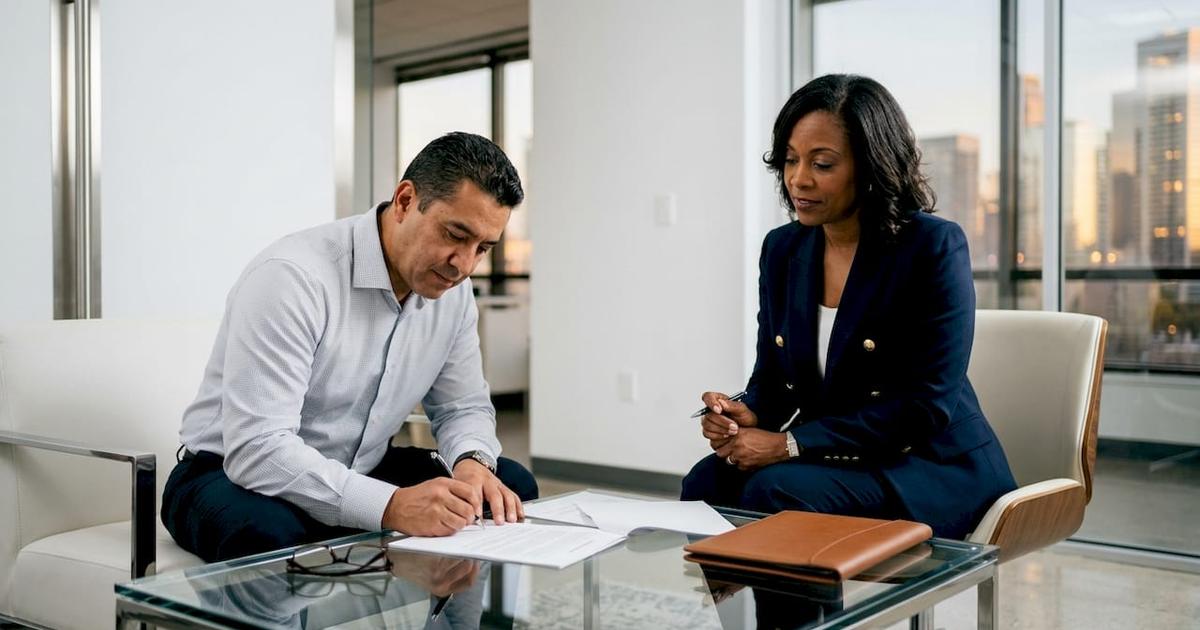
A witness in deed notarization is defined as a neutral, disinterested observer who attests that the grantor signed the deed voluntarily and in their presence. This role is distinct from the notary’s function, which centers on verifying identity and administering acknowledgments. The role of witness in deed notarization directly affects whether a deed is accepted for recording by county recorder offices. States like Connecticut, Florida, Georgia, Louisiana, and South Carolina require two witnesses in addition to notarization. Getting this right the first time prevents costly delays and document rejection.
Which states require witnesses for deed notarization?
Most states rely solely on a notarized acknowledgment to validate a deed. A minority of states go further and require one or two witnesses to sign alongside the notary.
The states with the strictest witness requirements are well documented. Connecticut, Florida, Georgia, Louisiana, and South Carolina require two witnesses for deed conveyance. Failing to meet this requirement causes rejection by the county recorder, which means the deed cannot be recorded and the property transfer stalls.

Some states allow the notary to count as one of the required witnesses. Others, including Georgia and Louisiana, prohibit notaries from serving as witnesses at all. This distinction matters because using the same person in both roles in a state that prohibits it can void the deed entirely.
| State | Witnesses Required | Notary Can Serve as Witness? |
|---|---|---|
| Florida | 2 | Varies by county practice |
| Georgia | 2 | No |
| Louisiana | 2 | No |
| Connecticut | 2 | Check state statute |
| South Carolina | 2 | Check state statute |
| Most other states | 0 | Not applicable |
Pro Tip: When state law is unclear, include two independent witnesses anyway. Over-witnessing adds no legal risk and prevents recording delays.
Who qualifies as a valid deed signing witness?
Witness eligibility is not open to interpretation. The law sets clear standards, and failing to meet them can invalidate the deed even if the notarization itself was properly done.
A valid witness must meet all of the following criteria:
- Disinterested party. The witness must have no financial or personal stake in the property transaction. Beneficiaries, buyers, and immediate family members typically cannot serve as valid witnesses. An interested witness can void the deed.
- Legal age. The witness must be at least 18 years old.
- Mental competency. The witness must be of sound mind and capable of understanding what they are attesting to.
- Physical presence. The witness must personally observe the grantor sign the deed. A witness who signs without being present at the signing provides no legal attestation.
- No conflict of interest. Attorneys who stand to benefit from the transaction, or anyone named in the deed, are disqualified.
There are two distinct types of witnesses in notarization practice. An attestation witness observes the actual signing and signs the deed to confirm it. A credible identifying witness serves a different purpose: they vouch for the signer’s identity when the signer lacks acceptable government-issued ID. Credible identifying witnesses vouch under oath for the signer’s identity, which allows the notary to proceed when standard identification is unavailable.
Pro Tip: Confirm witness eligibility before the signing appointment. Discovering a disqualified witness at the table means rescheduling the entire signing.
How do witnesses and notaries differ in authority?
The notary and the witness perform separate legal functions. Confusing the two leads to execution errors that can invalidate a deed.
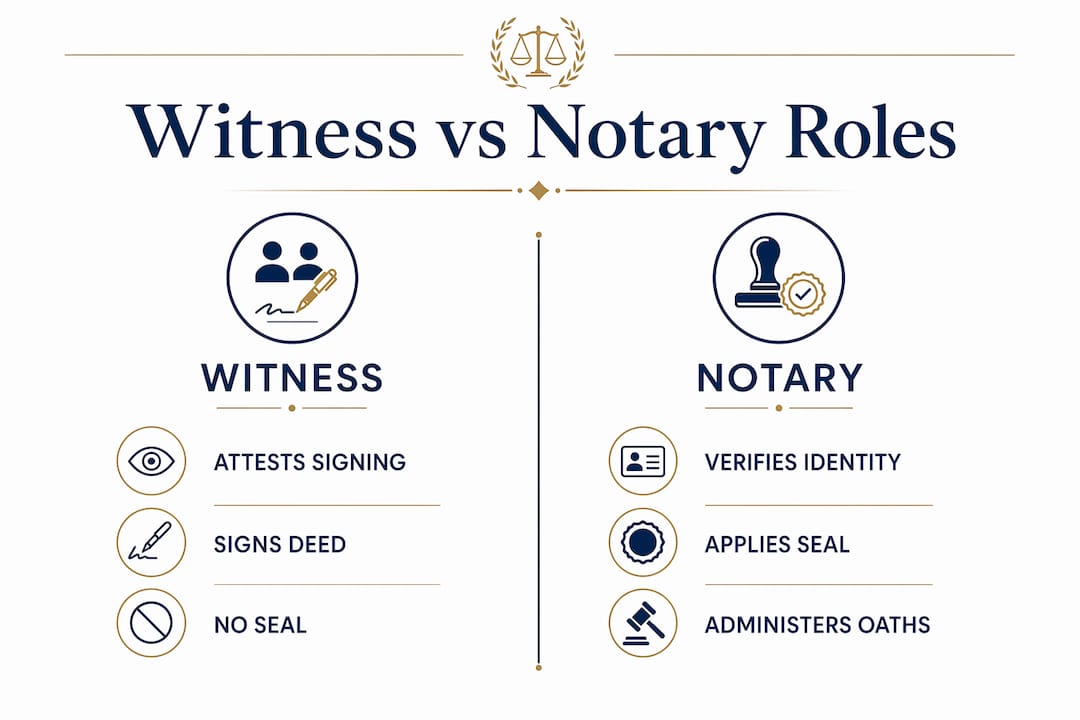
The notary’s role is to verify identity and administer acknowledgments or jurats, then apply an official seal. The notary does not need to watch the actual signing moment. The witness, by contrast, must observe the signing directly. The witness’s role is evidentiary: their signature confirms that the deed was signed voluntarily and in their presence.
A notary cannot notarize their own signature. In states like Georgia and Louisiana, using the same person as both notary and witness is prohibited and can jeopardize deed validity. Even in states that do not explicitly address this, the practice creates legal uncertainty that title companies and county recorders may flag.
| Role | Primary Function | Signs the Deed? | Applies a Seal? |
|---|---|---|---|
| Notary | Verifies identity, administers acknowledgment | No (typically) | Yes |
| Attestation witness | Observes voluntary signing | Yes | No |
| Credible identifying witness | Vouches for signer’s identity | Yes (under oath) | No |
The table above shows that the two roles complement each other rather than overlap. A deed that has proper notarization but an unqualified witness still fails. A deed with qualified witnesses but no notarization also fails in states that require both. Both elements must be correct for the document to record successfully. For documents beyond real estate deeds, similar dual-role logic applies to will and testament notarization, where witness and notary functions are equally distinct.
What are the risks of incorrect witness usage?
Improper witnessing is one of the most common reasons deeds fail at the county recorder’s office. The consequences are practical, financial, and sometimes irreversible without significant effort.
- Deed rejection at recording. County recorder offices check witness counts and signatures before accepting a deed. A deed with missing or disqualified witnesses is returned unfiled.
- Mandatory re-execution. Re-execution of a deed due to improper witnessing requires reassembling all original parties. If the grantor has moved, become incapacitated, or died, re-execution may be legally impossible.
- Title defects. A deed recorded with a known witnessing defect can create a cloud on title. Title companies may refuse to insure the property until the defect is corrected.
- Financial costs. Delays in property transfer affect closing timelines, mortgage funding dates, and lease agreements. Every day of delay carries a financial cost.
- Legal challenges. A deed signed without a disinterested witness can be challenged in court by any party claiming the signing was not voluntary.
The scenario where a notary served as the sole witness in a state that prohibits dual roles illustrates the risk clearly. The deed records, but a title search later reveals the defect. The buyer cannot sell or refinance until the original grantor executes a corrective deed, which may require litigation if the grantor is uncooperative.
Over-witnessing, meaning including more independent witnesses than required, carries no legal downside. It is the safest approach when state witness requirements are unclear. A review of common notarization mistakes shows that witness errors rank among the most frequent and most preventable problems in real estate document execution.
For anyone handling documents that cross international borders, proper execution at the domestic level, including correct witnessing, is the foundation before any apostille or authentication process can proceed.
Key Takeaways
The role of a witness in deed notarization is legally distinct from the notary’s function, and both must be correctly fulfilled for a deed to record without defect.
| Point | Details |
|---|---|
| Witness role is evidentiary | Witnesses confirm voluntary signing firsthand; notaries confirm identity and apply a seal. |
| State rules vary significantly | Florida, Georgia, Louisiana, Connecticut, and South Carolina require two witnesses in addition to notarization. |
| Disinterested party rule is strict | Buyers, beneficiaries, and family members cannot serve as witnesses; violations can void the deed. |
| Physical presence is mandatory | A witness who did not observe the signing provides no valid attestation under the law. |
| Over-witnessing is safe practice | Including two independent witnesses when requirements are unclear prevents recording rejection. |
What I’ve learned from seeing deed witnessing go wrong
After processing over 1,900 documents at Premier Notary & Apostille Services, the witnessing errors we see most often are not from ignorance. They come from assumptions. A client assumes the notary counts as a witness. A family member steps in because they are available. A witness signs a deed they did not actually watch being executed. Each of these situations looks fine on the surface and creates a serious problem later.
The most underappreciated risk is the re-execution scenario. People focus on the recording rejection, which is visible and immediate. What they do not think about is what happens when the grantor is no longer available to sign again. That is when a witnessing error stops being an inconvenience and becomes a legal crisis.
My strong recommendation is to treat witness requirements the same way you treat the notary requirement: non-negotiable and verified in advance. Check the specific county recorder’s requirements for the state where the property is located, not just the general state statute. Some counties apply additional standards. When in doubt, bring two independent, disinterested witnesses regardless of what the minimum appears to be.
Professional notarization services exist precisely to remove this uncertainty. Premier Notary & Apostille Services confirms state-specific requirements before every signing, which means clients do not discover problems at the recorder’s office.
— Premier
Deed notarization done right with Premier Notary & Apostille Services
Witness errors in deed notarization are preventable. Premier Notary & Apostille Services handles state-specific witness requirements for every real estate document signing, confirming eligibility, count, and presence requirements before the appointment begins.

With over 1,900 documents processed and a 5-star rating on Google, Premier Notary & Apostille Services provides same-day processing options and a guided intake process that catches compliance issues before they reach the county recorder. Book your real estate deed notarization with a team that knows the witness rules for your state. Transparent pricing, experienced professionals, and no surprises at recording.
FAQ
What is the role of a witness in deed notarization?
A witness in deed notarization observes the grantor sign the deed voluntarily and then signs the document to attest to that fact. This is an evidentiary function separate from the notary’s role of verifying identity and applying a seal.
How many witnesses does a deed require?
Most states require no witnesses beyond notarization, but Connecticut, Florida, Georgia, Louisiana, and South Carolina require two witnesses for deed conveyance. Always check the specific state statute and county recorder requirements before signing.
Can a notary serve as a witness on a deed?
In some states, yes. In Georgia and Louisiana, notaries are prohibited from also serving as witnesses. Using the same person in both roles in a state that prohibits it can void the deed.
Who cannot serve as a deed witness?
Buyers, beneficiaries, and immediate family members of the grantor cannot serve as valid witnesses. Any person with a financial or personal interest in the transaction is disqualified, and their signature as a witness can be grounds to challenge the deed.
What happens if witness requirements are not met?
The county recorder will reject the deed, and the original parties must reconvene to execute a new document. If the grantor is unavailable, re-execution may require court intervention, making the initial error significantly more costly to fix.