Remote Online Notarization for Real Estate: 2026 Guide

Remote Online Notarization for Real Estate: 2026 Guide

Remote online notarization for real estate is defined as the completion of legally valid property document notarizations through secure, live audio-video technology without any in-person meeting. Known in the industry as RON, this process lets real estate professionals and homebuyers sign and notarize deeds, mortgages, and closing documents from any location. RON is legally valid in nearly 45 states plus Washington, D.C., making it a mainstream option for property transactions. Premier Notary & Apostille Services supports clients through this process with certified electronic notaries and same-day processing options.
What is remote online notarization in real estate?
Real estate notarization is the formal process of authenticating property documents through a commissioned notary public. It serves as a gatekeeper for public land records, meaning accuracy and compliance are non-negotiable regardless of the format used. A rejected deed or mortgage can expose buyers and sellers to serious legal risk.
RON replaces the physical notary table with a secure video platform. The notary witnesses your signature in real time, applies a digital seal, and records the entire session. MISMO, the Mortgage Industry Standards Maintenance Organization, sets the technical standards that RON platforms must meet to keep closing documents compatible with county e-recording systems. States like Texas, Florida, and Virginia have built county infrastructure specifically to support remote closings at scale.

The core legal equivalency is the key point here. A RON-notarized deed carries the same legal weight as one signed at a title company’s conference table. That equivalency is what makes virtual notarization for real estate a practical, not just convenient, choice.
What are the prerequisites for remote online notarization?
Three categories of requirements apply before you can complete a RON session: technology, identity verification, and state authorization.
Technology requirements
- A device with a working camera and microphone (laptop, tablet, or smartphone)
- A stable internet connection capable of supporting live video
- A compatible browser or the RON platform’s dedicated application
- Access to your documents in digital format before the session begins
Identity verification
RON platforms use a two-factor identity verification process. First, credential analysis scans your government-issued ID for authenticity markers. Second, knowledge-based authentication (KBA) presents a short quiz drawn from your credit history and public records. Both steps must pass before the notary can proceed. These security measures exceed what traditional in-person notarization requires, since a notary at a physical table only checks your ID visually.
State authorization and platform standards
| Requirement | Detail |
|---|---|
| State RON authorization | Nearly 45 states plus D.C. permit RON for real estate documents |
| Platform compliance | Must meet MISMO RON standards for e-recording compatibility |
| Session recording | Required by law; retained for 5–10 years depending on state |
| Identity verification | Credential analysis plus KBA quiz required in all RON states |
| County e-recording | Verify your county accepts electronically transmitted documents |
Pro Tip: Call your title company before scheduling a RON session. Confirm that the county recorder where your property is located accepts e-recorded documents. Some rural counties still require paper originals.
How to complete a RON session for real estate step by step
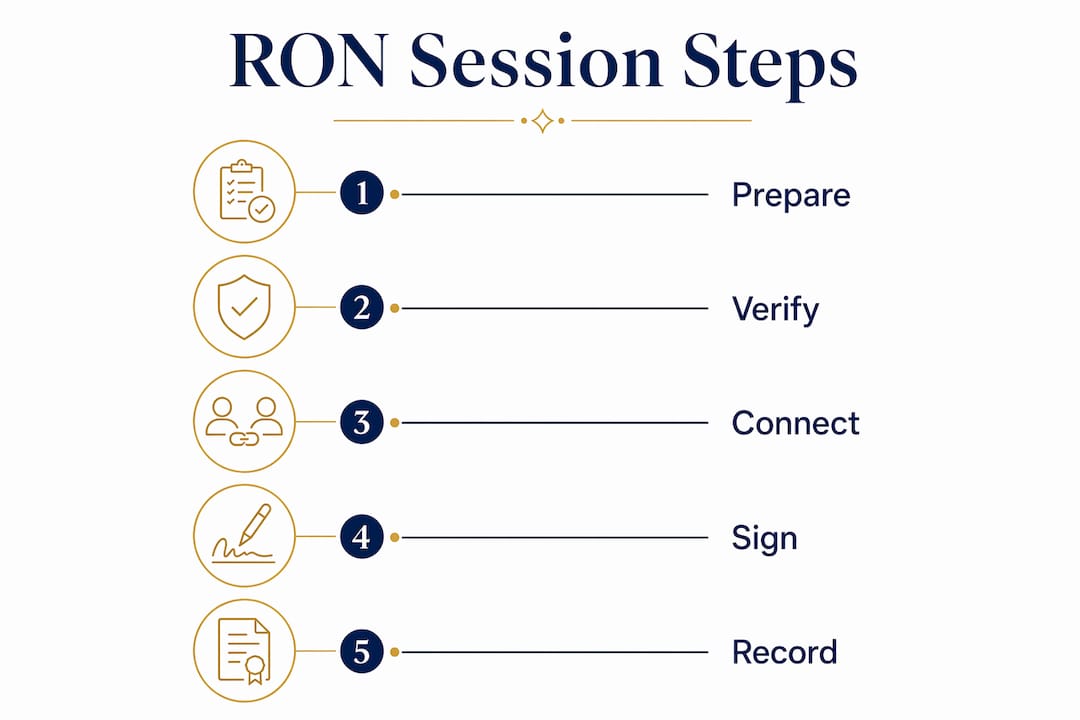
The typical remote notarization process for a real estate closing follows a clear sequence. Deviating from any step can invalidate the session.
-
Schedule your session. Book with a certified RON notary through a compliant platform. Premier Notary & Apostille Services offers online scheduling for real estate document notarization with same-day availability.
-
Prepare your documents. Upload all required documents to the platform before the session. Review every page so you know where signatures are required. Missing a signature field is one of the most common reasons a deed gets rejected for recording.
-
Connect via secure video. Join the session from a private, well-lit space. The notary will confirm your identity on camera before any documents are reviewed.
-
Complete identity verification. Present your government-issued ID to the camera for credential analysis. Then complete the KBA quiz. If you fail KBA, the session stops. You may retry, but repeated failures can lock you out temporarily.
-
Sign documents live. State RON statutes define “in-presence” as signing while the notary watches via live video. Pre-applied signatures are invalid in most states. Sign each document only when the notary directs you to do so.
-
Notary applies the digital seal. The notary affixes a tamper-evident digital seal and certificate to each notarized document. This seal is compliant with MISMO standards and preserves chain-of-custody integrity.
-
Electronic transmission. The platform sends the executed documents to your title company and, where applicable, directly to the county recorder via e-recording. Counties with e-recording partnerships accept these documents immediately, which accelerates recording time compared to mailing paper originals.
-
Session recording is stored. The platform retains the full video recording for the period required by your state’s RON statute, typically 5–10 years.
Pro Tip: Test your camera, microphone, and internet speed at least 30 minutes before your session. A dropped connection mid-signing can require you to restart the entire identity verification process.
What common errors occur during real estate RON sessions?
Errors in notarization can cause a deed or mortgage to be rejected for recording, which exposes all parties to legal and financial risk. Most mistakes fall into predictable categories.
- Identity verification failure. Expired IDs, damaged IDs, or names that do not match public records will fail credential analysis. Bring a current, undamaged government-issued ID and confirm your name matches your credit file.
- Pre-signing documents. Signing before the notary witnesses you live violates the in-presence requirement in most RON states. Never sign anything before the notary instructs you to.
- Jurisdictional mismatches. Not every state permits RON for every document type. Some states exclude certain deed types or require a licensed attorney to be present. Verify your state’s specific rules before booking.
- County recorder incompatibility. Some rural counties still have format requirements that do not accept electronically transmitted documents. Title companies typically verify this, but you should confirm independently.
- Platform or technology failure. Poor internet, a frozen camera, or an incompatible browser can interrupt the session. Use a wired internet connection when possible and close all unnecessary applications.
- Missing notary certificate. A notarized document without a complete notary certificate is invalid. RON platforms enforce this automatically, but review every page before the session ends.
“Communication with title agents and notaries is critical to comply with in-presence requirements and ensure document validity. A five-minute call before closing day prevents the most common RON errors.”
For a deeper look at what goes wrong and how to prevent it, the common notarization mistakes guide from Premier Notary & Apostille Services covers the full list with practical fixes.
Why does remote notarization work well for real estate closings?
RON delivers three concrete advantages over traditional in-person notarization: speed, audit trail quality, and scheduling flexibility. Faster closings result from eliminating travel, coordinating fewer physical locations, and transmitting documents electronically the moment the session ends.
The cost comparison also favors RON in most transactions. Technology fees for a RON session typically run $25–$50. Mobile notaries, by contrast, may charge $50–$200 in travel fees on top of standard notarization charges. That gap widens when a closing requires multiple signers in different locations.
| Factor | RON | Traditional in-person |
|---|---|---|
| Location requirement | Any device with camera and internet | Physical presence required |
| Technology fee | $25–$50 | None |
| Travel cost | None | $50–$200 (mobile notary) |
| Audit trail | Mandatory video recording | Paper log only |
| Recording speed | Immediate via e-recording | Days to weeks by mail |
| Security verification | Credential analysis plus KBA | Visual ID check only |
The one area where traditional notarization retains an edge is client comfort. Some clients prefer in-person notarization for high-stakes documents like estate-planning instruments, where personal trust matters as much as legal validity. That preference is legitimate and worth respecting. For standard real estate closings, however, RON’s superior audit trail and speed make it the stronger choice in most cases.
Maintaining legal digital file storage practices alongside your RON records adds another layer of protection for long-term document security.
Pro Tip: Ask your RON platform whether it integrates directly with your title company’s closing software. Direct integration eliminates manual document transfers and reduces the chance of version errors.
Key takeaways
Remote online notarization for real estate is legally valid in nearly 45 states, requires MISMO-compliant platforms, and delivers faster closings, stronger audit trails, and lower travel costs than traditional in-person notarization.
| Point | Details |
|---|---|
| Legal validity | RON is authorized in nearly 45 states plus D.C. for real estate documents. |
| Two-factor identity check | Credential analysis and KBA are both required before any signing begins. |
| Sign live, not before | Pre-signing violates in-presence rules and can invalidate your deed. |
| Verify county acceptance | Confirm your county recorder accepts e-recorded documents before closing day. |
| Cost advantage | RON technology fees ($25–$50) are lower than mobile notary travel fees ($50–$200). |
What I’ve learned from watching RON reshape real estate closings
The shift to remote online notarization is not just a convenience upgrade. It changes who controls the closing timeline. Buyers in different states, sellers relocating mid-transaction, and investors managing multiple properties simultaneously all gain real scheduling power that in-person notarization never offered.
What I’ve seen consistently is that the professionals who get the most out of RON are the ones who prepare before the session, not during it. They confirm county recorder acceptance early. They brief their clients on the KBA quiz so identity verification does not catch anyone off guard. They choose platforms that meet MISMO standards rather than the cheapest option available.
The trust question is real, and I do not dismiss it. For a first-time homebuyer signing the biggest document of their life, a video call can feel less personal than sitting across from a notary. The right answer is not to force RON on every client. It is to offer it clearly, explain the security measures honestly, and let the client decide. Most choose RON once they understand that the notarization process is just as rigorous online as in person.
The future of real estate closings is hybrid. RON handles the routine transactions efficiently. In-person notarization remains available for clients who want it. The professionals who understand both formats will serve their clients better than those who default to one or the other.
— Premier
Premier Notary & Apostille Services for your real estate notarization needs
Premier Notary & Apostille Services works with real estate professionals and homebuyers who need reliable, compliant document authentication without delays. With over 1,900 documents processed and a 5-star rating on Google, the team brings verified expertise to every closing.

Whether you need a deed, mortgage, or closing package notarized, Premier Notary & Apostille Services offers same-day processing, certified electronic notaries, and a guided intake process that walks you through every requirement. Transparent pricing means no surprises on closing day. Book your real estate notarization online and get your documents processed quickly, correctly, and with full legal compliance.
FAQ
What is remote online notarization in real estate?
Remote online notarization (RON) is the process of notarizing real estate documents through a live, secure audio-video session with a commissioned notary. It is legally valid in nearly 45 states plus D.C. and carries the same legal weight as in-person notarization.
How does identity verification work for RON?
RON platforms require two steps: credential analysis of your government-issued ID and a knowledge-based authentication quiz drawn from your credit and public records. Both must pass before the notary can witness your signature.
Can I sign documents before the RON session starts?
No. Most RON states require signatures to be applied live while the notary watches via video. Pre-signed documents violate in-presence requirements and can cause your deed or mortgage to be rejected for recording.
How much does a RON session cost for real estate?
Technology fees for RON sessions typically range from $25–$50. That is generally lower than mobile notary travel fees, which can reach $50–$200 on top of standard notarization charges.
Does every county accept electronically notarized real estate documents?
Not all counties accept e-recorded documents. Some rural or smaller counties still require paper originals. Always verify county recorder acceptance with your title company before scheduling a RON session.