Notarization Tips to Prevent Closing Delays

Notarization Tips to Prevent Closing Delays

Most real estate closings that fall apart at the last minute trace back to one preventable cause: a notarization error. Every signature, initial, and date must occur in the physical presence of the notary. Pre-signing even a single document can trigger a package rejection and push your funding date back by days. Here are the core notarization best practices to keep your closing on track:
- Verify the signer’s government-issued photo ID before any document is touched. The name on the ID must match the name printed in the loan package exactly.
- Confirm the correct notarial certificate type for each document. Using a jurat where an acknowledgment is required creates a legal defect that requires re-execution.
- Test your notary stamp on scrap paper before the appointment. A smudged or incomplete seal causes county recorders to reject recorded documents, which is especially damaging on purchase transactions with firm close-of-escrow deadlines.
- Do a page-by-page review of the entire package after signing, before leaving the appointment. Missing initials and incorrect dates are far easier to fix on the spot than after the package has been returned.
- Use a checklist that covers document count, certificate types, signer name variations, and stamp readiness.
- Carry a backup notary stamp, particularly in conditions where ink dries quickly or paper texture affects impression quality.
- Confirm the signing date with the title company or escrow officer if there is any ambiguity near a date boundary.
Pro Tip: Call the title company or escrow officer before the appointment to confirm any special instructions, acceptable name variations, and the exact signing date. Five minutes on the phone prevents hours of rescheduling.
Table of Contents
- What legal requirements and common notarization errors cause closing delays?
- How should you prepare and coordinate for closing day notarizations?
- What are the pros and cons of using power of attorney at closing?
- What do industry experts say about the “Golden Rule” of notarization?
- Premier Notary & Apostille Services makes real estate notarizations straightforward
- FAQ
- Key Takeaways
What legal requirements and common notarization errors cause closing delays?
Real estate notarizations carry legal weight that standard notarizations do not. A loan package involves dozens of time-sensitive documents where every field must be completed exactly as the lender or title company requires. One misstep can cascade through the entire package and push a funding date back by days.
The most frequent errors that cause rejections include:
- Pre-signed documents. Any signature, initial, or date completed before the signer appears in front of the notary violates the foundational rule of notarization. Title companies reject these packages outright.
- Expired or mismatched identification. Accepting an expired ID or one that does not match the loan documents is a compliance failure. The notary must stop the appointment and notify the escrow officer immediately.
- Wrong name variations. A signer who uses a nickname or abbreviation instead of their full legal name creates a discrepancy that title companies flag. Confirm the exact name on the ID before the first signature.
- Incorrect or missing dates. Pre-dating or forgetting to date a field is a serious compliance issue. The signing date, document date, and effective date can all differ and must match lender instructions precisely.
- Smudged or illegible notary seals. A worn stamp or poor ink pressure causes recorders to reject the document entirely.
- Wrong certificate wording. Loan documents typically require acknowledgment certificates. Using a jurat instead is a legal defect requiring the document to be re-executed.
Lenders and title companies have zero tolerance for these errors on purchase transactions. The cost is not just paperwork. A missed closing date can trigger financial penalties for all parties involved.
How should you prepare and coordinate for closing day notarizations?
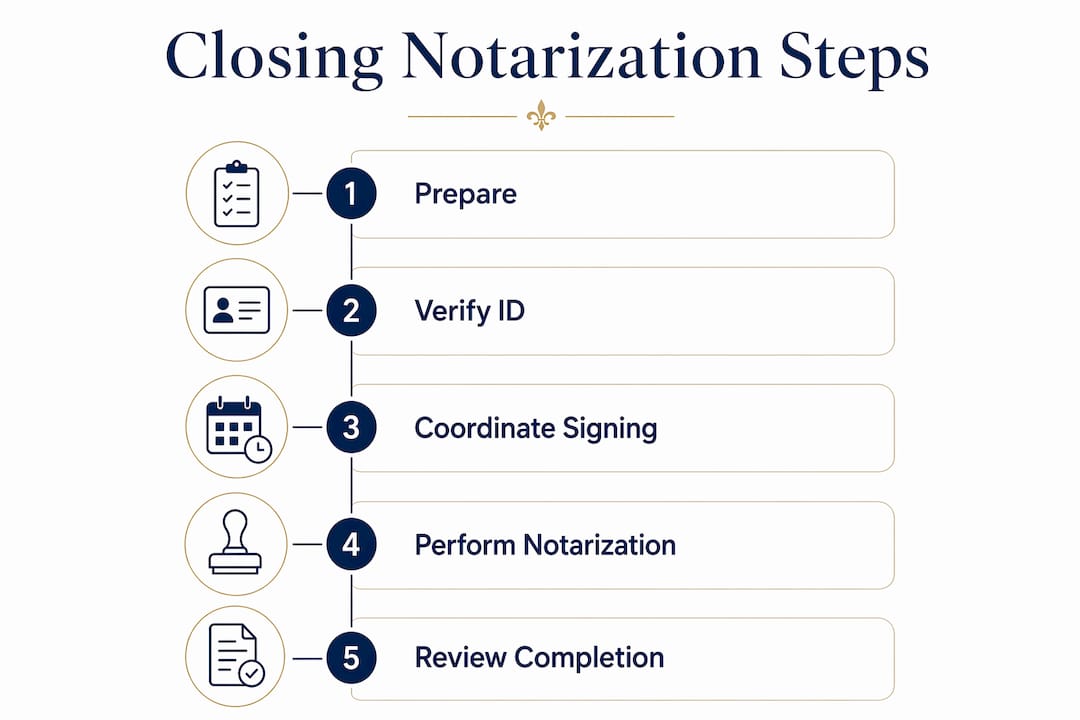
Preparation before the appointment is where most delays are actually prevented. A structured pre-appointment checklist dramatically reduces the chance of a package being rejected.
Before the appointment, work through these steps:
- Review all lender and escrow instructions. Confirm the signing date, acceptable name variations, and any special requirements.
- Count all pages in the package and verify the count matches the instructions.
- Identify every document requiring notarization and confirm the correct certificate type for each one.
- Confirm signer name variations in advance, especially for married signers or those with hyphenated surnames.
- Test your notary stamp and bring your notary journal.
- Have a direct contact number for the title company or escrow officer in case issues arise mid-signing.
Scheduling coordination matters just as much as document preparation. Premature signings, where a borrower signs before the notary arrives or before the correct date, are a common source of closing setbacks. Confirm the appointment time with all parties and never allow signing to begin until the notary is physically present.
Remote online notarization (RON) is worth considering for supplemental documents. eNotarization reduces printing, shipping, and scanning friction and creates a built-in audit trail, which is particularly useful for powers of attorney and other documents handled outside the main closing package. The Mortgage Bankers Association tracks RON adoption across states at mba.org.

Pro Tip: Advise clients never to sign or initial any document before the notary is present and seated. Even a single pre-signed page can invalidate the entire package.
For a detailed breakdown of which real estate documents require notarization, essential document guidance from Premier Notary & Apostille Services covers the full list.
What are the pros and cons of using power of attorney at closing?
A power of attorney (POA) lets a trusted agent sign closing documents when the principal cannot be present. Used correctly, it prevents delays caused by an unavailable buyer or seller. Used incorrectly, it creates some of the most stubborn delays in the entire mortgage process.
Benefits of using a POA at closing:
- Allows closing to proceed when the principal is traveling, ill, or otherwise unavailable.
- Reduces the need to reschedule, which protects the close-of-escrow deadline.
- Can be executed in advance and notarized separately from the main closing package.
Risks and common pitfalls:
- Vague or imprecise POA wording causes lenders and title companies to reject the document. The POA must specifically authorize the agent to execute real estate transactions.
- The POA itself must be notarized to the same legal standard as the closing documents. A defective POA notarization is a gating item that quietly stalls loan velocity.
- Misalignment between the closing documents and the supplemental POA notarization is one of the most common sources of fragmented mortgage workflows.
- Lenders must approve the POA before closing. Submitting it at the last minute almost always causes a delay.
Alternatives to POA use:
- Reschedule the closing to a date when the principal can attend in person.
- Use remote online notarization so the principal can participate from another location.
- For military personnel, specific federal provisions may apply. Check with your lender and title company for applicable options.
Get the POA approved by the title company and lender well before the closing date. For guidance on notarizing POA documents correctly, power of attorney notarization details from Premier Notary & Apostille Services walk through the requirements step by step.
What do industry experts say about the “Golden Rule” of notarization?
The single most cited cause of package rejection is violating what experienced signing agents call the “Golden Rule”: no signature, initial, or date should appear on any document before the signer physically appears before the notary. Title companies and lenders treat this as an absolute standard, not a guideline.

The most trusted notaries build their reputations on thoroughness rather than speed. A complete page-by-page audit of the signed package before leaving the appointment is the professional standard, and it is the most effective single action to catch defects before they become funding delays. Skipping this review to save ten minutes costs everyone far more time when a rejection comes back the next morning.
Lenders treat overlooked notarizations, such as powers of attorney and trust certifications, as gating items that quietly slow loan velocity even though they fall outside the main signing event. These documents are often handled with diffuse responsibility and limited visibility, which is exactly why they cause silent delays in otherwise clean transactions. Integrating them into the same preparation checklist as the main package closes that gap.
Common notarization mistakes and how to avoid them are covered in detail at notarization mistakes from Premier Notary & Apostille Services, including a practical checklist built around the errors that cause the most rejections.
Pro Tip: Keep a detailed record of every notarization act in your journal, including the document name, signer identification used, and date. If a defect is discovered after the package is returned, this record is your fastest path to resolution.
Document rejection patterns in real estate closings follow a consistent profile. Missing signatures or initials are the most frequent cause, followed by seal defects, incorrect certificate wording, and name discrepancies. A thorough post-signing review addresses all four in a single step. For context on how document rejection parallels appear across other authentication processes, document rejection causes offer useful parallels from the broader document verification field.
Premier Notary & Apostille Services makes real estate notarizations straightforward
Real estate closings move fast. One rejected document can cost you the closing date entirely.
Premier Notary & Apostille Services has processed over 1,900 documents with a 5-star rating on Google reviews, specializing in real estate document notarization with same-day processing options. The guided intake process walks you through exactly what to bring, what to expect, and how each document needs to be executed. Pricing is transparent with no surprises at the appointment. Whether you need a standard closing package notarized or a supplemental POA handled correctly alongside your main documents, the team at Premier Notary & Apostille Services prioritizes accuracy and document security at every step. Book your real estate notarization today and get your closing done right the first time.
FAQ
What is the “Golden Rule” of notarization?
No signature, initial, or date should appear on any document before the signer physically appears in front of the notary. Violating this rule is one of the most common causes of package rejection by title companies.
How do you speed up the closing process?
Prepare a pre-appointment checklist covering signer ID, document count, certificate types, and stamp readiness. Confirm the signing date and all special instructions with the title company before the appointment.
What should you do if a buyer keeps delaying closing?
Contact the title company or escrow officer immediately to identify the specific document or notarization issue causing the hold. Prompt communication gives the closing team time to arrange a correction or re-execution before the funding deadline passes.
What identification is required for real estate notarization?
Every signer must present valid, current, government-issued photo identification before any notarization is performed. The name on the ID must match the name on the loan documents exactly.
How does Premier Notary & Apostille Services help prevent closing delays?
Premier Notary & Apostille Services provides experienced notaries who follow a guided intake process, verify all document requirements before the appointment, and offer same-day processing to keep real estate closings on schedule.
Key Takeaways
Preventing closing delays comes down to preparation, correct identification, and a thorough post-signing review before the package leaves the appointment.
| Point | Details |
|---|---|
| Follow the Golden Rule | No signature, initial, or date should appear before the signer is physically present with the notary. |
| Verify ID before signing | Government-issued photo ID must be current and match the name on all loan documents exactly. |
| Use the right certificate | Loan documents typically require acknowledgment certificates; using a jurat instead creates a legal defect requiring re-execution. |
| Review every page before leaving | A page-by-page audit after signing catches missing initials, seal defects, and date errors before they cause a rejection. |
| Premier Notary & Apostille Services | Offers same-day real estate notarization with a guided intake process, transparent pricing, and over 1,900 documents processed. |