How to Notarize a Passport Copy Step by Step

How to Notarize a Passport Copy Step by Step
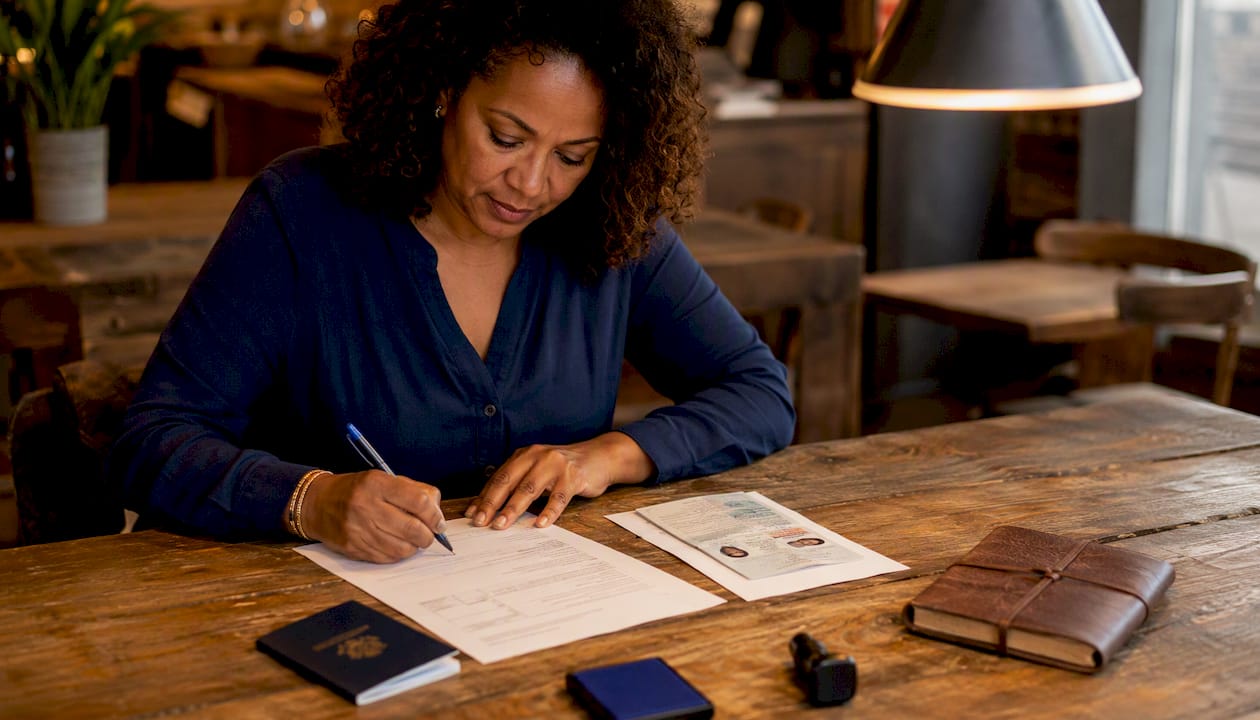
You can get a legally valid notarized passport copy in the U.S. The fastest path for most people is a document-custodian jurat: you swear under oath that your photocopy is accurate, and a notary notarizes that sworn statement. In states that explicitly allow it, a notary can instead complete a true-copy certificate directly. Which method works depends on your state and what the recipient will accept.
Before you book an appointment, take these steps:
- Check your state’s rules. The National Notary Association maintains state-by-state guidance on whether notaries may certify passport copies.
- Confirm what the recipient accepts. A bank, embassy, or school may require a specific certificate type, or even a State Department certified copy.
- Bring your original passport and a clear, full-size photocopy of the biographic data page.
- Book a notary — or contact Premier Notary & Apostille Services for in-person, mobile, or same-day service.
Table of Contents
- Why state law and document type change everything
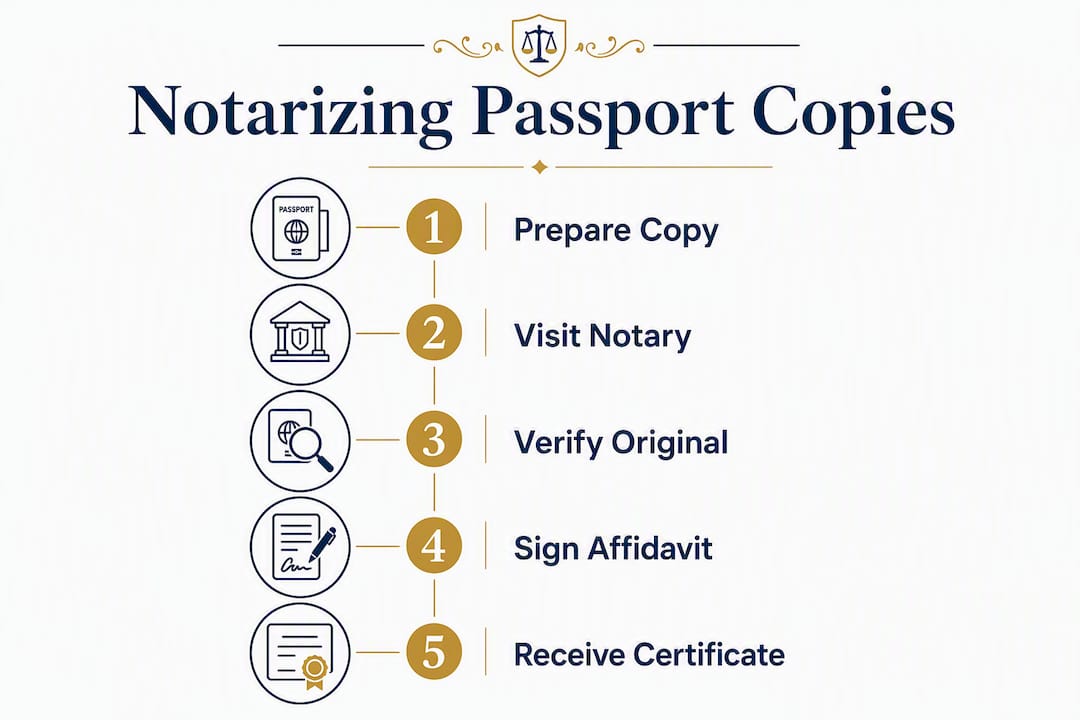
- Step-by-step: how to notarize a passport copy in the U.S.
- Sample wording you can bring to the notary
- When a notarized copy is not enough: apostilles and State Department certified records
- Common rejection reasons and how to fix them before you leave
- Key Takeaways
- Why professional help reduces risk on high-stakes filings
- Premier Notary & Apostille Services passport and apostille services
- Useful sources and further reading
- FAQ
Why state law and document type change everything
The phrase “notarize a passport copy” covers two legally distinct acts, and mixing them up is the most common reason documents get rejected.
True-copy certificate: The notary personally compares your original passport to the photocopy and certifies they match. This is clean and simple, but some states prohibit it for passports because a U.S. passport is a federal document. California, for example, restricts direct copy certification for federal records. Other states explicitly permit it. Many fall somewhere in between with no clear statutory guidance either way.

Document-custodian jurat: When direct copy certification is off the table, the workaround is a sworn affidavit. You, as the passport holder, sign a statement declaring the copy is true and accurate. The notary then notarizes your signature and oath. The legal certification shifts to you, not the notary, which protects both parties and works in virtually every state.
The NNA’s three-question checklist is the right starting point: Does your state allow copy certification at all? Does it specifically exclude passports? Does the request meet any other copy-certification requirements your state imposes? If any answer is unclear, the custodian jurat is the safer choice.
Procedural rules also vary. Florida requires the notary to supervise the copying of the original. Arkansas requires the notary to retain a copy for their records. These details matter because skipping a required step can void the certificate.
Pro Tip: Always confirm the recipient’s exact acceptance criteria before your appointment. A notarized custodian jurat is not the same as a State Department certified copy, and some institutions will only accept one of them.
Step-by-step: how to notarize a passport copy in the U.S.
Follow these steps in order. Steps 1 and 2 happen before you leave the house; the rest happen at the notary appointment.
- Confirm what the recipient requires. Ask the bank, embassy, school, or agency whether they accept a document-custodian jurat, a true-copy certificate, or only a State Department certified copy. Get this in writing if possible.
- Check your state’s rules. Visit your state Secretary of State’s notary page or the NNA state-law knowledge center to confirm which method your state allows for passport copies.
- Make a clear, full-size photocopy. Copy the biographic data page (photo, name, passport number, expiration date). The copy must be legible; a blurry or cropped scan will likely be rejected.
- Prepare your documents to bring:
- Original passport
- Full-size photocopy of the biographic data page
- A second government-issued ID if the notary requests it
- A printed sworn-statement template or the requestor’s required wording (see Section 4 below)
- Any written instructions from the receiving authority
- Present the original and copy to the notary. The notary will compare them. In states like Florida, the notary must supervise or perform the copying themselves, so call ahead.
- Sign the jurat or sworn statement in front of the notary. Do not pre-sign. The notary must witness your signature.
- The notary completes the certificate. They sign, apply an ink seal, and add their printed name and commission expiration date.
- Before you leave, verify the seal. Check that the ink seal is legible, the commission expiration date is present, and the notary’s printed name is clear. Test-photograph the document to confirm it scans cleanly.
Fee note: Standard notary fees vary by state, typically ranging from a few dollars to around $15 per signature, though mobile or same-day services carry additional fees. If the recipient requires an official certified copy from the U.S. Department of State, budget a $50 certification fee plus several weeks of processing time.
Remote online notarization (RON) is available in many states and may work for a custodian jurat, but confirm with the recipient first. Many foreign governments and some domestic institutions do not accept remotely notarized copies for certified-copy requirements.
Sample wording you can bring to the notary
Two templates cover most U.S. situations. Print the one that fits your state and hand it to the notary. They will use it as a reference and substitute the correct state-specific certificate language.
Certificate of true copy (for states that allow it)
CERTIFICATE OF TRUE COPY
State of _______________ County of _______________
I, [Notary Full Name], a Notary Public in and for the above State and County, do hereby certify that the attached document is a true, exact, complete, and unaltered photocopy of the original [U.S. Passport, Passport No. _______________] presented to me by [Document Holder Name] on [Date].
Notary Public Signature
Printed Name: _______________ Commission Expires: _______________ [Notary Seal]
Document-custodian jurat (sworn declaration — works in most states)
SWORN DECLARATION OF DOCUMENT CUSTODIAN
I, [Your Full Name], declare under penalty of perjury that the attached photocopy of my U.S. Passport (Passport No. _______________, issued [Date], expiring [Date]) is a true, accurate, and complete copy of the original document, which is in my possession.
Declarant Signature
Subscribed and sworn to before me on [Date] by [Your Full Name], who is personally known to me or proved identity through [ID Type].
Notary Public Signature
Printed Name: _______________ Commission Expires: _______________ [Notary Seal]
How to use these templates: Bring a printed copy to the appointment. Tell the notary which template you have and ask them to confirm it matches their state’s required certificate language. Never pre-fill the notary’s signature or seal area. The notary completes that section only after witnessing your signature.
For a deeper look at common certificate errors, see Premier Notary & Apostille Services’s guide on notarization mistakes before your appointment.
When a notarized copy is not enough: apostilles and State Department certified records
A notarized custodian jurat works for many domestic purposes. For international filings, it often falls short.
If the receiving country is a member of the Hague Convention, an apostille is typically required for document legalization, and a notarized affidavit will not substitute for it. The apostille must be attached to an officially certified copy, not a privately notarized one.
The process for international use usually runs in two stages:
- Request a certified copy from the U.S. Department of State. Submit a written records request to the Office of Records Management. The State Department charges a $50 certification fee per document. Processing can take several weeks, so plan accordingly.
- Request an apostille. Once you have the State Department certified copy, submit it to the U.S. Secretary of State’s Office of Authentications or your state’s Secretary of State, depending on the destination country’s requirements.
Key check before you start: Confirm with the foreign institution or embassy whether they require an apostille on a State Department certified copy, or whether a notarized custodian jurat is acceptable. Skipping this step is the most common reason passport documents fail for international filings — and it typically forces an expensive restart.
For a full breakdown of what apostilles cover and where they fall short, Premier Notary & Apostille Services’s apostille limitations guide and the apostille vs. authentication overview are useful starting points.
If you are relocating internationally and need to verify country-specific document requirements, the Digital Nomad In Spain eligibility checker is one example of a country-specific resource that outlines what documentation foreign authorities expect.
Common rejection reasons and how to fix them before you leave
Most rejections are preventable. Check these before you walk out of the notary’s office.
- Illegible notary seal. The ink seal must be clear and fully readable. If it smears or fades, ask the notary to re-stamp before you leave.
- Missing commission expiration date. This is one of the most frequent causes of rejection. Confirm it appears on the certificate.
- Wrong certificate type. A jurat and a true-copy certificate are not interchangeable. If the recipient specified one, confirm that is what the notary completed.
- Poor-quality photocopy. A blurry, cropped, or incomplete copy will be rejected. The biographic data page must be fully visible and legible.
- Recipient requires an apostille or State Department certified copy. A notarized affidavit will not satisfy this requirement. If you discover this after the fact, you will need to restart with the State Department process.
- Notary’s printed name missing. Some jurisdictions require the notary’s printed name in addition to their signature. Verify it is there.
If your document is rejected: Identify the specific reason in writing from the receiving party. Then decide: return to a notary with the correct certificate wording, or initiate a State Department certified-copy request if an official record is required. Avoid re-notarizing without first confirming the new certificate will be accepted.
For a broader list of errors that cause documents to fail, the Premier Notary & Apostille Services notarization mistakes guide covers the most common ones with practical fixes.
Key Takeaways
Getting a notarized passport copy right the first time requires confirming the recipient’s exact requirement before choosing between a document-custodian jurat, a state-authorized true-copy certificate, or a State Department certified copy with apostille.
| Point | Details |
|---|---|
| Confirm recipient requirements first | Ask whether they accept a jurat, true-copy certificate, or only a State Department certified copy before booking. |
| Check your state’s rules | Some states prohibit notaries from certifying passport copies directly; use the NNA state-law resource or your Secretary of State’s page. |
| Bring the right documents | Original passport, full-size legible photocopy, a second ID if requested, and a printed template or the requestor’s required wording. |
| International use needs more steps | A State Department certified copy costs $50 per document and processing takes several weeks; an apostille requires that certified copy as the base document. |
| Premier Notary & Apostille Services handles the full chain | Premier Notary & Apostille Services offers in-person, mobile, and same-day notarization for passport jurats and true-copy certificates, plus apostille routing for international filings. |
Why professional help reduces risk on high-stakes filings
The step-by-step process above is manageable for a routine domestic request. For time-sensitive or international filings, the margin for error is much smaller, and the cost of a mistake is higher.
Premier Notary & Apostille Services has processed over 1,900 documents and holds a 5-star rating on Google. That volume matters because passport and apostille work involves a specific chain: correct certificate type, legible seal, proper jurat language, and, for international use, correct routing to the State Department and apostille authorities. A professional service handles that chain as a single workflow rather than leaving each step to the client to coordinate.
The specific advantages are practical. A professional notary confirms the correct certificate language for your state before the appointment starts. They verify the recipient’s acceptance criteria. For international filings, they route the document to State Department certified-copy processing and apostille services without requiring the client to manage each agency separately. And they apply quality control at the appointment: seal legibility, commission expiration, printed name, and certificate completeness are checked before the document leaves the office.
Passport documents contain sensitive identity information. Premier Notary & Apostille Services handles all documents with secure chain-of-custody procedures, whether the appointment is in-person, mobile, or handled via secure mail.
Premier Notary & Apostille Services passport and apostille services
Premier Notary & Apostille Services offers a direct alternative to managing the passport notarization process on your own. The concrete difference: same-day appointments, correct certificate language confirmed upfront, and a single point of contact for the full chain from notarized jurat through State Department certified-copy requests and apostille processing.
Services available include in-person and mobile notarization for passport jurats and true-copy certificates, affidavit and sworn-statement notarization, State Department certified-copy coordination, apostille handling for Hague Convention and non-Hague countries, and expedited same-day options for urgent filings. All appointments include secure document handling and privacy protection for identity documents.
Confirm your recipient’s acceptance criteria first. Then, when you want a professional to manage the correct certificate and chain of custody, book a passport notarization or schedule an affidavit appointment online. Mobile appointments are available if you cannot come to the office.
Useful sources and further reading
The authoritative resources for passport copy notarization in the U.S.:
- National Notary Association — State Laws: The NNA’s state-by-state notary law database is the most reliable place to check whether your state permits true-copy certification for passports and what procedural requirements apply.
- NNA — Are Notaries Allowed to Notarize Passports?: Specific NNA guidance on the three-question checklist for passport copy certification and the custodian-jurat alternative.
- Your state Secretary of State’s notary page: Search “[your state] Secretary of State notary public” for the official copy-certification rules that apply to your commission. Iowa’s notary handbook at sos.iowa.gov is one example of the level of detail state offices provide.
Before you proceed: Always confirm the requestor’s exact acceptance criteria in writing. The difference between a notarized jurat and a State Department certified copy is not a technicality — it determines whether your document will be accepted at all.
For more in-depth guidance on passport and travel document notarization, visit the Premier Notary & Apostille Services blog.
FAQ
Can a notary certify a copy of a passport?
It depends on your state. Some states allow notaries to issue a true-copy certificate for a passport; others, including California, restrict or prohibit it for federal documents. Where direct certification is not allowed, the standard alternative is a document-custodian jurat in which you swear the copy is accurate and the notary notarizes your oath.
How do I certify a copy of my passport in the U.S.?
Make a clear, full-size photocopy of the biographic data page, then visit a notary with your original passport. In most states, you sign a sworn statement declaring the copy is true, and the notary notarizes that statement. In states that permit it, the notary may complete a true-copy certificate directly after comparing the original and the copy.
How do I notarize a passport copy in Florida?
Florida requires the notary to supervise or perform the copying of the original document. Bring your original passport to the appointment and let the notary make the copy. The notary then completes the certificate and applies their seal. Call ahead to confirm the notary’s procedure before your appointment.
Can you notarize a passport copy in Texas?
Texas notaries may certify copies of documents under Texas law, but confirm with your specific notary and the recipient that a true-copy certificate or custodian jurat will be accepted. The NNA’s state-law resource is the most reliable place to verify current Texas copy-certification rules before proceeding.
When does a notarized copy not work for international use?
When the destination country is a Hague Convention member and requires an apostille, a notarized custodian jurat is not sufficient. You must first obtain a State Department certified copy ($50 fee per document, processing takes several weeks), then attach an apostille through the appropriate U.S. authority. Premier Notary & Apostille Services handles both steps as part of its apostille service.
This article is general information, not legal advice. Notary laws vary by state and change over time. Confirm current rules with your state Secretary of State, the National Notary Association, or a qualified legal professional before proceeding.