Loan Signing Notarization Step by Step: 2026 Guide

Loan Signing Notarization Step by Step: 2026 Guide

Loan signing notarization is the process of verifying a signer’s identity and witnessing their signature on loan documents to give those documents legal authenticity and deter fraud. The industry term for professionals who specialize in this work is “notary signing agent,” though the broader notarization process guide applies to any commissioned notary handling loan documents. A notary does not validate loan terms or offer legal advice. The notary’s sole job is to confirm identity and witness execution. Understanding this distinction is the foundation of every accurate loan signing notarization step by step.
What documents and tools do you need before a loan signing?
Preparation determines whether a signing goes smoothly or stalls at the table. Loan signing agents should confirm appointment details and review all instructions thoroughly before meeting signers. That single step prevents the majority of errors and delays.
Required notary tools
Every notary must bring the following to a loan signing:
- Valid notary commission issued by your state
- Official notary seal or stamp (ink or embosser, per state rules)
- Notary journal for recording each act
- Black or blue ink pen (check lender instructions)
- Acknowledgment and jurat certificate forms as backup
Accepted government-issued IDs
State laws specify which IDs qualify for signer verification. The most widely accepted forms include:
- Driver’s license or state-issued ID card
- U.S. passport or passport card
- Military ID
- Permanent resident card
Pro Tip: Always check your state’s specific ID requirements before the appointment. Some states accept foreign passports; others do not.
Loan documents that commonly require notarization
Loan documents often signal the need for notarization through explicit certificate blocks printed near signature lines. Common documents in a real estate loan package include the Deed of Trust or Mortgage, the Note, the Right to Cancel form, and various disclosure statements. Not every page requires a notary seal, but every page with a certificate block does.
| Document type | Notarization required? |
|---|---|
| Deed of Trust / Mortgage | Yes |
| Promissory Note | Varies by state |
| Right to Cancel | No (signature only) |
| Loan disclosures | No (signature only) |
| Compliance agreements | Sometimes |
A standard in-person loan notarization typically takes less than 15 minutes, with fees ranging from $2 to $25 per signature depending on state rules. Knowing the fee cap in your state before the appointment prevents billing disputes.
What is the step-by-step process for loan signing notarization?
The notarization process follows a fixed sequence. Skipping or reordering steps creates legal exposure for the notary and can void the transaction.
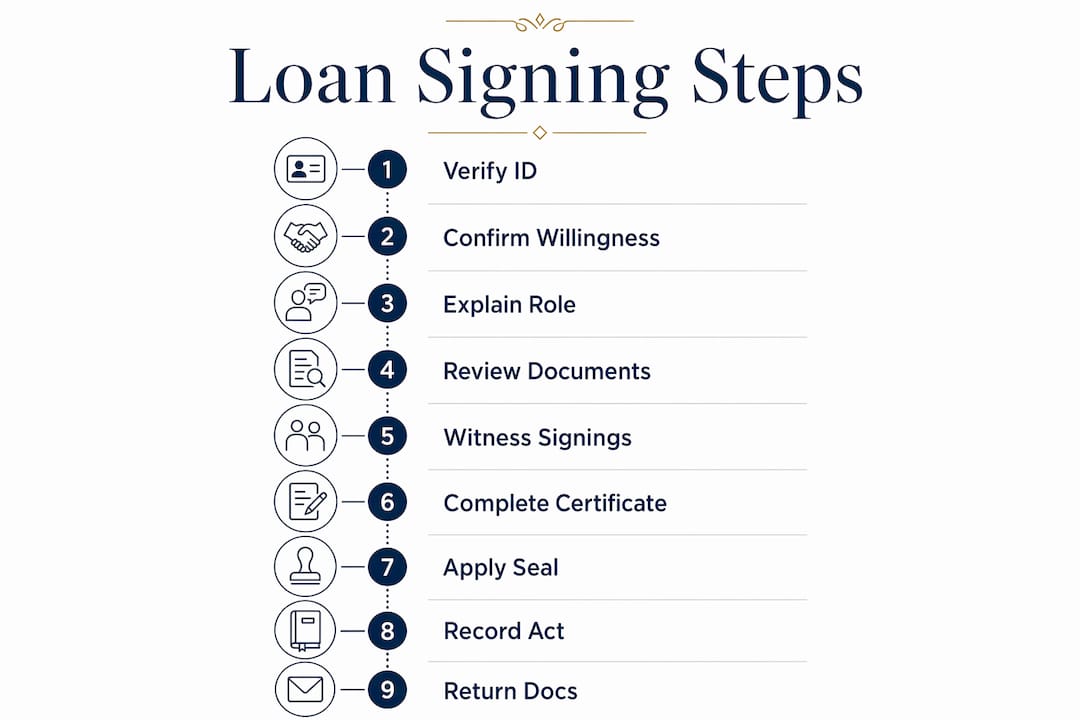
Step 1: Verify signer identity
Check the signer’s government-issued ID before any document is touched. Compare the photo, name, and expiration date. The name on the ID must match the name printed on the loan documents. Notaries act as impartial witnesses verifying signer identity and willingness. This step is non-negotiable.

Step 2: Confirm the signer is willing and aware
Ask the signer directly whether they are signing voluntarily. Watch for signs of confusion, coercion, or incapacity. A notary who proceeds with a signer who appears unwilling or incapacitated risks personal liability and invalidates the notarization.
Step 3: Explain your role and its limits
Tell the signer clearly that you are there to witness signatures, not to explain loan terms. Notaries must never provide legal advice or explain document content. If the signer has questions about rates, terms, or clauses, direct them to their lender or attorney before proceeding.
Step 4: Walk through the document package
Guide the signer page by page through the package. Point out each signature, initial, and date line. Do not skip pages. Missing a required signature or initial is one of the most common reasons a loan package gets rejected by the title company or lender.
Pro Tip: Use a colored sticky note or flag system to mark every signature and initial line before the appointment. This cuts signing time and reduces missed lines significantly.
Step 5: Witness the signer affix each signature
The signer must sign in your physical presence. You cannot notarize a document that was signed before you arrived. If you find a pre-signed document in the package, ask the signer to re-sign it in front of you on a fresh page, or contact the lender for guidance.
Step 6: Complete the notarization certificate
Fill in the certificate block completely. Include the state, county, date, and the signer’s name exactly as it appears in the document. Incomplete certificate wording is a leading cause of rejected notarizations. Cross-reference any attached certificates to the main document with a staple or notation to prevent tampering.
Step 7: Apply your seal and sign
Affix your official notary seal clearly within the certificate block. Sign your name as it appears on your commission. The seal must be legible. A smudged or cut-off seal can invalidate the entire notarization.
Step 8: Record the act in your notary journal
Enter every notarization in your journal immediately. Record the date, time, document type, signer’s name, ID type and number, and fee charged. A thorough notary journal with complete entries creates a legally defensible permanent record. This protects you if a dispute arises months or years later.
Step 9: Return documents per instructions
Follow the lender or title company’s return instructions exactly. Some packages ship overnight; others go to a local escrow office. Confirm the deadline before you leave the signing table.
What mistakes should you avoid during loan signing notarization?
Even experienced signing agents make errors that delay closings or create liability. Knowing the most common mistakes in advance keeps your signings clean.
- Name mismatches: A mismatch between the name on the ID and the loan documents is the most common cause of signing delays. Request supporting documentation or ask the lender to correct the documents before the appointment.
- Incomplete journal entries: Skipping fields in your notary journal weakens your legal protection. Every entry must be complete.
- Improper certificate wording: Using the wrong certificate type (acknowledgment vs. jurat) or leaving fields blank creates grounds for rejection. Match the certificate type to what the document requires.
- Giving legal advice: Explaining what a clause means or recommending whether to sign crosses the line. Refer signers requesting legal advice to a qualified attorney immediately.
- Handling multiple signers carelessly: When two or more signers are present, verify each identity separately and record each act individually in your journal.
- Missing pages or unclear instructions: Contact the lender or title company before the appointment if any pages are missing or instructions are ambiguous. Never guess.
“Notarization gives legal strength by verifying the signer, not by validating loan terms. Every error at the signing table traces back to a notary who confused those two roles.”
You can find a detailed breakdown of the most frequent errors in this notarization mistakes guide from Premier Notary & Apostille Services.
How has technology changed loan signing notarization?
Remote Online Notarization, known as RON, allows notaries and signers to complete the entire process over a video call using electronic documents and digital signatures. RON authorization is expanding at the state level, though not every state permits it for real estate transactions yet.
Electronically signed loan agreements are legally valid under the ESIGN Act and equivalent frameworks when a verifiable audit trail, such as a tamper-proof certificate, is present. That audit trail is what gives the digital notarization its legal weight. Without it, the electronic signature carries no more authority than a typed name.
| Feature | Traditional notarization | Remote online notarization |
|---|---|---|
| Signer location | Must be physically present | Can be anywhere with internet |
| Identity verification | Government ID in person | Knowledge-based authentication + video |
| Document format | Paper | Electronic |
| Audit trail | Notary journal + seal | Tamper-proof digital certificate |
| Fee range | $2–$25 per signature | Typically higher due to platform costs |
RON fees can exceed traditional notarization fees due to technology and compliance overhead. That cost difference is worth it for signers who cannot appear in person, but it requires careful vetting of the platform’s state authorization status. Electronic notarization adoption is expanding, but compliance with evolving regulations remains the notary’s responsibility.
For commercial transactions requiring e-notarization, Premier Notary & Apostille Services offers commercial notarization appointments that cover both in-person and remote options.
What I’ve learned from years of loan signings
After processing over 1,900 documents at Premier Notary & Apostille Services, the pattern is clear: most problems at the signing table are not caused by complex legal issues. They are caused by skipped preparation steps.
The notaries who perform the cleanest signings are the ones who read every page of the package before they walk in the door. They know which documents need a seal, which need only a witness signature, and which have certificate blocks that require specific wording. That preparation takes 20 minutes and prevents an hour of back-and-forth with the title company.
The hardest part of this job is not the paperwork. It is staying in your lane when a signer is confused or upset about their loan terms. The instinct to help is strong. But the moment you explain what a clause means or suggest whether someone should sign, you have crossed from notary to legal advisor. That distinction protects the signer, the lender, and you.
My practical advice: build a pre-signing checklist and use it every time. Confirm the appointment, review the instructions, check your tools, and verify your commission is current. Consistency beats talent in this work.
— Premier
Premier Notary & Apostille Services is ready for your loan signing needs
Real estate loan signings require accuracy, speed, and a notary who knows the process cold. Premier Notary & Apostille Services has handled over 1,900 documents with a 5-star rating on Google reviews, offering both in-person and remote notarization appointments with same-day processing options.

Whether you need a notary for a real estate loan package or a commercial transaction, the booking process is straightforward and guided. Transparent pricing means no surprises on fees. Experienced notaries handle the full document package from first signature to final return. Book your appointment directly at Premier Notary & Apostille Services and get your documents processed correctly the first time.
Key takeaways
Loan signing notarization requires strict identity verification, complete certificate wording, and a thorough journal entry for every act to be legally valid and defensible.
| Point | Details |
|---|---|
| Identity verification is first | Check the signer’s government ID before any document is touched or signed. |
| Notaries do not give legal advice | Direct signers with questions about loan terms to their lender or attorney. |
| Journal entries protect you | Record date, time, document type, ID details, and fee for every notarization. |
| Name mismatches cause delays | Confirm names match between ID and documents before the appointment. |
| RON is valid but regulated | Electronic notarizations require a tamper-proof audit trail and state authorization. |
FAQ
What is loan signing notarization?
Loan signing notarization is the act of a commissioned notary verifying a signer’s identity and witnessing their signatures on loan documents to give those documents legal authenticity. The notary does not validate loan terms or provide legal advice.
How long does a loan signing notarization take?
A standard in-person loan notarization typically takes less than 15 minutes. Complex packages with multiple signers or documents may take longer.
What ID is accepted for loan signing notarization?
Most states accept a driver’s license, state-issued ID, U.S. passport, military ID, or permanent resident card. Check your state’s specific requirements before the appointment.
Can a loan be notarized online?
Yes. Remote Online Notarization is legally valid in states that authorize it, provided the platform generates a tamper-proof audit certificate and uses approved identity verification methods under the ESIGN Act.
What happens if there is a name mismatch during a loan signing?
A name mismatch between the signer’s ID and the loan documents is the most common cause of signing delays. The notary should contact the lender or title company to correct the documents or obtain supporting documentation before proceeding. You can also review the full notarization process guide from Premier Notary & Apostille Services for additional guidance.