Lender Notarization Requirements: What You Need to Know

Lender Notarization Requirements: What You Need to Know

A lender notarization requirement is the legal mandate that a qualified, impartial notary public authenticate specific loan documents before they become enforceable. This process confirms signer identity, witnesses signatures, and creates a verified record that protects both borrowers and lenders from fraud. Specialized professionals called Notary Signing Agents, certified under standards set by the National Notary Association, handle the most complex loan packages. Whether you are closing on a home, refinancing a mortgage, or signing a commercial loan, understanding these requirements keeps your transaction on track and legally sound.
What is lender notarization requirement and why does it matter?
A lender notarization requirement defines the conditions under which a notary public must verify and authenticate loan documents. The core purpose is fraud prevention. Notarization confirms that the person signing is who they claim to be, that they signed willingly, and that the document is legally binding.
Without proper notarization, a deed of trust or promissory note can be challenged in court and declared unenforceable. That outcome can freeze a real estate transaction, delay loan funding, or expose a lender to significant financial risk. The requirement exists precisely because the stakes are high on both sides of the transaction.

The notarization process for lenders goes beyond a simple stamp. A notary must verify a signer’s government-issued photo ID and witness every signature in real time. Signers must never pre-sign documents before the notary arrives. That single rule prevents one of the most common forms of mortgage fraud.
Who can notarize lender documents?
Not every commissioned notary public is qualified to handle lender document notarization. State law requires that the notary be a neutral third party with no financial interest in the transaction.
A loan officer, mortgage broker, or anyone who earns a commission from the loan cannot legally notarize that same transaction. Doing so voids the impartiality requirement and can render the loan documents unenforceable. This rule applies even when the loan officer holds a valid notary commission.
The professionals best suited for lender notarization are Notary Signing Agents (NSAs). NSAs are commissioned notaries who complete additional training specifically for mortgage and real estate loan packages. They must also pass criminal background checks and certification exams mandated by mortgage industry standards. That extra layer of vetting protects lenders, title companies, and borrowers alike.
The consequences of using an unqualified notary are serious. Loans notarized by someone with a financial interest, or by a generic notary who executes the documents incorrectly, can face legal challenges that delay or cancel funding entirely.
Key qualifications to look for in a notary handling your loan documents:
- Active state notary commission in the state where the signing occurs
- NSA certification from a recognized industry body such as the National Notary Association
- Passed criminal background check within the last 12 months
- Errors and omissions insurance coverage
- Documented experience with multi-page mortgage packets
Pro Tip: Ask your lender or title company to confirm the notary’s NSA certification before your closing date. A quick verification call takes two minutes and can prevent a costly re-signing.
Which documents require notarization in a loan transaction?
Lender document notarization applies to a specific set of documents, not every piece of paper in a loan package. Loan documents requiring notarization typically include deeds of trust, promissory notes, affidavits, and closing disclosures. Each serves a distinct legal function.
A deed of trust transfers a security interest in the property to the lender until the loan is repaid. A promissory note is the borrower’s written promise to repay. Affidavits confirm specific facts under oath, such as the borrower’s occupancy intent. Closing disclosures summarize the final loan terms and costs.
Some documents in a loan package do not legally require notarization but are notarized anyway for added security. Lenders sometimes request notarized copies of income verification letters or authorization forms to create a stronger paper trail. The distinction matters because missing a required notarization stops funding, while skipping an optional one rarely does.
Notarization also extends beyond the closing table. Powers of attorney and affidavits that arise during underwriting require consistent process management to avoid workflow delays. Many borrowers and even some lenders overlook these mid-process documents, which creates bottlenecks that push closing dates back.
| Document | Notarization required | Primary purpose |
|---|---|---|
| Deed of trust | Yes | Secures lender’s interest in the property |
| Promissory note | Yes (varies by state) | Documents borrower’s repayment obligation |
| Affidavit of occupancy | Yes | Confirms borrower’s intended use of property |
| Closing disclosure | Yes | Verifies borrower reviewed final loan terms |
| Power of attorney | Yes | Authorizes a third party to sign on borrower’s behalf |
| Income verification letter | Sometimes | Supports loan application; notarized for added security |
For a detailed breakdown of real estate notarization documents, Premier Notary & Apostille Services publishes a practical guide covering what each document does and when notarization applies.
How do lenders manage the notarization process?
The responsibility for securing a qualified notary rests with the lender or title company, not the borrower. Lenders and title companies typically hire Notary Signing Agents who specialize in handling complex loan document packages. Borrowers generally show up, present their ID, and sign where directed.
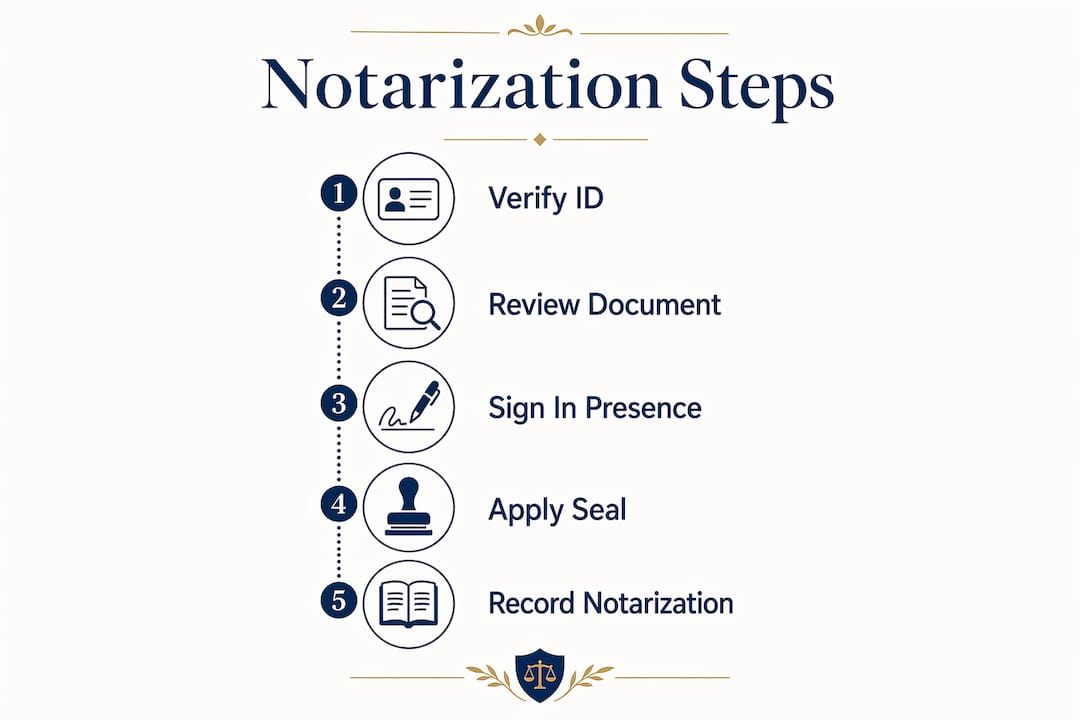
The standard workflow follows these steps:
- The lender or title company prepares the loan document package, often 100 or more pages.
- They assign a certified NSA to conduct the signing appointment.
- The NSA contacts the borrower to schedule a time and location.
- At the signing, the NSA verifies the borrower’s government-issued photo ID.
- The NSA walks through each document, explains what the borrower is signing, and witnesses every signature.
- The NSA applies the notarial seal and completes the notarial certificate for each required document.
- The completed package is returned to the title company or lender for review and funding.
Generic bank branch notaries often lack the training to manage this process correctly. A standard bank notary is qualified to notarize simple documents but may not know how to handle a 120-page mortgage packet with multiple notarial acts. Errors in execution, such as missing a notarial certificate or using the wrong acknowledgment form, can require a full re-signing and delay funding by days.
Borrowers purchasing property out of state face additional complexity. Coordinating a signing across state lines requires a notary licensed in the state where the signing physically occurs. Resources like out-of-state home inspection guidance illustrate how multi-state transactions add layers of coordination that buyers should plan for early.
Pro Tip: If your lender has not confirmed a notary assignment within 48 hours of your scheduled closing, call the title company directly. Waiting until the day before creates unnecessary risk of delay.
How is electronic notarization changing lender requirements?
Remote Online Notarization (RON) is becoming a preferred method for lenders because it reduces scheduling friction, produces fewer errors, and creates strong digital audit trails. Lenders integrating RON report improved workflow speed and better risk management compared to paper-based notarizations. That shift is not a trend. It is becoming the operational standard.
eNotarization refers to the electronic execution of notarial acts using digital signatures and electronic seals. RON is a specific form of eNotarization where the signer and notary connect via live video, allowing signings to occur across geographic distances. Both methods maintain the same legal requirements as traditional notarization: identity verification, witness of signature, and a notarial certificate.
The practical benefits for borrowers are real. RON eliminates the need to coordinate schedules with a physical notary, which is especially valuable for buyers relocating from another state or closing on investment properties remotely. For lenders, digital notarization integrates directly into loan origination platforms, reducing manual handling and the risk of lost documents.
Borrowers should confirm that their state authorizes RON before agreeing to a remote signing. Most states have enacted RON legislation, but requirements vary. A notary conducting a RON session must be authorized in the state where the transaction is governed, not just where the notary is physically located.
| Feature | Traditional notarization | Electronic / RON notarization |
|---|---|---|
| Location | In-person required | Remote via video platform |
| Audit trail | Paper journal | Tamper-evident digital record |
| Scheduling | Requires physical coordination | Flexible, often same-day |
| Error rate | Higher with complex packets | Lower due to guided digital workflow |
| Document security | Physical storage | Encrypted digital storage |
Key Takeaways
Lender notarization requirements mandate that a qualified, impartial notary public authenticate specific loan documents to ensure legal enforceability and prevent fraud.
| Point | Details |
|---|---|
| Impartiality is non-negotiable | Loan officers and anyone with a financial interest cannot legally notarize the same transaction. |
| NSAs are the right choice | Notary Signing Agents hold specialized certification and background checks suited for complex loan packages. |
| Key documents must be notarized | Deeds of trust, promissory notes, affidavits, and closing disclosures are the core documents requiring notarization. |
| Lenders arrange the notary | Borrowers do not need to find their own notary; the lender or title company handles this assignment. |
| RON is reshaping the process | Remote Online Notarization delivers faster closings, stronger audit trails, and fewer execution errors. |
What working with lender notarizations has taught me
After processing over 1,900 documents at Premier Notary & Apostille Services, the pattern is consistent: most delays at closing trace back to one of two problems. Either the wrong notary was assigned, or the borrower did not know what to expect and pre-signed documents before the notary arrived.
The second issue surprises people. Borrowers often receive their loan package electronically the night before closing and sign everything to save time. That action invalidates the notarization. Every signature must occur in the notary’s presence. No exceptions.
The other thing I see regularly is borrowers assuming their bank’s notary can handle a mortgage closing. Standard bank notaries are qualified for simple documents. A 120-page loan package with multiple notarial certificates is a different assignment entirely. Using the wrong person costs time and money.
Digital notarization is genuinely improving this process, but it requires borrower education. Clients who understand RON before their signing appointment move through it confidently. Clients who encounter it for the first time without preparation often hesitate, which slows the session. Ask your lender to explain the platform before the appointment.
The best advice is simple: verify your notary’s credentials before closing day, never pre-sign anything, and bring a valid government-issued photo ID. Those three steps eliminate the majority of notarization problems.
— Premier
Premier Notary & Apostille Services and lender notarization compliance
Lender notarization requirements are specific, and the cost of getting them wrong is a delayed or failed closing.

Premier Notary & Apostille Services works with individuals and businesses on loan closings, affidavit notarizations, and real estate document authentication. The team includes certified Notary Signing Agents trained to handle complex mortgage packages accurately. With same-day processing options and a 5-star rating from Google reviews across more than 1,900 documents processed, clients get fast, verified service without the guesswork of finding a qualified notary on their own. Book your affidavit notarization or schedule real estate document notarization directly through the site.
FAQ
What is a lender notarization requirement?
A lender notarization requirement is the legal mandate that a qualified, impartial notary public verify signer identity and witness signatures on specific loan documents. This process makes those documents legally enforceable and protects both parties from fraud.
Can a loan officer notarize their own loan documents?
No. A loan officer or anyone with a financial interest in the transaction cannot legally notarize those same documents. Doing so violates the impartiality requirement and can render the loan unenforceable.
What documents typically require notarization in a mortgage closing?
Deeds of trust, promissory notes, affidavits, and closing disclosures are the documents most commonly required to be notarized. The exact list varies by state and lender, but these four appear in nearly every residential mortgage closing.
What is a Notary Signing Agent and do I need one?
A Notary Signing Agent is a commissioned notary who has completed specialized training and background checks for handling loan document packages. Lenders and title companies assign NSAs to closings because generic notaries often lack the expertise to execute complex mortgage packets correctly.
Is Remote Online Notarization valid for lender documents?
Remote Online Notarization is legally valid in most states and is accepted by a growing number of lenders. The notary must be authorized to conduct RON sessions, and the platform must produce a tamper-evident digital record that meets state and lender requirements.