How Same-Day Notarization Closing Works in 2026

How Same-Day Notarization Closing Works in 2026

How same-day notarization closing works: the essentials
Same-day notarization closing is the process of completing all required notarial acts for a real estate transaction within a single day. The notary public witnesses signatures, verifies signer identity, and applies an official seal to documents such as deeds, mortgages, and deeds of trust. All of this happens in one session, allowing the title company or closing attorney to record documents and disburse funds without delay.
Several elements must align for this to work:
- Document readiness: The full closing package must be finalized and available before the session begins.
- Valid government-issued ID: Every signer needs a current, unexpired photo ID that matches the name on the documents.
- Notary availability: A commissioned notary public or Notary Signing Agent (NSA) must be scheduled and confirmed.
- Proper certificates: Each notarized document requires a completed acknowledgment or jurat certificate.
- Signer presence: All required parties must be physically present or connected via an approved audio-video platform for remote sessions.
The notary does not review the legal terms of the documents. That role belongs to the title company, lender, or closing attorney. The notary’s job is identity verification, signature witnessing, and seal application. When every piece is in place, the entire real estate closing can move from signing to recording on the same calendar day.
Timing matters. Notarizing a document typically takes 5–30 minutes for a single document; a full mortgage closing package can run 30–60 minutes depending on document volume and signer questions.
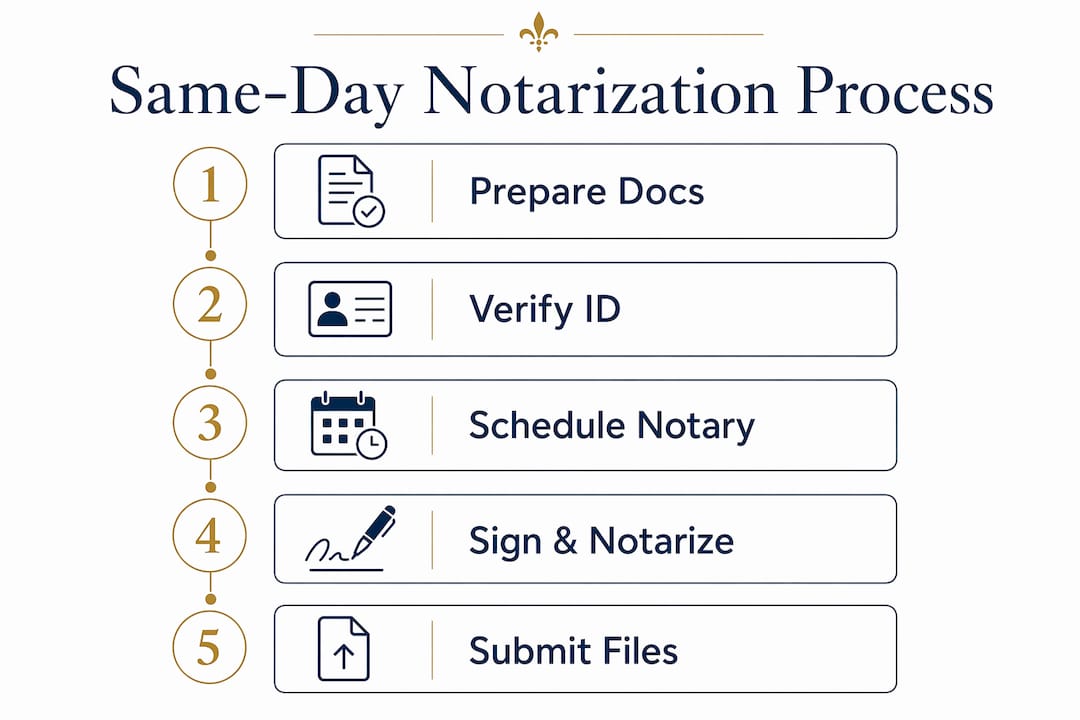
Table of Contents
- What the law requires for same-day notarization across U.S. states
- How remote notarization is changing same-day real estate closings
- Step-by-step: how to complete a same-day notarization closing
- Common mistakes and best practices in same-day notarization closings
- How Notary Signing Agents make same-day closings more reliable
- Premier Notary & Apostille Services handles your real estate closing documents
- FAQ
- Key Takeaways
What the law requires for same-day notarization across U.S. states
Same-day notarization is legally valid in the U.S. with no mandatory waiting period between signing and notarizing. Florida’s Chapter 117 and comparable statutes in other states explicitly permit notarization to occur the same moment a signature is applied, provided all procedural requirements are met.
Core legal requirements vary by state but consistently include:
- Identity verification: A current, government-issued photo ID is the baseline. Some states accept passports, military IDs, or credible identifying witnesses when a photo ID is unavailable.
- Notary journal: Many states require notaries to maintain a sequential journal of every notarial act, recording the date, document type, signer name, and ID type presented.
- Notarial certificate: Every notarized document must carry a completed certificate, either an acknowledgment (confirming the signer appeared and signed voluntarily) or a jurat (confirming the signer swore an oath before signing).
- Notary seal: A physical or electronic seal bearing the notary’s name, commission number, and state must appear on the certificate.
- Disinterested witnesses: Some states require one or two witnesses for deeds and mortgages who have no financial interest in the transaction.
Documents typically requiring notarization at a real estate closing:
County recorders require notarized deeds and mortgages with proper certificates. Missing notarization or a witness signature will result in recording rejection. Standard documents include the deed of trust or mortgage, the deed conveying ownership, any affidavits of title, and a power of attorney if a signer is acting on behalf of another party.
Fees and costs:
Mobile notaries traveling to a client’s location typically charge travel fees of $50–$200 in addition to per-signature fees capped by state law. Signing agent fees for a full closing appointment generally range $75–$200, often rolled into the closing costs the lender or title company passes to the buyer.
Common legal pitfalls:
- Signing before the notary arrives, which invalidates the notarization.
- Using an expired or out-of-state notary commission.
- Failing to confirm that a power of attorney is current and, where required, recorded.
- Leaving blank spaces in documents before notarizing.
The Revised Uniform Law on Notarial Acts (RULONA), adopted in whole or in part by many states, provides a consistent statutory baseline for notarial procedures, certificate language, and electronic notarization standards.
How remote notarization is changing same-day real estate closings
Remote online notarization (RON) allows a notary and signer to complete a notarial act over a live audio-video connection, with electronic signatures and a digital notary seal. RON is legal in 49 states plus Washington, D.C. as of 2026. California remains the only holdout, with legislation scheduled to take effect in 2030.
How RON identity verification works:
- Credential analysis: The signer’s government-issued ID is scanned and analyzed by software that checks security features, expiration, and authenticity.
- Knowledge-based authentication (KBA): The signer answers questions drawn from public records, such as previous addresses or loan history, that only the real person would likely know.
- Live video confirmation: The notary visually confirms the signer’s face matches the ID photo during the session.
Audio-video and recording requirements:
Fannie Mae’s notarization standards specify that recordings of remote ink-signed notarization (RIN) sessions must be retained for a minimum of 10 years. Most RON platforms meet or exceed this standard, storing encrypted session recordings for compliance and dispute resolution.

Practical pros and cons of remote notarization:
| Factor | RON Advantage | Consideration |
|---|---|---|
| Speed | Eliminates travel time entirely | Requires stable internet connection |
| Scheduling | Available outside business hours | Not yet legal in California |
| Document handling | Fully digital from signing to recording | Some lenders still require wet signatures |
| Identity verification | Multi-layer credential analysis + KBA | Technology failures can delay sessions |
| Cost | No travel fees | Platform fees may apply |
With an end-to-end digital process, customers, notaries, and lenders can sign, notarize, and process all closing documents on the same day. That is the core benefit for anyone trying to close quickly.
Pro Tip: Before scheduling a RON session, confirm that your lender and title company both accept electronically notarized documents. Some secondary market investors still require wet-ink originals for certain loan types.
Step-by-step: how to complete a same-day notarization closing
A clean same-day closing depends on preparation before the notary ever arrives or connects. Here is the sequence that works.
-
Confirm the closing package is final. Contact your lender or title company at least 24 hours before the scheduled session. The full document package must be ready before the notary can begin. Last-minute changes to loan terms or closing costs will push the timeline.
-
Review the closing disclosure. Your lender must provide a closing disclosure at least three business days before closing. Compare it against the final documents at the session. Discrepancies in loan amount, interest rate, or cash-to-close figures need to be resolved before signing.
-
Schedule a qualified notary or NSA. Book a Notary Signing Agent experienced with mortgage documents. Confirm the appointment time, location, and whether the session will be in-person or remote. For mobile notaries, confirm the address and any access instructions.
-
Gather valid identification. Every signer needs a current, government-issued photo ID. Acceptable forms typically include a driver’s license, state ID card, or passport. Check that the name on the ID matches the name on the closing documents exactly.
-
Prepare funds for closing. If you owe money at closing, arrange a cashier’s check or wire transfer before the session. Forgetting this step will delay disbursement even if all documents are signed and notarized correctly.
-
Walk through the signing session. The NSA will present each document, explain its general purpose, and indicate where you sign, initial, or date. You have the right to read every document before signing. Ask questions about document purpose; the NSA cannot give legal advice, but they can explain what each form does.
-
Complete notarizations. For each document requiring notarization, the notary witnesses your signature, confirms your identity from the ID presented, completes the notarial certificate, and applies the official seal. Do not sign notarized documents before the notary is present and watching.
-
Return the package. After all signatures and seals are applied, the NSA or title company representative collects the complete package. The title company then disburses funds, records the deed with the county recorder’s office, and distributes copies to all parties.
Pro Tip: Ask the title company to send you a digital copy of the closing package 24 hours in advance. Reviewing documents before the session cuts signing time significantly and reduces the chance of last-minute surprises.
Common mistakes and best practices in same-day notarization closings
Even well-organized closings run into problems. Most delays are preventable.
Frequent mistakes:
- Signing before the notary arrives. A pre-signed document cannot be notarized. The notary must witness the actual act of signing. This is the single most common error that voids a notarization.
- Outdated or unrecorded powers of attorney. If a signer is acting under a power of attorney, the document must be current and, in many jurisdictions, recorded with the county before it can be used at closing. Stale or unrecorded POAs can void notarizations and force a closing to reschedule.
- Mismatched names. The name on the signer’s ID must match the name on the closing documents. A middle initial present on one but absent on the other can trigger a recording rejection.
- Missing witnesses. Some states require one or two disinterested witnesses for deeds or mortgages. Arriving without confirmed witnesses when the state requires them stops the closing.
- Invalid or expired IDs. An expired driver’s license is not acceptable. Confirm ID validity before the session date.
- Technology failures in remote sessions. Poor internet connection, camera issues, or browser incompatibility can interrupt a RON session mid-signing. Test your equipment in advance.
Best practices:
- Verify the notary’s commission status through your state’s notary database before the appointment.
- Confirm the notary has no financial interest in the transaction. A notary who is also a party to the deal cannot notarize documents for that transaction.
- Communicate with all signers about what to bring and what to expect. Uninformed signers slow down every session.
- For remote closings, use a supported browser and check camera and microphone permissions ahead of time.
- Keep copies of all signed and notarized documents. You will need them for tax records and future reference.
Mobile and remote notaries facilitate the signing session but do not control the accuracy of the underlying closing documents. Title companies manage document corrections and recording. If an error appears in the documents themselves, the notary cannot fix it. Contact the title company or lender immediately.
How Notary Signing Agents make same-day closings more reliable
Not every notary is prepared for a real estate closing. A standard notary commission qualifies someone to witness signatures and apply a seal. A Notary Signing Agent has additional training specifically for mortgage and real estate documents, covering loan package components, lender instructions, and the proper handling of closing packages from signing through return.

NSAs understand the difference between a deed of trust and a mortgage, why a right of rescission notice matters, and how to handle a closing disclosure versus a HUD-1 settlement statement. That document-level familiarity prevents errors that would otherwise require the title company to reprint and re-execute documents.
What an NSA does at closing:
- Verifies each signer’s identity against the closing documents.
- Presents and explains each document’s general purpose without offering legal advice.
- Witnesses signatures and notarizes required documents with proper certificates and seals.
- Confirms the package is complete before returning it to the title company or lender.
- Flags any blank spaces, missing signatures, or obvious document issues before the package leaves the table.
Credential verification matters. NSAs can be certified through organizations such as the National Notary Association (NNA), which requires a background screening and a notary signing agent exam. Title companies and signing services often require this certification before assigning a closing.
Premier Notary & Apostille Services holds a 5-star rating from Google reviews. That track record reflects consistent accuracy and fast turnaround, both of which are non-negotiable when a same-day closing timeline is on the line. For complex real estate notarization needs, working with a provider that has handled volume at this level reduces the risk of errors that delay recording.
The business sale closing process shares structural similarities with real estate closings: multiple documents, multiple parties, and a hard deadline for fund disbursement. In both contexts, an experienced signing professional who knows the document set is the difference between a closing that finishes on time and one that reschedules.
Premier Notary & Apostille Services handles your real estate closing documents
Real estate closings move fast. When the title company sends the package and the lender sets the date, you need a notary who is ready, credentialed, and familiar with mortgage documents.

Premier Notary & Apostille Services offers same-day notarization for real estate closing documents, with a guided intake process that confirms document requirements before the session starts. Over 1,900 documents processed and a 5-star Google rating back that up. Transparent pricing means no surprise fees added after the fact. Whether you need an in-person signing agent or have questions about remote options, the process starts with a straightforward booking. Schedule your real estate closing notarization now at Premier Notary & Apostille Services.
FAQ
Can a real estate closing be completed electronically?
Yes. RON is legal in 49 states plus Washington, D.C., allowing buyers, sellers, and notaries to complete the full closing process over a live audio-video connection with electronic signatures and digital seals.
Can a notary conduct a real estate closing?
A notary public can witness and notarize the required closing documents, but a Notary Signing Agent with mortgage document training is better suited to guide borrowers through a full closing package without errors.
How long does notarizing a document take?
Notarizing a single document takes 5–30 minutes. A complete real estate closing package typically runs 30–60 minutes, depending on document volume and signer questions.
What is the most common notary mistake at closing?
The most common error is allowing a signer to sign a document before the notary is present to witness it. A pre-signed document cannot be legally notarized and must be reprinted and re-executed.
Does Premier Notary & Apostille Services offer same-day real estate notarization?
Yes. Premier Notary & Apostille Services provides same-day notarization for real estate closing documents, with a guided intake process and transparent pricing. Book directly at premiernotaryservices.com.
Key Takeaways
Same-day notarization closing is legally valid across the U.S. and requires document readiness, valid ID, a qualified notary, and proper certificates to complete a real estate transaction within a single day.
| Point | Details |
|---|---|
| Legal validity | Same-day notarization is permitted under U.S. state statutes with no mandatory waiting period. |
| RON availability | Remote online notarization is legal in 49 states plus D.C. as of 2026; California joins in 2030. |
| Timing | A full real estate closing package typically takes 30–60 minutes to sign and notarize. |
| Fees | Mobile notary travel fees run $50–$200; full signing agent appointments range $75–$200. |
| Premier Notary & Apostille Services | Offers same-day real estate document notarization with over 1,900 documents processed and a 5-star Google rating. |