How a Notary Verifies Signer Identity: 2026 Guide

How a Notary Verifies Signer Identity: 2026 Guide

A notary verifies signer identity by confirming who a person is through one of three legally authorized methods: government-issued photo ID, personal knowledge, or credible witnesses. This process, formally called notary signer authentication, is the foundation of every valid notarization. Without it, a signed document carries no legal weight. Understanding how notary verifies signer identity helps you prepare the right documents, avoid rejected appointments, and protect yourself from fraud. This guide covers all three methods, their legal requirements, and the practical steps both notaries and signers need to know in 2026.
How notaries verify signer identity: the three legal methods
Notaries establish signer identity through exactly three authorized channels: a valid government-issued photo ID, personal knowledge of the signer, or testimony from a credible identifying witness. Each method carries its own legal standards, and notaries must reach “reasonable certainty” before proceeding. If no method produces that certainty, the notary must refuse the notarization. State laws govern which methods are available, so requirements vary by jurisdiction. The National Notary Association and state notary associations publish updated guidelines each year to keep notaries current on these rules.

What government-issued IDs do notaries accept?
Government-issued photo ID is the primary and most widely used method for notary public identity verification. Acceptable documents include driver’s licenses, state-issued ID cards, U.S. passports, military IDs, and tribal IDs. Accepted IDs must include a photograph, a physical description, a signature, and an issue date within the last five years in most states.
The step-by-step ID inspection process
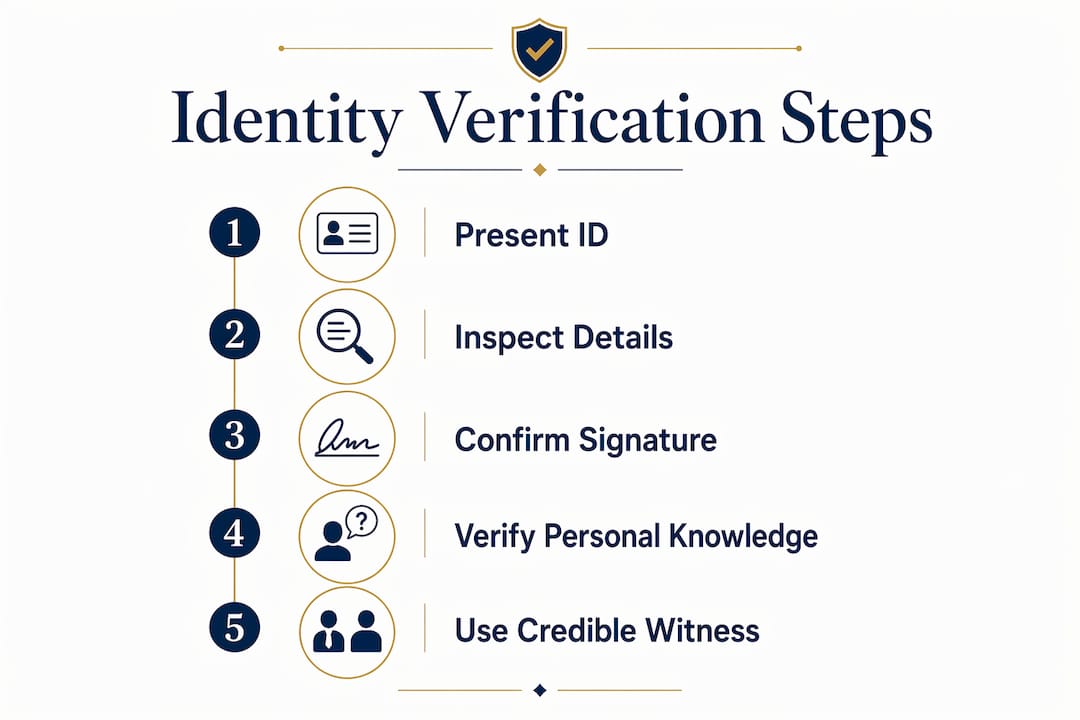
Notaries do not simply glance at an ID and move on. The multi-pass inspection process recommended by National Notary Association expert Bill Anderson involves three distinct checks.
- First pass: Hold the ID at arm’s length and confirm the photo matches the person in front of you. Check the name, date of birth, and physical description against the signer.
- Second pass: Bring the ID closer and examine the surface for signs of tampering. Look for uneven lamination, altered text, or mismatched fonts.
- Third pass: Check security features including holograms, ghost photos, micro-printing, and raised lettering. Blue light and a magnifying glass help reveal hidden features that counterfeit IDs cannot replicate.
After all three passes, the notary compares the ID signature to the signature the signer places on the document. A mismatch is a red flag that warrants further scrutiny or refusal.
Pro Tip: Bring a current, unexpired government-issued photo ID to every notary appointment. If your ID was recently issued and your appearance has changed significantly, bring a second form of ID as backup.
Name discrepancies between the ID and the legal document require attention. Even a missing middle initial can invalidate a notarization if not handled correctly. The notary must request supplemental identification or require a correction before proceeding. Guessing or ignoring the difference is not an option.
How does personal knowledge work as identity verification?
Personal knowledge is a legally recognized method where the notary confirms identity based on direct, established familiarity with the signer. This is not a casual acquaintance. Personal knowledge requires sustained, repeated interactions that eliminate reasonable doubt about who the person is. A notary who has known a neighbor for years and interacted with them regularly may qualify. A notary who met someone once at a community event does not.
States set their own standards for this method, and the differences matter.
- California prohibits personal knowledge entirely. Signers in California must always present a qualifying government-issued ID.
- Most other states allow personal knowledge but require the notary to document the basis for that knowledge in their notary journal.
- The notary must record the use of personal knowledge in place of ID details in the journal entry for that notarization.
- If the notary has any doubt, they must default to requesting a government-issued ID or a credible witness.
Pro Tip: If you are a business owner who regularly works with the same notary, confirm in advance whether your state allows personal knowledge as a verification method. Do not assume it applies.
The risk with personal knowledge is entirely on the notary. If the identity claim later proves false, the notary bears legal responsibility for the notarization. This is why many notaries choose to request a government-issued ID even when personal knowledge would technically suffice.
When is a credible witness used to verify signer identity?
A credible witness steps in when the signer cannot produce a qualifying government-issued ID and personal knowledge is unavailable or prohibited. Credible witnesses must know the signer personally, have no financial interest in the document, present a valid government-issued photo ID of their own, and take an oath or affirmation under penalty of perjury. This method adds a layer of accountability because the witness assumes legal responsibility for the identity claim.
Witness requirements at a glance
| Requirement | Details |
|---|---|
| Personal knowledge of signer | Witness must know the signer through sustained, direct interaction |
| No financial interest | Witness cannot benefit from the document being notarized |
| Valid government-issued ID | Witness ID must meet the same standards as the signer’s ID |
| Oath or affirmation | Witness swears under penalty of perjury that the signer is who they claim |
| No disqualifying relationship | Family members with a stake in the document are disqualified |
The number of witnesses required depends on the state and whether the notary personally knows the witness. Some states accept one witness if the notary knows them. Others require two witnesses if the notary does not know either party.
Family members acting as credible witnesses can invalidate a notarization if they have any financial interest in the document. This catches many signers off guard. A spouse who stands to inherit under a will being notarized cannot serve as a credible witness for that document.
Common situations where credible witnesses are needed include elderly signers whose IDs have lapsed, individuals who have recently lost their wallet, and foreign nationals whose documents do not meet state ID standards. For documents like affidavit notarizations, having a credible witness lined up in advance prevents delays.
Common challenges in the identity verification process
The identity verification process produces predictable problems that both notaries and signers can prepare for.
- Expired IDs: State laws vary on expired ID rules. Many states allow IDs issued within the last five years even if technically expired, but this rule is not universal. Misunderstanding expiration rules is a common reason appointments fail.
- Name mismatches: A legal document bearing a full name while the ID shows a nickname or omits a middle name requires supplemental ID. The notary cannot proceed on assumption.
- Suspected fraud: If an ID shows signs of tampering, the notary must refuse the notarization. Notaries must legally refuse if reasonable certainty cannot be reached by any authorized method.
- Incomplete journal entries: Every notarization requires a thorough journal record. Journal entries must include the type of ID presented, the signer’s name, the document type, and the date. This documentation is the notary’s legal defense if a notarization is ever challenged.
- Witness conflicts of interest: Signers sometimes bring a family member as a witness without realizing that a financial interest in the document disqualifies that person entirely.
Pro Tip: Before your appointment, check that your ID is current, matches the name on your document exactly, and is a government-issued photo ID accepted in your state. For passport-related documents, confirm that your passport meets the issue-date requirements for your state.
Businesses face a specific challenge when employees sign documents on behalf of a company. The notary verifies the individual’s identity, not the company’s authority. A corporate resolution or power of attorney may also be required, depending on the document type. For real estate notarizations and commercial transactions, preparing both personal ID and authorization documents in advance prevents last-minute complications.
For travel document preparation, urgent travel document best practices outline what ID and supporting materials to have ready before any notarization appointment tied to international travel.
Key Takeaways
A notary verifies signer identity through government-issued photo ID, personal knowledge, or credible witnesses, and must refuse notarization if reasonable certainty cannot be reached by any of these methods.
| Point | Details |
|---|---|
| Three authorized methods | Notaries use government-issued ID, personal knowledge, or credible witnesses to confirm identity. |
| ID must meet specific standards | Accepted IDs require a photo, physical description, signature, and issue date within five years in most states. |
| Personal knowledge has strict limits | California bans it entirely; other states require documented, sustained familiarity between notary and signer. |
| Credible witnesses carry legal weight | Witnesses must have no financial interest, present valid ID, and swear under oath to the signer’s identity. |
| Journal documentation is mandatory | Thorough records of ID type, signer name, document, and date protect the notary’s legal standing. |
What I’ve learned about identity verification after 1,900+ notarizations
After processing over 1,900 documents at Premier Notary & Apostille Services, one pattern stands out: most notarization problems trace back to identity verification, not the documents themselves. Signers arrive with expired IDs, names that do not match their legal documents, or witnesses who have a financial stake in the outcome. These are not rare edge cases. They happen regularly.
The conventional advice is to “just bring a valid ID.” That is not enough. You need to confirm that your ID matches the exact name on your document, that it meets your state’s issue-date rules, and that any witness you bring has no interest in the document being notarized. These three checks prevent the majority of appointment failures.
State guidelines also shift more often than most people realize. The rules around expired IDs, acceptable ID types, and personal knowledge standards have all seen updates in recent years. Staying current on those changes is part of what separates a reliable notary from one who creates liability for their clients.
The balance between thorough verification and good client service is real. Rigorous checks protect everyone at the table. A notarization that skips proper identity verification is not just a legal risk for the notary. It is a risk for the signer and anyone relying on that document. The notarization process works because identity verification works.
— Premier
Premier Notary & Apostille Services: professional notarization with verified identity checks
Premier Notary & Apostille Services handles notarizations for individuals and businesses with the same thorough identity verification standards described in this article. Every appointment includes a compliant review of government-issued ID, proper journal documentation, and guidance on what to bring.

Services cover affidavits, passport documents, real estate, vehicle transfers, commercial agreements, and more. Same-day processing is available, and the guided intake process tells you exactly what to prepare before you arrive. With a 5-star rating from Google reviews and over 1,900 documents processed, Premier Notary & Apostille Services delivers fast, accurate, and legally compliant notarizations. Book your affidavit notarization online and get your documents handled correctly the first time.
FAQ
What ID does a notary accept for identity verification?
Notaries accept government-issued photo IDs including driver’s licenses, passports, military IDs, state ID cards, and tribal IDs. The ID must include a photo, physical description, signature, and generally must have been issued within the last five years.
Can a notary verify identity without a photo ID?
Yes. A notary can verify identity through personal knowledge of the signer or through a credible identifying witness who knows the signer, has no financial interest in the document, and takes an oath under penalty of perjury.
What happens if a notary cannot verify signer identity?
The notary must refuse the notarization. Proceeding without reasonable certainty of identity exposes the notary to legal liability and can invalidate the document entirely.
Does California allow personal knowledge for notary identity verification?
No. California prohibits personal knowledge as a verification method. Signers in California must present a qualifying government-issued photo ID or use a credible witness.
Why would a credible witness be disqualified?
A credible witness is disqualified if they have a financial or personal interest in the document being notarized. Family members with a stake in the outcome, such as a beneficiary on a will, cannot serve as credible witnesses for that document.