Document Legalization Country by Country: 2026 Guide

Document Legalization Country by Country: 2026 Guide

What is document legalization and how does it vary by country?
Document legalization is the process of certifying a document’s authenticity so foreign authorities will accept it. The specific steps depend almost entirely on whether the destination country has signed the 1961 Hague Apostille Convention.
Two paths exist:
-
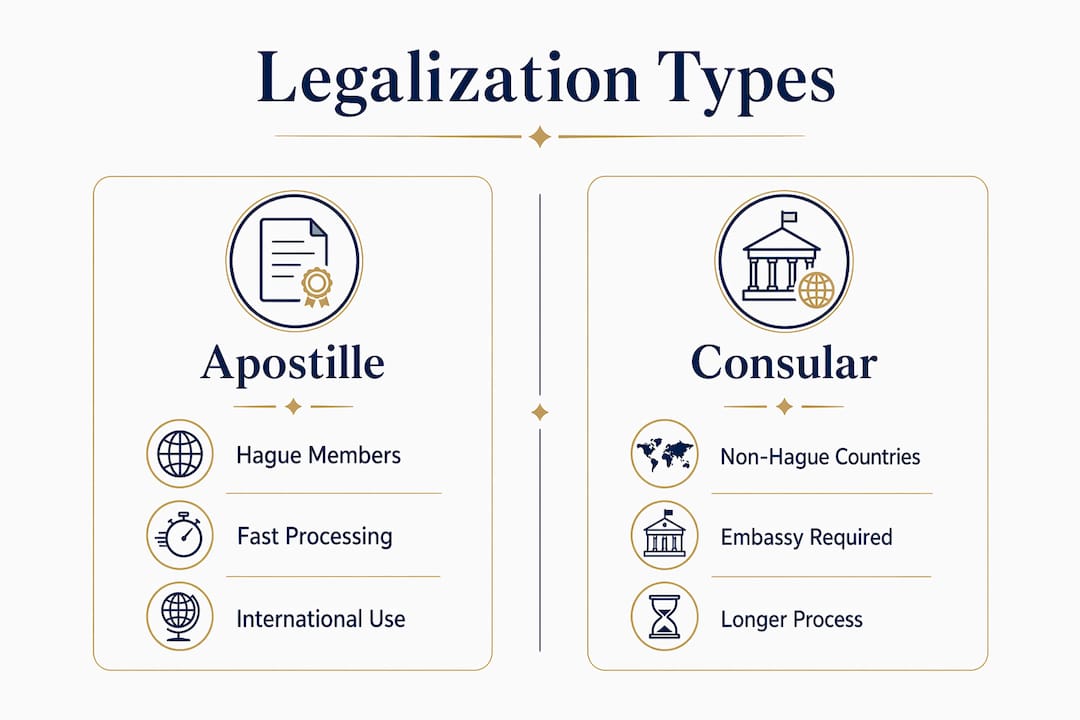
Apostille: A standardized certificate issued for documents used in Hague Convention member countries. One certificate, recognized across all member states, no embassy visit required.
-
Consular legalization: A multistep chain of authentications required for non-Hague countries. Documents typically pass through a notary, a state authority, the U.S. Department of State, and finally the destination country’s embassy or consulate.
-
Key U.S. authority: The U.S. Department of State Office of Authentications issues both apostille certificates and authentication certificates for federal documents.
-
Document type matters: Birth certificates, diplomas, powers of attorney, and corporate documents each follow different preparation rules depending on the receiving country.
-
State vs. federal documents: State-issued documents (like marriage certificates) go through the issuing state’s office, not the federal Office of Authentications, for Hague countries.
The single biggest mistake people make is assuming one process fits all countries. It does not.
Which countries require apostilles and which require consular legalization?
The table below covers key countries and their current legalization status as of 2026. Document type and intended use (personal, academic, or business) can shift requirements even within the same country.
| Country | Legalization Status | Common Documents | Notes |
|---|---|---|---|
| Germany | Apostille (Hague member) | Birth certificates, diplomas, powers of attorney | Sworn German translation often required |
| France | Apostille (Hague member) | Marriage certificates, court records | Certified French translation may be needed |
| Italy | Apostille (Hague member) | Academic transcripts, corporate documents | Sworn translations mandatory for most documents |
| Spain | Apostille (Hague member) | Birth certificates, powers of attorney | Sworn Spanish translation required |
| Mexico | Apostille (Hague member) | Vital records, educational credentials | State-level apostille authority varies |
| Canada | Apostille (Hague member, joined 2024) | Corporate documents, personal records | Recently acceded; confirm current acceptance |
| China | Non-Hague (consular legalization) | Business contracts, academic degrees | Full chain: notary → state → federal → Chinese embassy |
| Saudi Arabia | Non-Hague (consular legalization) | Employment contracts, educational records | Embassy legalization plus Arabic translation required |
| United Arab Emirates | Non-Hague (consular legalization) | Powers of attorney, corporate documents | MOFA attestation required after U.S. authentication |
| Egypt | Non-Hague (consular legalization) | Personal and business documents | Egyptian consulate authentication required |
| Brazil | Apostille (Hague member) | Birth certificates, diplomas | Portuguese translation typically required |
| India | Apostille (Hague member) | Educational certificates, affidavits | MEA apostille required; state attestation first |
Some Hague member countries maintain exceptions that exclude certain document categories from apostille coverage, requiring local legalization instead. Always verify with the competent authority in the country where your document was issued.
How does the Hague Apostille Convention work, and what is the e-APP?
The Hague Apostille Convention, formally the Convention of 5 October 1961 Abolishing the Requirement of Legalisation for Foreign Public Documents, created a single-step certification system between member states. As of June 2026, 130 countries participate in the Hague Apostille Convention, covering the majority of destinations for international document use.
Many countries have joined the Hague Apostille Convention, making the apostille a widely accepted form of international document authentication.
The Electronic Apostille Programme (e-APP) extends this framework into the digital space. Under e-APP, electronic apostilles carry the same legal weight as paper ones, but acceptance depends on the destination country’s own regulations. Not every Hague member has implemented e-APP, so confirm before submitting a digital certificate.
Key points about the Convention’s practical limits:
- Apostille does not eliminate translation requirements. Countries like Italy and Spain require sworn translations alongside a valid apostille.
- Some documents fall outside the Convention’s scope entirely, even in member countries.
- The apostille certifies the signature and seal on the document, not the document’s content.
- Each country designates its own competent authority to issue apostilles; in the U.S., that is the Office of Authentications for federal documents and the Secretary of State’s office for state documents.
How do you get a document legalized in the United States?
The U.S. process splits cleanly based on destination. For Hague Convention countries, you get an apostille. For all others, you get an authentication certificate, which then feeds into the full consular legalization chain.
Steps for federal documents (apostille or authentication):
- Confirm your document qualifies: it must be signed by a U.S. federal official, a U.S. consular officer, a foreign consul registered with the State Department, or a military notary.
- Prepare an original or certified copy with original ink signatures and a date of issuance.
- Complete Form DS-4194 and include the applicable fee.
- Submit by mail or, for urgent cases, in person at the Office of Authentications in Washington, D.C.
- For non-Hague countries, budget approximately 5 weeks for mail processing and a $50 consular seal fee at the destination embassy.
For state documents used in Hague countries, contact the Secretary of State in the issuing state directly. That office handles apostilles for birth certificates, marriage licenses, and notarized documents. Understanding state-specific apostille details before you submit saves significant time.
Pro Tip: Never notarize an original document before submitting it for an apostille. If a translation is required, have the translation notarized, not the source document. Notarizing the original can invalidate the authentication entirely.

For documents used in non-Hague countries, U.S. embassies and consulates abroad provide notarial and authentication services as part of the consular legalization chain.
How to avoid common mistakes in the international legalization process
Getting the paperwork right the first time saves weeks. These steps apply regardless of destination country.
- Verify the destination country’s current status. Treaty membership changes. Canada only joined the Hague Convention in 2024. Always confirm before starting.
- Check translation requirements separately. An apostille does not mean your document is ready. Countries like Germany, Italy, and Spain require certified or sworn translations that meet local standards. Research the apostille certification process for your specific destination.
- Use certified copies, not photocopies. A certified copy carries an official statement that it is a true copy of the original. Plain photocopies are rejected. Original ink signatures must be present.
- Match the document to the correct authority. Federal documents go to the Office of Authentications. State documents go to the issuing state’s Secretary of State. Sending a birth certificate to the federal office is a common, costly error.
- Plan for the full chain in non-Hague countries. For China, Saudi Arabia, or the UAE, the process involves multiple agencies across weeks. Start early, especially for business contracts or employment documents with deadlines.
- Track your submission. Use certified mail with tracking for any documents sent to the Office of Authentications. Originals are irreplaceable.
Pro Tip: Before you prepare a single page, call or check the website of the destination country’s embassy in the U.S. Requirements change, and the embassy’s current instructions override any general guide. For notarization before legalization, working with a professional service like Premier Notary & Apostille Services reduces errors at the first step, where most applications fail.
For documents like affidavits that frequently require legalization for international use, getting the notarization right from the start is the foundation everything else builds on. Premier Notary & Apostille Services offers affidavit notarization with same-day processing, so your documents are ready to move through the legalization chain without delay.

Key Takeaways
Document legalization requirements vary by country based on Hague Convention membership, document type, and intended use, making early research the single most important step.
| Point | Details |
|---|---|
| Apostille vs. consular legalization | Hague member countries accept apostilles; all others require a full consular legalization chain. |
| Contracting Parties | As of June 2026, 130 countries participate in the Hague Apostille Convention. |
| U.S. processing fees and time | Non-Hague country authentication takes approximately 5 weeks by mail with a $50 consular seal fee. |
| Do not notarize originals | Notarizing the source document before apostille can invalidate the entire authentication. |
| Translations are separate | An apostille does not satisfy translation requirements; countries like Italy and Spain require sworn translations. |