Corporate Resolution Notarization Process: 2026 Guide

Corporate Resolution Notarization Process: 2026 Guide

The corporate resolution notarization process is the method by which corporations validate signatures on resolutions through a notary public to confirm authenticity and legal acceptance. This process does not determine whether a signer has corporate authority. It confirms identity and voluntary execution. Corporate professionals most often encounter notarization requirements when dealing with banks, lenders, title companies, or foreign governments. Key documents involved include corporate resolutions, Secretary’s Certificates, and Incumbency Certificates. Understanding exactly when and how to notarize these documents prevents costly delays in transactions and financing.
When is notarization required for corporate resolutions?
Most corporate resolutions do not require notarization under state law to be legally binding. Notarization becomes necessary only when an external party demands it. This distinction matters because many corporate professionals waste time notarizing the resolution itself when the requesting party actually needs a notarized Secretary’s Certificate.
External parties that commonly require notarized documents include:
- Banks and lenders opening accounts or approving loans
- Title companies processing real estate transactions
- Foreign governments accepting documents for international business
- Regulatory agencies requiring certified corporate authority
- Counterparties in major contracts seeking verified execution
The Secretary’s Certificate serves as the formal document attaching the resolution for notarization. It provides clear proof of corporate authority required by banks and regulators. In practice, over 90% of institutional requests call for a notarized Secretary’s Certificate rather than a notarized resolution itself. Notarizing the wrong document stalls transactions and forces you to restart the process.
Incumbency Certificates also frequently require notarization. These documents confirm which officers hold authority to sign on behalf of the corporation. Foreign transactions and cross-border agreements often require both a notarized Secretary’s Certificate and a notarized Incumbency Certificate. Reviewing the cross-border signing compliance requirements before drafting documents saves significant time.
Pro Tip: Ask the requesting party in writing exactly which document they need notarized before scheduling any appointment. Banks and title companies often have specific form requirements that differ from standard practice.
What are the steps for notarizing corporate resolutions?
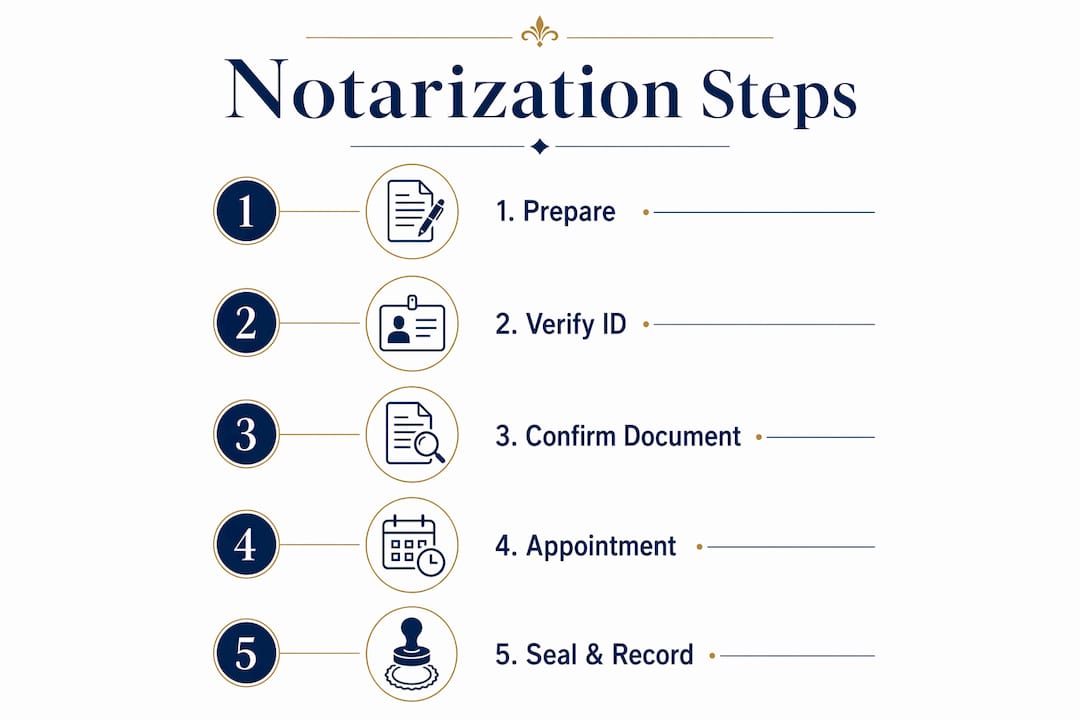
Proper preparation determines whether your notarization appointment succeeds or fails. Gather all required materials before contacting a notary.

Required documents and identification
You need the following before any appointment:
- The completed corporate resolution or Secretary’s Certificate with no blank fields
- Government-issued photo ID for every signer (driver’s license, passport, or state ID)
- The Incumbency Certificate if the transaction requires proof of authority
- Any supporting corporate governance documents the requesting party specified
Expired IDs or name mismatches between the ID and the document cause immediate notarization rejections. The name on the ID must match the name on the document exactly, including middle names or initials where listed.
Choosing between in-person and remote online notarization
Both options are valid for most corporate documents. Your choice depends on timing, location, and the accepting party’s requirements.
In-person notarization suits transactions where the counterparty prefers traditional wet-ink seals. Standard appointments take 15–30 minutes, and state-mandated fees range from $2 to $25 per signature. This option works well when multiple signers can gather in one location.
Remote online notarization (RON) works through a live audio-video session. 49 states and Washington, D.C. authorize remote notarization as of 2026. Remote platforms charge around $25 for the first document in a session. This option suits geographically distributed corporate teams or time-sensitive closings.
| Element | In-person notarization | Remote online notarization |
|---|---|---|
| Signer location | Must appear physically | Appears via live video |
| Identity verification | Government-issued photo ID | Credential analysis plus knowledge-based authentication |
| Typical duration | 15–30 minutes | 20–40 minutes |
| Fee range | $2–$25 per signature | ~$25 per session |
| Availability | Local notary required | Available in 49 states and D.C. |
Pro Tip: Confirm with the requesting institution whether they accept remotely notarized documents before booking a remote session. Some foreign governments and older financial institutions still require traditional wet-ink notarization.
For corporate real estate transactions, booking a specialized notary familiar with property-related corporate documents reduces errors at closing.
What happens during the notarization appointment?
The notarization appointment follows a defined sequence. Each step protects the integrity of the document and the validity of the notarial act.
For in-person appointments
- Physical appearance. The signer must appear in person before the notary. No exceptions apply for traditional notarization.
- Identity verification. The notary examines the signer’s current government-issued photo ID and confirms the name matches the document exactly.
- Selection of notarial act. The notary determines whether an acknowledgment or a jurat applies. An acknowledgment confirms the signer voluntarily executed the document. A jurat requires the signer to swear or affirm the document’s contents are true. Corporate resolutions and Secretary’s Certificates typically use acknowledgments.
- Signature or acknowledgment. For an acknowledgment, the signer may have signed the document beforehand. For a jurat, the signer must sign in the notary’s presence after taking an oath.
- Certificate completion. The notary completes a detailed certificate, applies an official seal, and logs the transaction in a journal. Journal entries include the document type, identification method, party names, and date.
For remote online notarization
- The signer connects via a secure audio-video platform
- Automated credential analysis scans the ID document
- Knowledge-based authentication asks questions only the signer should answer
- The notary observes the signing live on video
- Digital signatures and cryptographic seals are applied, creating a tamper-evident record
The journal entry and seal serve as key evidence if the notarization is ever challenged. A well-documented notarial act protects both the corporation and the counterparty.
How do you avoid common mistakes in corporate notarization?
Most notarization failures trace back to preparation errors, not the appointment itself. Fixing these issues before the appointment saves days of rework.
Incomplete documents. Any blank field in a corporate resolution or Secretary’s Certificate gives the notary grounds to refuse the appointment. Complete every field, including dates, officer titles, and corporate name exactly as it appears in the articles of incorporation.
Name mismatches. Expired IDs or name discrepancies are the most common cause of rejection. If a signer recently changed their name, bring supporting documentation such as a marriage certificate.
Notarizing the wrong document. Misunderstanding which document requires notarization causes transaction stalls. Confirm with the requesting party whether they need the resolution, the Secretary’s Certificate, or the Incumbency Certificate notarized.
Missing proof of authority. Notarization verifies identity, not corporate authority. Without an Incumbency Certificate or Secretary’s Certificate paired with the notarized document, counterparties may reject the submission. Pairing notarized signatures with incumbency certificates is best practice for every institutional transaction.
Quorum and conflict documentation gaps. If the resolution was adopted without proper quorum or with undisclosed conflicts of interest, the document may be challenged even after notarization. Confirm that the meeting minutes and adoption procedures comply with your state’s corporate governance statutes before presenting documents for notarization.
Pro Tip: Use a legal document signing checklist before every notarization appointment. A checklist catches name mismatches, blank fields, and missing attachments before you sit down with the notary.
Key Takeaways
The corporate resolution notarization process succeeds when you identify the correct document, prepare complete materials, verify signer identity, and pair notarized signatures with proper authority documentation.
| Point | Details |
|---|---|
| Notarize the right document | Banks and institutions typically require a notarized Secretary’s Certificate, not the resolution itself. |
| Prepare before the appointment | Complete all fields and confirm ID names match the document exactly before scheduling. |
| Choose the right notarization method | Remote online notarization is authorized in 49 states and suits distributed corporate teams. |
| Pair notarization with authority proof | Always attach an Incumbency Certificate to confirm the signer’s authority to bind the corporation. |
| Confirm third-party requirements early | Ask the requesting party in writing which documents they need notarized to avoid rework. |
What I’ve learned about notarization in corporate transactions
Notarization is not a formality. It is a trust signal that tells every counterparty, bank, and regulator that your corporation takes its governance seriously.
After working through hundreds of corporate document requests at Premier Notary & Apostille Services, the pattern is clear. The transactions that close fastest are the ones where the corporate team treated notarization as part of the drafting process, not an afterthought. They confirmed requirements early, prepared complete documents, and paired every notarized signature with the right authority certificate.
The biggest time losses come from a single assumption: that notarizing the resolution is enough. It rarely is. The Secretary’s Certificate is the document that carries legal weight in institutional settings. Getting that right the first time is what separates a smooth closing from a two-week delay.
Remote online notarization has changed the calculus for distributed teams. The identity verification process in a well-run remote session is actually more rigorous than many in-person appointments, which reduces fraud risk and strengthens the document’s credibility. Corporate teams that have not yet integrated remote notarization into their workflows are leaving speed on the table.
The next shift will be broader acceptance of digital signatures with cryptographic seals across international jurisdictions. Corporate professionals who build these capabilities into their document workflows now will have a real advantage as cross-border transactions grow more common.
— Premier
Premier Notary & Apostille Services: professional corporate document notarization
Corporate documents need to be right the first time. Premier Notary & Apostille Services has processed over 1,900 documents with a 5-star rating from Google reviews, and the team knows exactly what banks, title companies, and regulators expect.

You can book commercial notarization online in minutes, with office visits by appointment only. Premier Notary & Apostille Services handles corporate resolutions, Secretary’s Certificates, Incumbency Certificates, and related business documents through both in-person and remote online notarization. Transparent pricing, guided intake, and experienced notaries mean your documents are prepared correctly before the appointment starts. Get your corporate documents notarized without delays.
FAQ
Does a corporate resolution need to be notarized?
Most state laws do not require notarization for corporate resolutions to be legally binding. Notarization is required only when an external party such as a bank, lender, or title company demands it.
What document is typically notarized for corporate transactions?
The Secretary’s Certificate, which attaches the resolution as an exhibit, is the document most commonly notarized in institutional transactions. Over 90% of bank and lender requests call for a notarized Secretary’s Certificate rather than the resolution itself.
How long does a corporate notarization appointment take?
In-person appointments typically take 15–30 minutes. Remote online notarization sessions run slightly longer due to the automated identity verification steps required before the live video session begins.
What ID is required for corporate document notarization?
Every signer must present a current, government-issued photo ID with a name that matches the document exactly. Expired IDs and name mismatches are the most common reasons notarization appointments fail.
Can corporate documents be notarized remotely?
Yes. Remote online notarization is authorized in 49 states and Washington, D.C. as of 2026. Confirm that the receiving institution accepts remotely notarized documents before scheduling a remote session.