Child Travel Consent Document Best Practices for Parents
Child Travel Consent Document Best Practices for Parents
Create a trip-specific, signed consent letter that names your child, the travel dates, the destination, the accompanying adult, and contact details for the absent parent — and get it notarized before any international trip. That single step covers the core of child travel consent document best practices and reduces the chance of delays at check-in or the border.
Take these actions now:
- Confirm exact travel dates and add a small buffer period to the letter’s validity window.
- Include your child’s passport number and date of birth exactly as they appear on the passport.
- Schedule notarization before departure — same-day appointments are available through Premier Notary & Apostille Services.
- Print two copies and store an encrypted digital backup accessible to a trusted contact at home.
- Enroll in the U.S. Department of State’s Children’s Passport Issuance Alert Program (CPIAP) as an added safeguard against unauthorized passport issuance.
- Check U.S. Customs and Border Protection (CBP) guidance and your destination country’s embassy requirements before you finalize the letter.
Pro Tip: A consent letter is a verification tool, not an absolute safeguard. The U.S. Department of State recommends pairing it with CPIAP enrollment so officials have a second layer of protection if someone tries to obtain a passport for your child without your knowledge.
Table of Contents
- What is a child travel consent letter and when do you need one?
- Who must sign the consent letter?
- What must you include in a child travel consent letter?
- How do domestic and international requirements differ?
- How do you notarize a consent letter and when do you need an apostille?
- How do you present the consent letter at the airport and border?
- Your pre-travel document checklist
- Key Takeaways
- Why a professional notary reduces your risk at the border
- Premier Notary & Apostille Services handles the authentication so you can focus on the trip
- Useful sources to check before you travel
- FAQ
What is a child travel consent letter and when do you need one?
A child travel consent letter is a signed, written statement from one or both parents (or a legal guardian) giving permission for a minor to travel with another adult, alone, or with only one parent. Border agents and airline staff use it to verify that the child’s travel is authorized and that no parental abduction concern exists.
USA.gov’s guidance on travel documents for children recommends that the letter be written in English and preferably notarized. It is not a custody document and does not transfer parental rights. Its job is to give officials a fast, credible way to confirm consent.
Domestic travel. The U.S. federal government does not require a consent letter for travel within the country. Airlines may still ask for one when a child flies as an unaccompanied minor, and some carriers request it when a child travels with only one parent. Carrying one is low-effort insurance.
International travel. This is where the letter matters most. Many countries, including Canada, strongly recommend or effectively require a signed consent letter when a child crosses the border without both parents. Some countries enforce strict documentation rules — South Africa, for example, requires an unabridged birth certificate and parental consent affidavit. Requirements vary widely by destination, so always verify with the destination embassy or consulate before you travel.
Common situations that call for a consent letter:
- A child traveling internationally with one parent while the other stays home
- Unaccompanied minors on domestic or international flights
Who must sign the consent letter?
The answer depends on your family situation. USA.gov is clear: when a child travels with a guardian or alone, both parents should sign the letter. Here is how that plays out across common scenarios.
By family situation:
- Both parents, shared custody: Both sign. Carry a copy of the custody order in case an official asks for it.
- Sole custodial parent: One parent signs. Carry the certified custody order proving sole custody — officials may ask for it.
- Legal guardian: The guardian signs and carries the guardianship order. A parent’s signature is not required when legal guardianship is formally established.
- Child welfare agency: An authorized agency representative signs and provides the agency’s official documentation.
- Deceased parent: The surviving parent signs and carries a certified death certificate. Do not leave home without it.
When the other parent is unavailable or refuses to sign:
This is the hardest scenario. If the other parent is simply unreachable, document your attempts to contact them and carry that record. If they actively refuse, you generally need a family court order authorizing travel. Courts can issue travel permission, but the process takes time. Start early — weeks, not days, before departure. Mediation can sometimes resolve a refusal faster than litigation, but a court order is the only document border agents will accept as a substitute for the missing signature.
Documents to carry as proof of authority:
- Certified custody orders (not photocopies — certified copies from the court clerk).
- Death certificate if one parent is deceased.
- Guardianship order if a non-parent is traveling with the child.
- Letters from child welfare agencies when applicable.
- Court travel permission order when the other parent refuses to sign.
What must you include in a child travel consent letter?
Every field below should appear in the letter. Missing even one can give a border agent reason to hold up your child’s travel.
Required fields:
- Child’s full legal name (exactly as it appears on the passport).
- Child’s date of birth.
- Child’s passport number and issuing country.
- Travel dates — use specific dates with a 2–3 day buffer, not vague ranges like “summer.”
- Full itinerary: departure city, destination(s), return city.
- Full name and relationship of the accompanying adult.
- Accompanying adult’s passport or ID number.
- Full contact information for the absent parent(s): phone number, email, and mailing address.
- An alternative emergency contact.
- An explicit statement of consent.
- Signatures of consenting parent(s) or guardian(s), with dates.
Copy-ready sample consent paragraph:
I, [Full Name of Parent/Guardian], [relationship to child], hereby authorize my child, [Child’s Full Legal Name], born [Date of Birth], passport number [Passport Number], to travel to [Destination(s)] from [Departure Date] to [Return Date] in the company of [Accompanying Adult’s Full Name]. I can be reached at [Phone Number] and [Email Address] to verify this consent. This letter is valid for the dates stated above only.
Adapt this language for domestic trips by removing the passport reference and substituting a birth certificate number if needed.
Formatting tips that reduce rejection risk:
- Match every name and number exactly to the passport — a single character difference can cause delays.
- Avoid laminating a notarized original; lamination can make the notary seal unreadable.
- Add an emergency medical authorization clause if the accompanying adult may need to consent to medical treatment on your behalf: “I also authorize [Accompanying Adult’s Name] to consent to emergency medical treatment for my child if I cannot be reached.”
- Store the consenting parent’s direct phone number prominently — officials may call it on the spot.
LawDepot’s free child travel consent form provides a structured template that walks through each of these fields step by step, which is useful if you prefer a guided format.
How do domestic and international requirements differ?
The gap between domestic and international expectations is significant, and understanding it helps you prepare the right level of documentation.
Domestic travel (within the U.S.):
No federal law requires a consent letter for domestic travel. That said, airlines set their own policies for unaccompanied minors, and many carriers ask for a signed letter when a child flies without both parents. Check your airline’s policy directly — policies differ and can change.
International travel and land/sea crossings:
CBP officers at ports of entry may request a consent letter, and foreign border agents often do. CBP guidance confirms that officers can ask to verify consent and may contact the absent parent directly. The Government of Canada does not legally require a consent letter but strongly recommends one for any child crossing into Canada without both parents — and Canadian border officers do ask for it regularly.
Requirements vary widely by destination. Some countries enforce strict rules; others have no formal requirement but officers still request documentation. TravelDocumentVault’s guidance notes that common rejection reasons include missing information, lack of notarization, and contacts that cannot be verified.
Practical checklist — when to take each step:
- International travel: — Notarized letter, passport, birth certificate.
If you are traveling to or through the UK and need to understand visa-related documentation requirements for children, this guide on child dependent visa eligibility covers the documentation expectations in detail.
How do you notarize a consent letter and when do you need an apostille?
Notarization is the step that converts a signed letter into a credible, harder-to-forge document. LegalClarity’s guidance explains that a notary verifies your identity and witnesses your signature — the notary does not evaluate parental rights or custody. That distinction matters: notarization adds authenticity, not legal authority.
Step-by-step notarization process:
- Draft the letter with all required fields completed.
- Do not sign it yet — sign in front of the notary.
- Bring valid government-issued photo ID (passport or driver’s license).
- The notary witnesses your signature, stamps the document, and signs it.
- For international travel, check whether the destination requires an apostille or consular legalization on top of the notary stamp.
Remote online notarization (RON): RON is now authorized in most U.S. states and is convenient for parents with tight schedules. Before relying on it, verify that the destination country’s border authorities accept digitally notarized seals — some do not.
When an apostille is required: If the destination country is a member of the Hague Apostille Convention, an apostille authenticates the notary’s seal for international use. If the country is not a member, you need consular legalization instead, which takes longer.
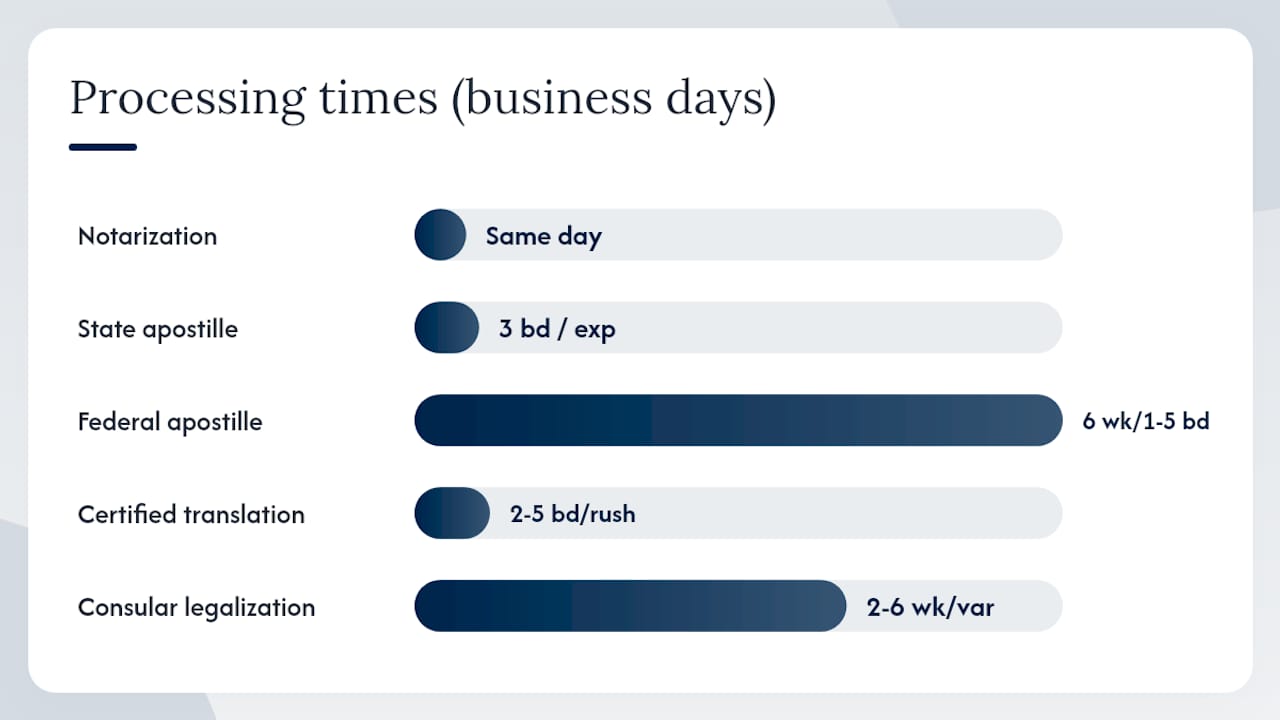
Timeline and processing options:
| Step | Standard Timeline | Expedited / Same-Day |
|---|---|---|
| Notarization | Same day (walk-in or appointment) | Same-day at Premier Notary & Apostille Services |
| State apostille | 3 business days (varies by state) | Expedited options available in many states |
| Federal apostille (U.S. Dept. of State) | 6 weeks standard | 1–5 business days expedited |
| Certified translation | 2–5 business days | Rush options available |
| Consular legalization | 2–6 weeks | Varies by consulate |
Pro Tip: Write trip-specific dates with a 2–3 day buffer and get fresh notarization if your passport changes or your travel dates shift. A letter dated for a previous trip is not valid for a new one — LegalClarity specifically advises against reusing old letters.
How do you present the consent letter at the airport and border?
Preparation on travel day is as important as drafting the letter correctly. Officials move quickly, and having everything organized avoids delays.
Day-of-travel document checklist:
- Original notarized consent letter (keep it in a document folder, not loose in a bag).
- Child’s passport (valid for at least 6 months beyond the return date for most international destinations).
- Child’s birth certificate (especially useful at land and sea crossings).
- Certified custody order or court travel permission, if applicable.
- Death certificate if one parent is deceased.
- Printed flight itinerary.
- Emergency contact list with phone numbers for both parents (or guardian) and one alternate.
- Translated and authenticated copies of the letter if the destination requires them.
What officials check:
CBP and foreign border agents typically verify that the child’s name and passport number match the letter exactly, confirm the travel dates are current, check the notarization seal, and may call the absent parent’s phone number on the spot. If custody documents exist, they may ask to see them even when a consent letter is present.

If an official questions the letter:
Stay calm. Provide the absent parent’s contact details immediately and offer to facilitate a call. If you are abroad and the situation escalates, request to contact the nearest U.S. consulate. Keep digital backups of all documents in an encrypted cloud folder — if the original is lost or damaged, you need a retrievable copy fast.
Pro Tip: Share an encrypted digital copy of the full document package with a trusted contact at home before you leave. If an original is lost at a foreign border, that contact can send a verified copy or coordinate with a notary service to courier a replacement.
Your pre-travel document checklist
Use this before every trip. Print it and check each item the day before departure.
Documents:
- Signed, notarized consent letter (trip-specific, current dates).
- Child’s valid passport.
- Child’s birth certificate.
- Certified custody order (if applicable).
- Death certificate for deceased parent (if applicable).
- Court travel permission order (if the other parent refused to sign).
- Notarized translation of the consent letter (if the destination requires it).
- Apostille or consular legalization stamp (if required by destination).
Copies and backups:
- Two printed copies of the consent letter (one to present, one as backup).
- Encrypted digital copy stored in a secure cloud folder.
- Digital copy shared with a trusted contact at home.
- Photos of all documents saved to a password-protected device.
Contacts verified:
- Absent parent’s phone number confirmed active.
- Alternate emergency contact confirmed available during travel dates.
- Destination embassy or consulate contact saved.
Storage guidance: Keep the original notarized letter in a waterproof document sleeve inside your carry-on, not checked luggage. Do not laminate it. Store digital backups in an app like 1Password or a secure cloud service — not an unprotected photo album.
Key Takeaways
A notarized, trip-specific child travel consent letter with exact dates, matching passport data, and verified contact information is the single most effective step parents can take to prevent delays at borders and airports.
| Point | Details |
|---|---|
| Use trip-specific letters | Write a new letter for each trip with exact dates and a 2–3 day buffer; never reuse an old letter. |
| Match names and numbers exactly | Every name and passport number must match the child’s passport character-for-character to avoid rejection. |
| Notarize for international travel | A notarized letter is far less likely to be questioned; same-day notarization is available at Premier Notary & Apostille Services. |
| Carry supporting documents | Bring certified custody orders, death certificates, or court travel permission whenever custody is complex. |
| Premier Notary & Apostille Services | Handles notarization, apostille processing, and certified translation with same-day options and over 1,900 documents processed. |
Why a professional notary reduces your risk at the border
Most parents treat the consent letter as a formality — a piece of paper to satisfy a checkbox. That framing is the mistake. Border agents and airline staff are trained to spot inconsistencies, and a letter with a missing field, an unverifiable phone number, or no notary seal gives them grounds to delay or deny travel.

The real value of professional notarization is not the stamp itself. It is the process that precedes it: a qualified notary checks your ID, confirms you are who you say you are, and witnesses the signature in real time. That chain of verification is what makes the document credible to a CBP officer or a foreign border agent who has never met you. A self-printed letter with a signature carries no such chain.
Parents who handle this themselves often discover the gap only at the airport. A missed field, a name that does not match the passport, or a letter dated for last year’s trip — these are fixable problems, but not at 5:00 AM at the departure gate. Getting it right before you leave is the only version of this that works.
Premier Notary & Apostille Services handles the authentication so you can focus on the trip
Getting a consent letter notarized, apostilled, and translated correctly is straightforward when you have the right support. Premier Notary & Apostille Services offers in-person and mobile notarization, apostille processing for U.S. and foreign documents, certified translation, and same-day options for parents working against a tight departure window. With over 1,900 documents processed and a 5-star Google rating, the service is built for exactly this kind of time-sensitive, detail-critical work.
The intake process is guided: you bring valid ID and your drafted letter, sign in front of the notary, and leave with a properly stamped original. For apostilles or translations, the team handles submission and tracks the document through the authentication chain. Mobile appointments are available when you cannot come in. Same-day affidavit and consent letter notarization is bookable directly online, as is passport document notarization for parents who need a full travel document package authenticated in one appointment.
Confirm your destination’s specific requirements with the embassy or consulate first, then book your appointment. Same-day slots fill quickly before school breaks and peak travel seasons.
Useful sources to check before you travel
Verify requirements directly with official sources before finalizing your documents. Rules change, and no article substitutes for current embassy or airline guidance.
- Travel.State.Gov — Minors traveling internationally
- USA.gov — Travel documents for children
- CBP help article — Article 1375
- LegalClarity — How to write a notarized child travel consent letter
- LawDepot — Free child travel consent form
- Travel.gc.ca — Recommended consent letter for children travelling abroad
- TravelDocumentVault — Child travel consent letter: when you need one
Contact the destination country’s embassy or consulate directly for the most current requirements. Call your airline to confirm its unaccompanied minor and single-parent travel policies before the day of departure.
This article provides general information, not legal advice. Confirm current requirements with the relevant government authority or a qualified legal professional before you travel.
FAQ
Does a child travel consent letter need to be notarized?
Notarization is not universally required for domestic travel, but it is strongly recommended for international trips. USA.gov advises that consent letters be preferably notarized, and many countries’ border agents will give a notarized letter significantly more weight than an unnotarized one.
What happens if the other parent refuses to sign the consent letter?
You generally need a family court order authorizing travel. Courts can issue travel permission, but the process takes time, so start the legal process as early as possible before your planned departure date.
Can I reuse a consent letter for multiple trips?
No. Each letter should be trip-specific with exact travel dates. LegalClarity specifically advises against reusing old letters, and a letter dated for a previous trip will not be accepted at the border.
What documents should I carry alongside the consent letter?
Bring the child’s passport, birth certificate, printed itinerary, and emergency contact list. If custody is shared or complex, add certified custody orders or a court travel permission order. A death certificate is required if one parent is deceased.
How quickly can I get a consent letter notarized?
Same-day notarization is available through Premier Notary & Apostille Services. Most notarizations are completed in a single appointment; bring valid photo ID and your drafted, unsigned letter. For apostilles, processing times vary by state and destination but expedited options are available.