Apostille vs Legalization: Understanding Document Authentication
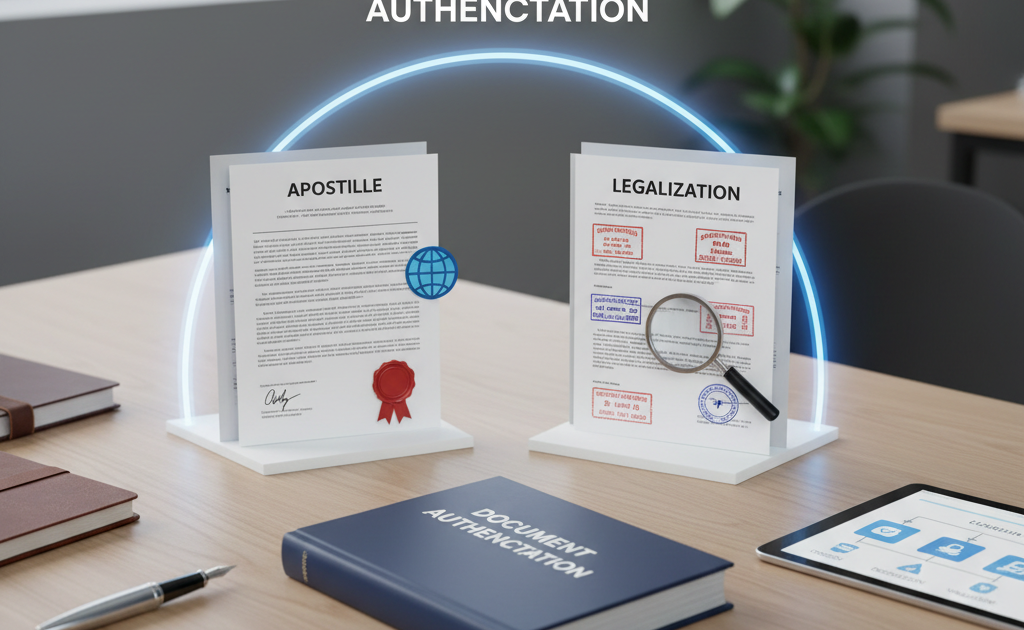
Apostille vs Legalization: When Do You Need Each?
Navigating the world of international document use can often feel like deciphering a complex legal code. You’ve been asked to provide an official document – perhaps a birth certificate, a power of attorney, or an academic transcript – for use in another country, and suddenly terms like “apostille” and “legalization” are being thrown around. It’s easy to get confused, especially when the stakes are high, such as for a visa application, international business deal, or even a marriage abroad.
The core purpose of both processes is the same: to certify the authenticity of a document issued in one country so that it will be recognized as legitimate in another. Without this crucial step, your important paperwork might be rejected, leading to frustrating delays, missed opportunities, and even financial losses. Understanding the distinction between an apostille vs legalization is not just a matter of semantics; it’s fundamental to ensuring your international plans proceed smoothly.
This comprehensive guide will demystify these two essential procedures for document authentication. We’ll break down what each process entails, when and where they apply, and provide practical advice to help you determine which one your document requires. By the end, you’ll have a clear understanding of how to prepare your documents for international use, saving you time, stress, and potential headaches.
What is an Apostille? The Hague Convention Explained
An apostille is a specific type of certification issued to documents for use in countries that are members of the Hague Convention Abolishing the Requirement of Legalisation for Foreign Public Documents (often simply called the Hague Apostille Convention). Signed in 1961, this international treaty simplified the process of authenticating documents between signatory nations. Instead of multiple layers of certification, a single apostille certificate is all that's needed.
Think of an apostille as a universal stamp of approval. It confirms the authenticity of the signature, the capacity in which the person signing the document acted, and, where appropriate, the identity of the seal or stamp which the document bears. It does not authenticate the content of the document itself, but rather the legitimacy of the official who signed or certified it.
For example, if you have a U.S. birth certificate and need to use it in Spain (a Hague Convention country), you would obtain an apostille from the appropriate authority in the U.S. (usually the Secretary of State's office in the state where the document was issued). This single certificate would then make your birth certificate legally recognized in Spain.
What is Legalization? The Traditional Authentication Process
Legalization, also known as consular legalization or embassy legalization, is the traditional, multi-step process of authenticating documents for use in countries that are not members of the Hague Convention. This process is significantly more complex and time-consuming than obtaining an apostille, as it involves multiple levels of verification.
The legalization process typically involves several sequential steps:
- Notarization: The document is first notarized by a local public notary. This certifies the signature of the document holder or the authenticity of the copy.
- County Clerk/Court Certification (if applicable): For some documents, especially those notarized, an additional certification from the county clerk or court may be required to verify the notary's signature.
- Secretary of State Certification: The document then goes to the Secretary of State's office (or equivalent state authority) in the state where it was issued. They verify the signature of the county clerk or the notary public.
- U.S. Department of State Certification: For federal documents or documents that have passed state-level certification, the next step is authentication by the U.S. Department of State in Washington D.C.
- Embassy/Consulate Legalization: Finally, the document must be presented to the embassy or consulate of the destination country located in the issuing country. This is the ultimate step where the foreign government officially recognizes the document.
Each step in the legalization process adds a layer of verification, ensuring that the document is legitimate before it reaches the final destination country. This multi-layered approach is designed for countries that do not have the streamlined agreement provided by the Hague Convention.
Apostille vs Legalization: Key Differences Summarized
The fundamental distinction between an apostille vs legalization boils down to the destination country's affiliation with the Hague Convention. Here’s a quick comparison:
- Hague Convention Membership:
- Apostille: Required for countries that ARE members of the Hague Convention.
- Legalization: Required for countries that are NOT members of the Hague Convention.
- Process Complexity:
- Apostille: Single-step certification by a designated authority (usually Secretary of State or equivalent).
- Legalization: Multi-step process involving notarization, state certification, U.S. Department of State, and finally the destination country's embassy/consulate.
- Cost & Time:
- Apostille: Generally less expensive and quicker due to the simplified process.
- Legalization: More costly and time-consuming due to multiple fees and processing times at various agencies.
- Certification Document:
- Apostille: A standardized certificate attached to the original document.
- Legalization: Multiple stamps and seals from various governmental bodies and the embassy/consulate.
Understanding these differences is crucial for effective document authentication and avoiding unnecessary delays.
When Do You Need an Apostille? Practical Examples
You will need an apostille if your document is intended for use in a country that is a signatory to the Hague Convention. The United States is a member, as are many European, South American, and Asian countries. Always verify the current list of member countries, as it can change.
Common scenarios requiring an apostille include:
- Educational Documents: Using a U.S. diploma or transcript for studying or working in Germany, Italy, or South Korea.
- Personal Documents: Presenting a U.S. birth certificate for a marriage in France or a death certificate for estate settlement in Mexico.
- Business Documents: Authenticating articles of incorporation for opening a branch office in Australia or a power of attorney for a business transaction in Japan.
- Legal Documents: Using a court order or affidavit for legal proceedings in the UK or Portugal.
The process usually starts with obtaining a certified copy or original of your document, ensuring it meets the requirements for an apostille (e.g., a certified copy of a birth certificate from the vital records office). Then, it's submitted to the relevant state or federal authority for the apostille certificate.
When Do You Need Legalization? Practical Examples
You will need legalization if your document is destined for a country that is not a member of the Hague Convention. Many countries in the Middle East, Africa, and parts of Asia require full consular legalization.
Examples of situations requiring legalization include:
- Employment: Presenting a U.S. university degree for a job application in the UAE or Kuwait.
- Residency/Visa: Submitting a police background check or marriage certificate for a residency permit in China or Vietnam.
- Business Transactions: Authenticating commercial invoices or certificates of origin for export to Qatar or Egypt.
- Family Matters: Using a divorce decree for personal affairs in Thailand or a power of attorney for property in Saudi Arabia.
The key here is patience and meticulous attention to detail. Each step in the legalization chain must be completed in the correct order, and each agency will have its own specific requirements, fees, and processing times. It's often advisable to work with a professional service for complex legalization cases.
How to Determine Which Process You Need
The easiest way to determine whether you need an apostille vs legalization is to ask the requesting party in the foreign country. They should be able to specify whether they require an “apostille” or if the document needs to be “legalized” or “authenticated” by their embassy/consulate. If they are unsure, follow these steps:
- Identify the Destination Country: Pinpoint the exact country where your document will be used.
- Check Hague Convention Membership: Refer to the official list of Hague Convention member countries (available on the Hague Conference on Private International Law website).
- If a Member: An apostille is generally required.
- If Not a Member: Full legalization through the embassy/consulate of that country is required.
It's also important to consider the type of document. Some documents, like federal FBI background checks, require federal-level authentication even before an apostille or legalization can be affixed. Always start by verifying the specific requirements of the receiving institution and the destination country.
Professional Assistance for Document Authentication
The processes of obtaining an apostille or navigating complex legalization can be daunting, especially when dealing with strict deadlines and intricate international regulations. Many individuals and businesses opt to use professional document authentication services.
These services specialize in:
- Guidance: Helping you understand whether you need an apostille vs legalization.
- Preparation: Ensuring your documents are correctly prepared and notarized.
- Expedited Processing: Leveraging their experience and relationships with government agencies to expedite the process.
- Accuracy: Minimizing errors that could lead to rejection and delays.
- Handling Multiple Steps: Managing all stages of the multi-layered legalization process.
While there is a fee for these services, the time saved, the reduction in stress, and the assurance of accuracy often make it a worthwhile investment, especially for critical documents or tight schedules.
Conclusion: Ensuring Your Documents Are Globally Recognized
Understanding the distinction between an apostille vs legalization is a critical step in preparing your documents for international use. Whether you're moving abroad, conducting international business, or dealing with personal legal matters across borders, proper document authentication is non-negotiable. The Hague Convention streamlined this for many countries, but for others, the traditional multi-step legalization process remains essential.
Always verify the specific requirements of your destination country and the requesting entity. Don't hesitate to seek professional assistance if the process seems overwhelming. Ensuring your documents are correctly authenticated from the outset will save you considerable time, effort, and potential frustration down the line.
Need help with your document authentication? Contact us today for expert guidance and efficient processing of your apostille or legalization needs!